2.07 Design and Prototype: Competing Carriers and a Decision Matrix
rank our criteria and constraints with numbers, compare competing carrier designs in a weighted decision matrix, predict hold time, and build version 1.
- I can specify both qualitative and quantitative criteria and constraints that solutions to the problem must meet.
- I can describe how to set up a nearly closed system for the investigation, including defining the system’s boundaries and initial conditions.
- I can identify the data I need to collect, such as the masses of the components and their initial and final temperatures.
- I can outline the experimental procedure, including how I will collect data, how many trials I will run, and what equipment I will use.
Phase 4: Build
Warm-Up ~5 min
Do Now. Rewrite this vague criterion so it can be measured: “The carrier keeps food pretty cold for a while.”
Which criterion is written best?
Instruction ~10 min
Class criteria and constraints for the Cool Carrier (set in 2.02, ranked in 2.07). Criteria: (1) a 355 mL can of water starting at 5 °C stays below 10 °C for at least 90 minutes in a lamp-heated test box at 35–40 °C; (2) it is reusable: five test runs with no more than 10 minutes lost from the hold time; (3) a volunteer can carry it in one hand and open it in under 5 seconds. Constraints: empty mass no more than 400 g; fits inside a 25 cm cube; materials cost no more than $5 at the sample class prices; no electricity; at most 200 g of ice, sealed in a bag; no dry ice and no chemical cold packs that must be opened.
Ranking. Food safety is the client’s first need, so hold time gets weight 3. Reusability gets weight 2 because the program runs all summer. Ease of carrying and opening gets weight 2. Cost gets weight 1 because every design must already fit the $5 constraint. Constraints are pass/fail.
Worked example 1: predicting hold time (sample design). A box 15 cm on each side with 2.0 cm foam walls: A = 6 × 0.152 = 0.135 m2. With 38 °C outside and 4 °C inside, P = kAΔT/d = (0.033)(0.135)(34)/0.020 = 7.57 W. Ice: 200 g × 334,000 J/kg = 66,800 J, which lasts 66,800/7.57 ≈ 8,820 s ≈ 2.5 h. The slab model ignores the lid gap and corners, so expect the real carrier to fall short. The prediction is a target to test, not a promise.
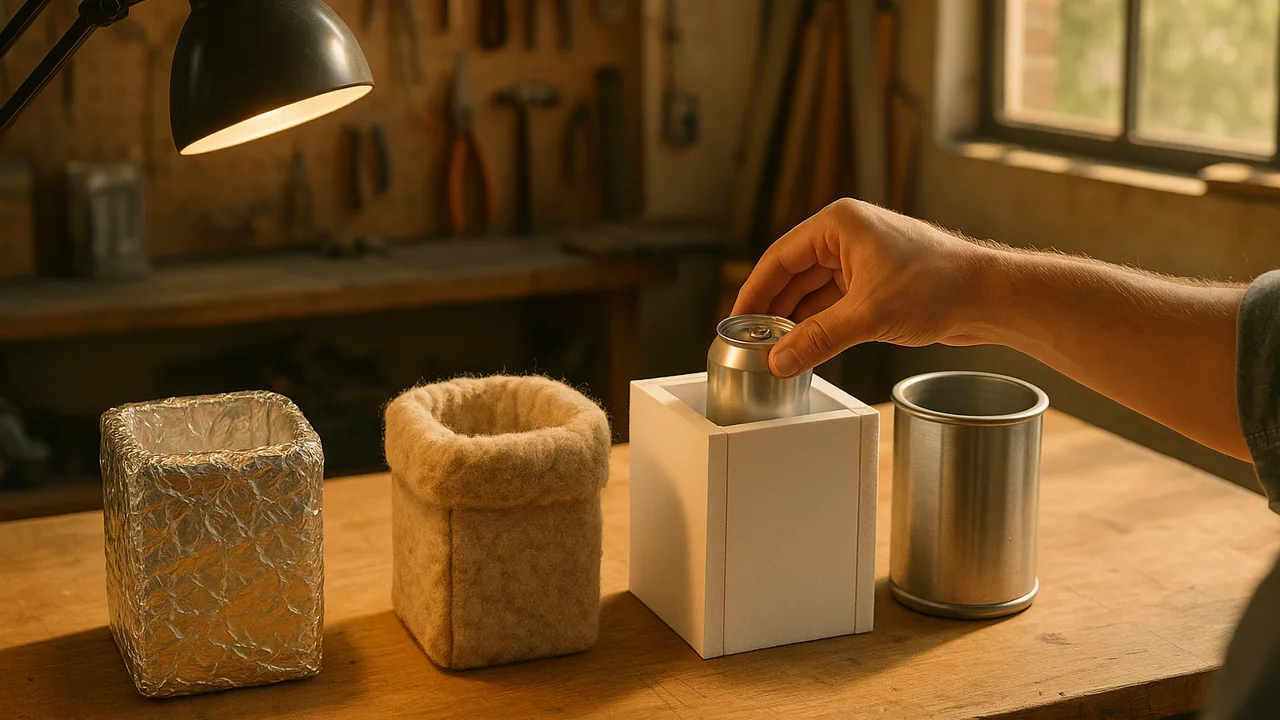
Worked example 2: a weighted decision matrix (sample scores). Mei’s team scored three ideas from 1 to 5 using evidence from 2.05 and 2.06.
| Criterion (weight) | A: foam box, foil outside | B: cardboard box lined with fleece | C: nested cups in a cloth bag |
|---|---|---|---|
| Hold time (3) | 5 → 15 | 3 → 9 | 2 → 6 |
| Reusability (2) | 4 → 8 | 2 → 4 | 4 → 8 |
| Carry and open (2) | 3 → 6 | 4 → 8 | 5 → 10 |
| Cost (1) | 3 → 3 | 4 → 4 | 5 → 5 |
| Total | 32 | 25 | 29 |
Design A wins on hold time, the heaviest weight. Its weakness is ease of opening, so the team plans a hinged lid with a soft seal.
The test plan (from 2.06). Lamp box at 35–40 °C; can of water at 5 °C; 200 g ice in a sealed bag; readings every 5 minutes; bare-can control in the same box.
| Time (min) | Box air (°C) | Version 1 can (°C) | Control can (°C) | Notes |
|---|---|---|---|---|
| 0 | ||||
| 15 | ||||
| 30 | ||||
| 45 | ||||
| 60 | ||||
| 75 | ||||
| 90 |
Guided Exercises ~15 min
Build your matrix and prediction, then check your reasoning.
Independent Practice ~10 min
Build version 1 and start the hold-time test.
Record your version 1 design drawing, its predicted hold time with the calculation, and your first readings. Explain how your criteria trace back to the cold-chain problem from 2.02.
Closure ~5 min
Version 1 is built and on test. Next lesson: critique, the full criteria check and version 2.
Exit ticket: which part of your carrier do you expect to leak the most energy, and how will your data show it?
How confident are you that you can I can write measurable criteria and constraints and use them to choose a design.
Teacher notes
Materials (per team): foam sheets or foam cups, cardboard, fleece or felt, aluminum foil, tape, string, a 355 mL can, a zip bag with 200 g ice, kitchen scale, thermometer, safety cutter at a supervised station. Lamp test box: a cardboard or plastic box with a clamped lamp above a vent, checked with a thermometer to hold 35–40 °C.
Setup: matrix and prediction 15 min, build 25 min, start the test 10 min. Hold tests run 90 minutes, so continue readings at the start of 2.08.
Listen for: criteria without numbers; weights with no reason; predictions treated as guarantees.
Support / stretch: give a pre-filled matrix with blank scores and a prediction template. Stretch: add the lid gap to the model as a second leak and solve for its size from the measured hold time.