2.10 Unit 2 Checkpoint: Thermal Energy and the Second Law
show what I know about thermal energy, heat flow, the second law, insulating materials and defining an engineering problem.
- I can plan an investigation to measure how the temperature of a hot object decreases and the temperature of a cold object increases when they are combined in a closed system.
- I can use temperature data and heat capacity values from scientific sources to show that the thermal energy lost by the hot object equals the energy gained by the cold object, resulting in a more uniform energy distribution.
- I can identify and explain how the molecular-level structure and atomic interactions of a designed material determine its function.
- I can communicate how the properties of a material make it suitable for its intended use.
- I can specify both qualitative and quantitative criteria and constraints that solutions to the problem must meet.
Phase 5: Prove It
Warm-Up ~5 min
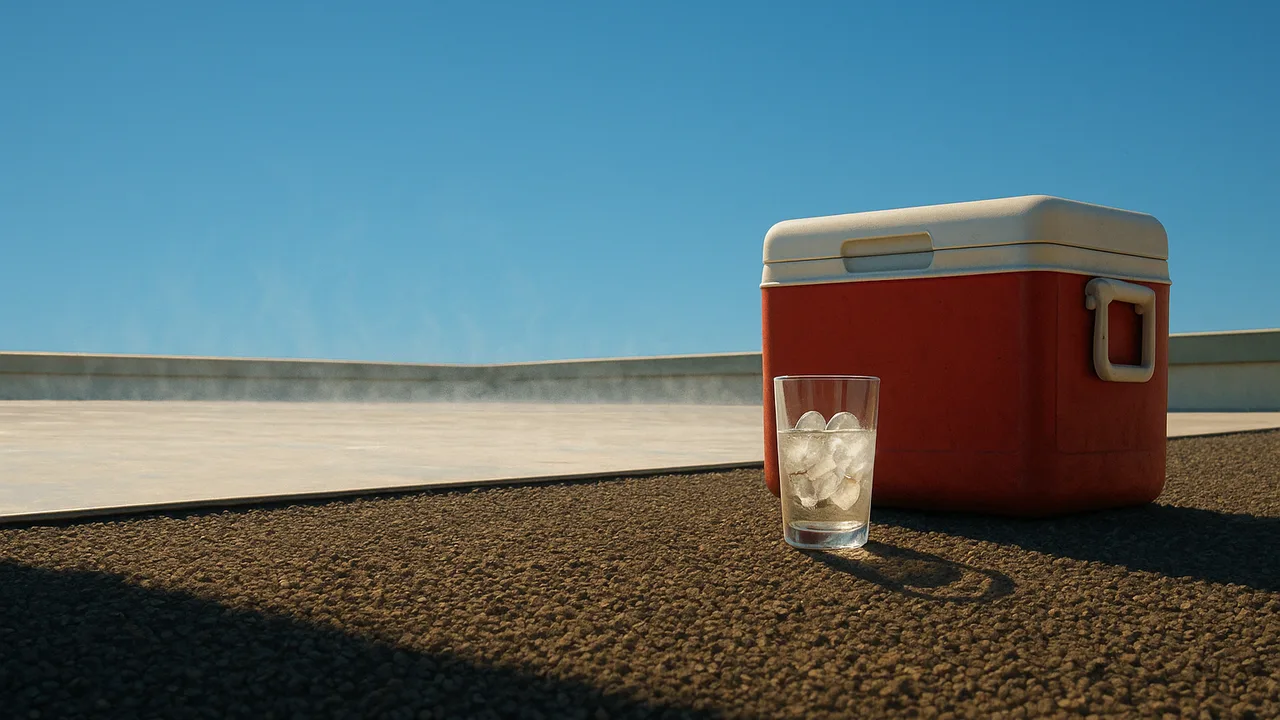
Do Now. Back to the phenomenon: in two sentences, explain why a dark roof gets hotter than a cool roof in the same sun, using the words absorb and thermal energy.
Two objects at the same temperature always have the same thermal energy.
Instruction ~10 min
Thermal engineers, this is the unit checkpoint. Part A is multiple choice with data. Part B is a scenario set. Part C is short constructed responses, each scored 0–3. Use cwater = 4186 J/(kg·K), cAl = 900 J/(kg·K), Lf = 334,000 J/kg, and kelvin = °C + 273.15.
How a 0–3 answer is scored. 3: correct claim, correct calculation or model with units, and reasoning that names the system and explains at the particle scale where asked. 2: correct claim with a small error or gap. 1: partly correct idea with major gaps. 0: incorrect or blank.
Worked example: from 2 points to 3. Question: “Why does foam insulate?” A 2-point answer: “It traps air, and air is a poor conductor.” A 3-point answer adds structure and forces: “Attractions between polymer chains make thin solid walls that enclose tiny cells of gas. The gas molecules are far apart and cannot circulate, so energy crosses only by slow conduction through still gas and thin walls.”
Scenario set data (sample data). Use for questions 7–10. A team drops 0.200 kg of aluminum at 90.0 °C into 0.150 kg of water at 20.0 °C in a foam-cup calorimeter. Readings:
| Time (s) | 0 | 20 | 40 | 60 | 80 | 100 | 120 |
|---|---|---|---|---|---|---|---|
| Water (°C) | 20.0 | 30.1 | 34.2 | 35.0 | 35.0 | 34.9 | 34.8 |
Materials data (approximate room-temperature thermal conductivity, W/(m·K)) for questions 5 and 6. Aluminum about 220; glass about 0.84; polystyrene foam about 0.033; still air about 0.026.
Guided Exercises ~15 min
Parts A and B: answer on your own. Your teacher reviews answers after everyone finishes.
Independent Practice ~10 min
Part C: constructed responses, each scored 0–3.
13. A remote clinic must carry vaccines on a 6-hour trip with no power. Describe the problem using one qualitative and one quantitative piece of information, define the system and its boundary, name the needs of two groups, and write two measurable criteria and two constraints. (0–3)
14. Choose foam, aerogel or a double-pane window gap. Using a labeled diagram AND a paragraph, describe the material's intended function and explain how forces between its molecules and its structure produce that function. Include why metals behave differently. (0–3)
15. Plan an investigation to show that the energy lost by hot water equals the energy gained by cold water when they are mixed. Name the system and boundary, the data you will collect, the number of trials, and one way energy could seem to be lost and how you would reduce it. Then explain how your data would support the second law. (0–3)
16. Draw a two-scale model of the Cool Carrier one hour into a test: show the energy paths in at the visible scale and, in zoom circles, the particles in the outside air, the foam wall and the melting ice. Use it to explain that total energy is conserved. (0–3)
Closure ~5 min
Finished, engineers. Your results guide the review before Unit 3. Next: the Phase 5 field trip.
Exit ticket: which idea from this unit would you most like to practice again, and why?
How confident are you that you can I can explain and measure thermal energy transfer, use the second law, explain insulating materials from their structure, and define an engineering problem.
Teacher notes
Materials: printed checkpoint, calculators, scoring guide for items 13–16.
Setup: about 40 minutes. Item tags: HS-PS3-4: 2, 3, 7–10, 15 (1a: 3, 15; 2a: 2, 8; 3a: 15; 4a: 7, 8; 5a: 9; 5b: 10, 15; 5c: 9, 15). HS-PS3-2: 1, 11, 16 (all four ids). HS-PS2-6: 5, 6, 14 (all seven ids through item 14). HS-ETS1-1: 12, 13 (all four ids). Answer key: item 2 gives 35 °C; item 8 gives 9,418.5 J; measured c = 9,418.5 ÷ (0.200 × 55.0) ≈ 856 J/(kg·K).
Listen for: Celsius in the Carnot ratio; “cold flows”; foam explained without structure.
Support / stretch: read items aloud on request and provide an equation sheet. Stretch: for item 15, add the calorimeter’s heat capacity to the energy balance.