1.07 Design and Prototype: Competing Converters and a Decision Matrix
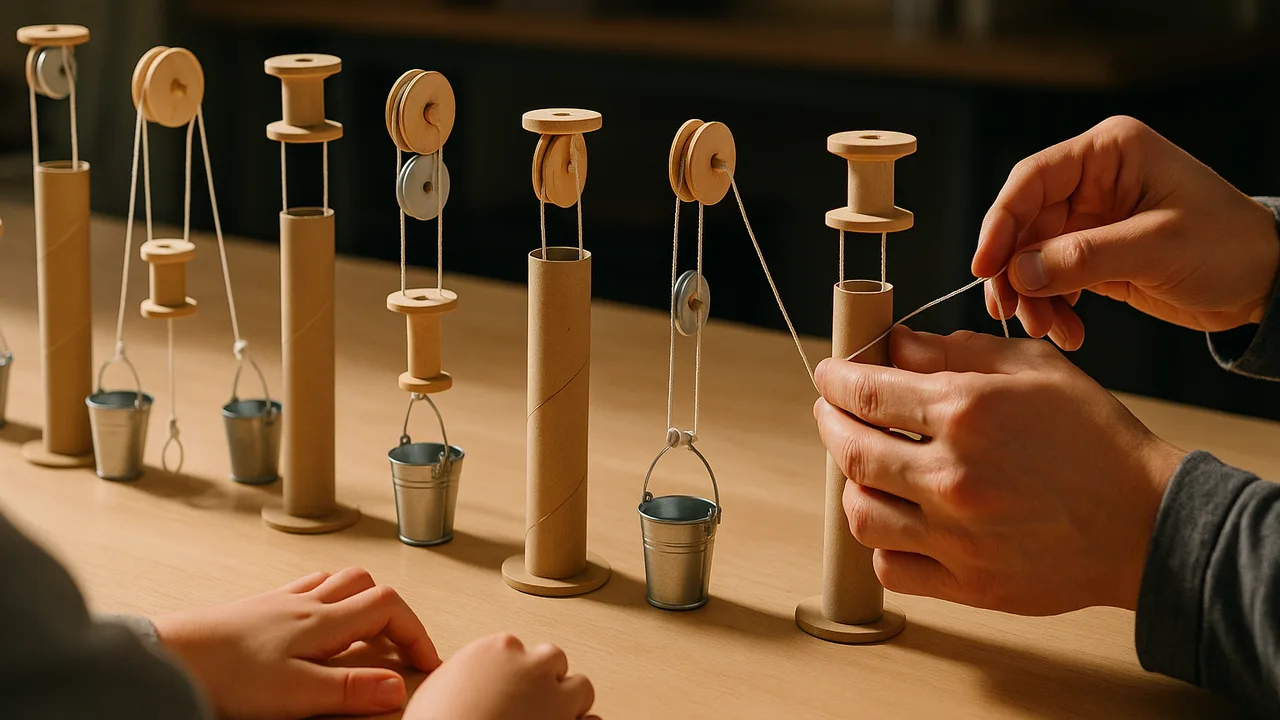
compare competing converter designs with a weighted decision matrix built from our criteria and constraints, then build and test version 1.
- I can design a device that converts one form of energy into another.
- I can describe and measure the most important criteria and constraints for my device, such as cost and efficiency, and explain the tradeoffs involved in my design choices.
- I can build and test my device according to my plan.
Phase 4: Build
Warm-Up ~5 min
Do Now. Look at your three starred ideas from 1.06. Which would you choose right now, and what is your reason? Keep the answer; we will test it against the matrix.
Why do engineers weight criteria in a decision matrix?
Instruction ~10 min
Class criteria and constraints for the exhibit converter (set in 1.02, ranked in 1.07). Criteria: (1) the final version reaches a mean efficiency of at least 50% over three trials; (2) its three trials agree within ±5 percentage points; (3) it runs 10 times in a row without repair, because visitors will use it all day. Constraints: input energy no more than 10 J (a falling mass of at most 1.0 kg dropped at most 1.0 m, or a band stretched at most 25 cm); it fits a 60 cm × 40 cm table space; class-kit or household materials only, costing at most 10 sample budget points; two build periods.
Ranking the criteria. The client’s top need is an exhibit that teaches efficiency, so efficiency gets weight 3. A visitor exhibit must survive many runs, so durability gets weight 3. Repeatability gets weight 2, because a device whose results jump around teaches nothing. Cost gets weight 1, since every option fits the 10-point budget. Constraints are pass/fail: a design that breaks one is out.
Worked example 1: a weighted decision matrix (sample scores). Priya’s team scored three ideas from 1 (poor) to 5 (excellent) using their lab evidence, then multiplied by the weight.
| Criterion (weight) | A: lifter with straw bearings | B: band car with large wheels | C: band launcher |
|---|---|---|---|
| Efficiency (3) | 4 → 12 | 3 → 9 | 3 → 9 |
| Durability (3) | 4 → 12 | 3 → 9 | 2 → 6 |
| Repeatability (2) | 4 → 8 | 2 → 4 | 4 → 8 |
| Cost (1) | 3 → 3 | 4 → 4 | 5 → 5 |
| Total | 35 | 26 | 28 |
The lifter wins, but the matrix also shows its weakness: cost. The team notes that the launcher is cheap and repeatable but the band may wear out, which matters for an exhibit.
Worked example 2: predicting version 1. Before building, predict. Input: a 1.00 kg mass falls 0.80 m, so 7.84 J. If the lifter is 55% efficient (sample estimate), the 0.50 kg load gains 0.55 × 7.84 = 4.31 J and rises 4.31 ÷ (0.50 × 9.8) = 0.88 m. Writing the prediction first turns the test into a check of your model.
Worked example 3: the test plan. Measure input directly (mass and drop height, or the area under the band’s F-x graph). Measure output with the 1.03 methods (meter stick for height, video frames for speed). Run three trials. Record the mean and the spread. Change only one thing between versions.
| Version 1 trial | Input energy (J) | Output measurement | Useful output (J) | Efficiency (%) | Notes (losses seen or heard) |
|---|---|---|---|---|---|
| 1 | |||||
| 2 | |||||
| 3 | |||||
| Mean ± spread |
Guided Exercises ~15 min
Build your own matrix first, then check your reasoning.
Independent Practice ~10 min
Build and test version 1. Fill in the trial table.
Record your version 1 prediction, your three trials, and the mean and spread. Draw an energy-flow diagram for version 1 with the useful path and every loss you observed, and name the scientific principle behind each part of the design.
Closure ~5 min
Version 1 exists and has data. Next lesson: critique, test against every criterion, and version 2.
Exit ticket: how close was version 1 to your prediction? Give one reason for the gap.
How confident are you that you can I can use criteria, constraints and trade-offs to choose and build an energy-converter design.
Teacher notes
Materials (per team): string, wooden dowels or pencils for axles, drinking straws, cardboard, cups, tape, a 1.0 kg mass set, a 0.50 kg load, rubber bands, toy-car chassis or bottle caps for wheels, meter sticks, balance, goggles. Hot-glue guns at a supervised tool station.
Setup: matrix 15 min, build 25 min, first trials 10 min. If building runs long, finish trials at the start of 1.08.
Listen for: weights with no link to the client; one-trial conclusions; constraints treated as negotiable.
Support / stretch: give a pre-filled matrix with blank scores. Stretch: run a sensitivity check by changing one weight and seeing if the winner changes.