4.07 Design and Prototype: Competing Alert Links and a Decision Matrix
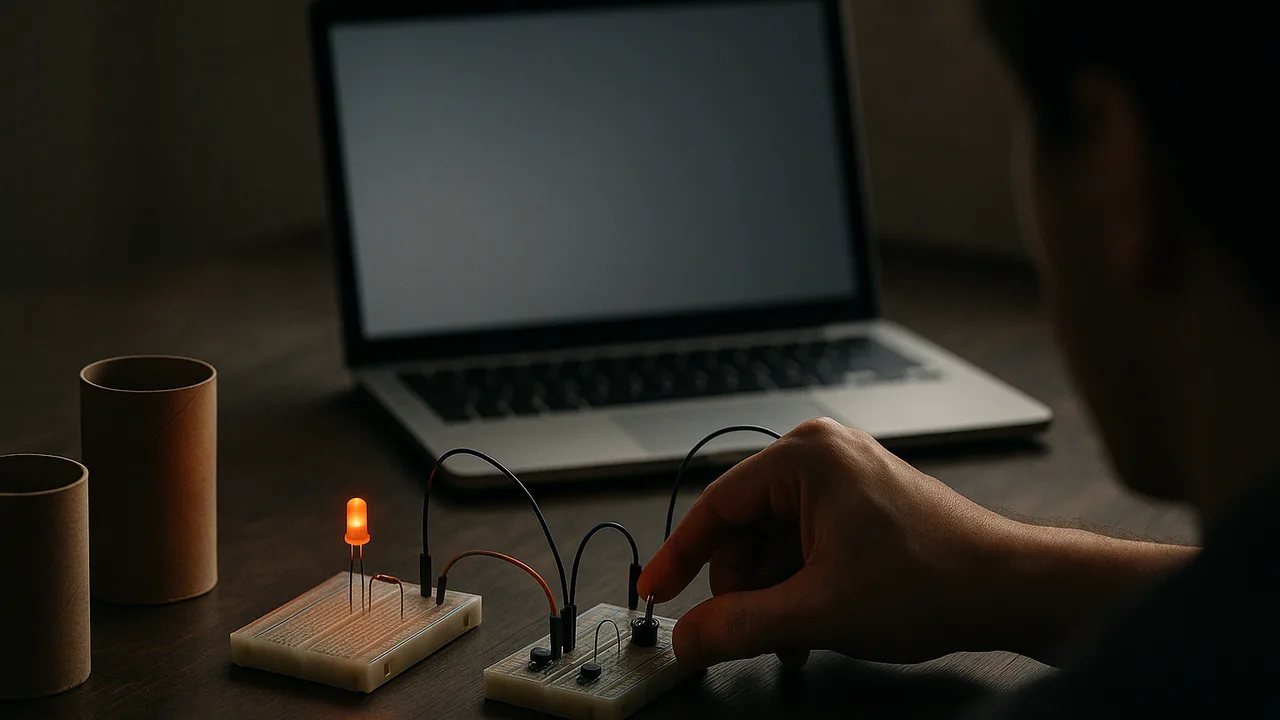
compare competing light-signal link designs in a weighted decision matrix, justify the encoding and hardware choices with wave and digital-signal science, and build and test version 1.
- I can describe how the stability and importance of digital systems relate to the advantages and disadvantages of digital transmission and storage.
- I can discuss how answers to questions about digital transmission and storage connect to real-life situations, like emailing homework, copying music, researching online, or using social media.
- I can evaluate whether answers to questions about digital transmission and storage provide ways to test if certain features are advantages or disadvantages.
- I can identify and explain the wave behavior or the absorption of photons and production of electrons that each device uses.
- I can qualitatively describe how basic physics principles were used in the design and development of each device to make it work.
Phase 4: Build
Warm-Up ~5 min
Do Now. From the idea wall, pick the two link ideas you think will be most reliable. Write how each one tells a 0 from a 1.
Design X sends bits with a red laser pointer and is very fast. What is its status?
Instruction ~10 min
Our class criteria and constraints. Criteria: (1) the link sends a 16-bit alert code (location, strength, action) across at least 5 m of classroom; (2) the receiver decodes it with no uncorrected errors in 3 of 3 trials; (3) the total send time is at most 20 s; (4) the code includes at least one check (parity) bit. Constraints: (5) visible light only, from LED flashlights or a phone light (no lasers), and class materials only; (6) the receiver may be a person or a phone light-meter app, and nobody shines a light into anyone’s eyes.
Competing solutions. Today each team takes its three strongest ideas into a weighted decision matrix. The client cares most that the alert arrives correctly; speed matters, but a fast wrong alert is worse than a slightly slower right one.
| Design | Decoded correctly (×3) | Send time ≤ 20 s (×2) | Error check (×2) | Works in a lit room (×2) | Easy to explain to families (×1) | Total |
|---|---|---|---|---|---|---|
Score each cell 1–3, multiply by the weight, then add.
Worked example 1: a filled matrix (sample). Malik’s team scored on-off flashes on a 0.5 s beat (decoded 2, time 3, check 2, lit room 1, explain 3: total 6 + 6 + 4 + 2 + 3 = 21), two LED colors for 0 and 1 (3, 3, 2, 2, 2: total 9 + 6 + 4 + 4 + 2 = 25) and short and long flashes (2, 1, 2, 2, 3: total 6 + 2 + 4 + 4 + 3 = 19). They chose the two-color link, because a receiver never has to guess whether a dark moment is a 0 or a pause. Then they added a cardboard tube around the receiver to block room light, a fix their matrix pointed to.
Worked example 2: justifying choices with science. Priya wrote: “Every bit is either green or blue, so the receiver makes a two-way decision, just like a digital receiver. Room light is noise; the tube blocks most of it. The parity bit lets the receiver catch a single misread bit and ask for a resend.” Every choice is tied to digital-signal science and a criterion.
Worked example 3: predicting performance. At one bit every 0.5 s, 16 bits take 8 s; with a 2 s start signal, 10 s. One resend would bring it to 20 s, right at the limit. Write your prediction before you test.
Build and test version 1. The sender reads the code from a card the receiver has not seen. The receiver writes each bit, checks parity and decodes the message. A detected error that is resent and fixed within 20 s counts as corrected; an error that slips through is uncorrected.
| Trial | Distance (m) | Room lights | Send time (s) | Bits wrong | Caught by parity? | Decoded correctly? |
|---|---|---|---|---|---|---|
| 1 | ||||||
| 2 | ||||||
| 3 |
Guided Exercises ~15 min
Complete your team matrix, then check each other’s reasoning.
Independent Practice ~10 min
Record version 1.
Paste your matrix and version 1 test table. Explain your encoding, hardware and receiver choices with wave and digital-signal science, and compare the measured send time and errors with your prediction.
Closure ~5 min
Version 1 exists and has data. Next class: gallery critique and version 2.
Exit ticket: which criterion did version 1 meet best, and which did it miss or barely meet? Give the numbers.
Teacher notes
Materials: LED flashlights (some with colored filters), phone lights, cardboard tubes, tape, stopwatches, code cards with random 15-bit messages, phones with a light-meter app (optional).
Setup: mark sender and receiver lines at least 5 m apart. Run one trial with room lights on and one with them off so teams see noise.
Listen for: matrices filled to justify a favorite; teams that forget to time the start signal; parity bits calculated on the wrong count.
Support / stretch: give a ready-made encoding table. Stretch: send two bits at once with two lights and measure the new bit rate and error rate.