1.04 Momentum Before and After a Collision
calculate the momentum of objects before and after a collision and argue from the calculations that the total momentum of a system is conserved when no net outside force acts on it.
- I can describe and calculate the momentum of each object in a one-dimensional system using the formula p = mv.
- I can calculate and describe the total momentum of a system by adding the one-dimensional momenta of two objects.
- I can use calculations of total momentum to support the claim that the system’s momentum is the same before and after the interaction.
Phase 2: Investigate
Warm-Up ~5 min
Do Now. A slow, loaded delivery truck and a fast bicycle are both heading for the same wall. Which would be harder to stop, and why? Write a two-sentence answer.
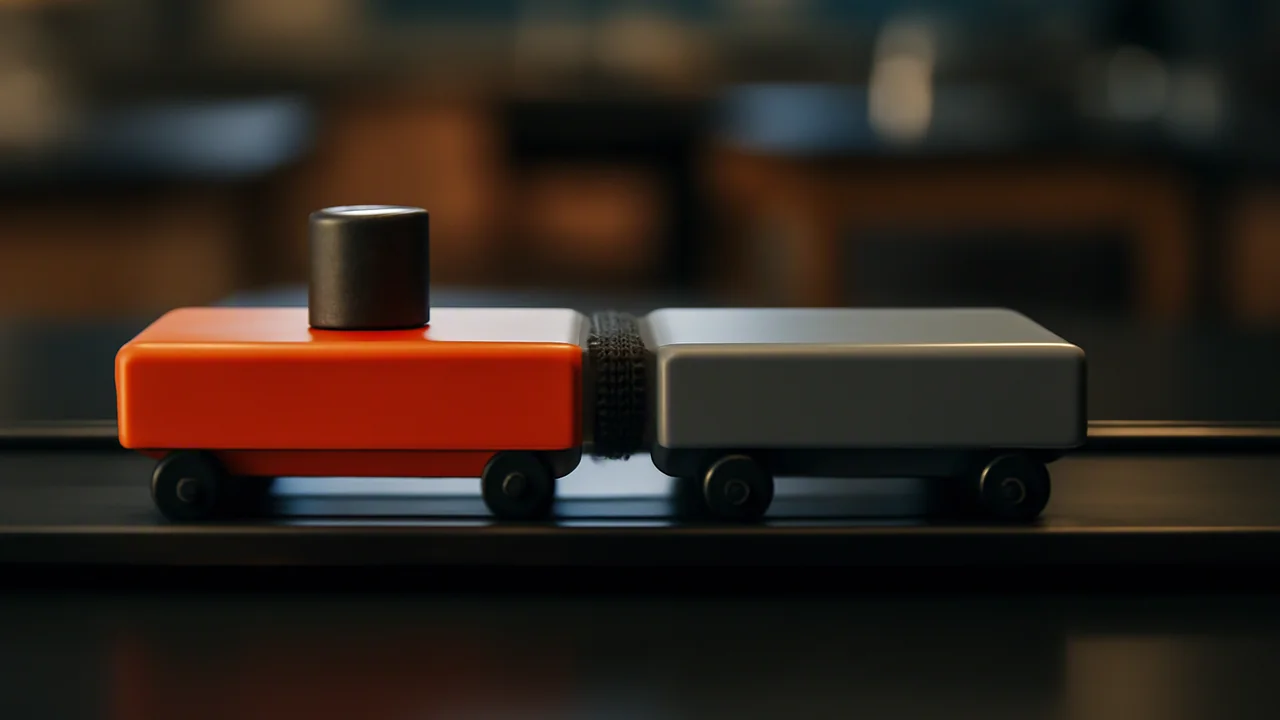
A moving cart hits an identical cart at rest and they stick together. Their speed afterward is
Instruction ~10 min
Why a new quantity? In a crash, two objects push on each other for a very short, complicated time. The forces are hard to measure. But something about the pair is the same before and after the crash, and that lets us predict the outcome without knowing the forces. That quantity is momentum.
Momentum. An object’s momentum is its mass times its velocity: p = mv, in kg·m/s. Direction matters: choose one direction as positive, and velocities the other way are negative. A 1,500 kg car at 25 m/s has momentum 1,500 × 25 = 37,500 kg·m/s. A 0.15 kg baseball at 40 m/s has 6 kg·m/s. A slow truck can have more momentum than a fast bicycle.
Conservation. First define the system and check its before motion: two carts rolling at steady speeds on a level, low-friction track are not speeding up or slowing down, which is evidence that the net outside force on the two-cart system is essentially zero. When the carts collide, Newton’s third law says they push on each other with equal and opposite forces for the same time. So whatever momentum one gains, the other loses. If no outside net force acts on the system, the total momentum stays the same:
total momentum before = total momentum after
Worked example 1: carts that stick. A 0.50 kg cart moving at 0.80 m/s hits a 0.50 kg cart at rest; Velcro makes them stick. Before: 0.50 × 0.80 + 0.50 × 0 = 0.40 kg·m/s. After, they move together with mass 1.00 kg, so 1.00 × v = 0.40 and v = 0.40 m/s. Half the speed, twice the mass, same momentum. Cart 1’s momentum changed by −0.20 kg·m/s and cart 2’s by +0.20 kg·m/s: equal and opposite.
Worked example 2: head-on. A 1,500 kg car moving east at 15 m/s collides head-on with a 1,000 kg car moving west at 10 m/s, and they lock together. Take east as positive. Before: 1,500(15) + 1,000(−10) = 22,500 − 10,000 = 12,500 kg·m/s. After: 2,500 v = 12,500, so v = 5.0 m/s east. (Illustrative numbers.)
Bouncing collisions. Momentum is conserved whether objects stick or bounce. When two equal carts with magnets or springs bounce, the moving cart often stops and the struck cart moves off at nearly the first cart’s speed: 0.50(0.80) = 0.50(0) + 0.50(0.80). What is not always conserved is kinetic energy; in a sticking collision some of it becomes thermal energy and sound, and in a car crash it crumples metal. Unit 3 tracks that energy.
Making the argument. HS-PS2-2 asks for a mathematical representation in support of the claim. Present a table: each object’s mass and velocity before and after, each momentum, and the totals. Compare totals and give the percentage difference. Then reason: equal and opposite forces over the same time transfer momentum from one object to the other without changing the total. Finally, address the conditions: the claim holds for a system with no net outside force. If your track slopes or your cart drags, momentum is not conserved for the carts alone, because an outside force acts. A good counter-claim to prepare for: “momentum was lost because the carts slowed down.” Answer it with the full system in the calculation.
Lab procedure: collision record. Use two carts on a level track (or the PhET Collision Lab). For each run, record masses and the velocities before and after, from slow-motion video or the sim’s values.
| Run | m1 (kg) | m2 (kg) | v1 before (m/s) | v2 before (m/s) | v1 after (m/s) | v2 after (m/s) | Total p before | Total p after | % difference |
|---|---|---|---|---|---|---|---|---|---|
| 1 bounce | |||||||||
| 2 stick | |||||||||
| 3 heavy target |
Reading: OpenStax Physics (high school), chapter 8 (CC BY 4.0).
Guided Exercises ~15 min
Fill your collision table as you go. Use east (or right) as positive.
Independent Practice ~10 min
Apply momentum to the crash-cushion problem.
Our cart (0.80 kg, sample) reaches the wall at 1.5 m/s. Calculate its momentum. If it stops dead, how much momentum must the cushion and wall remove? If it bounces back at 0.5 m/s, is the momentum change bigger or smaller? Show the signs.
Closure ~5 min
The momentum the cart brings to the wall is fixed by its mass and speed. Next class: how the cushion changes the force needed to remove it.
Exit ticket: why can a sand barrel slow a car by taking some of its momentum? Use the words system and conserved.
Teacher notes
Materials: two carts with Velcro and magnet bumpers per team (or devices for the PhET Collision Lab), a level track, phones for slow-motion video, goggles.
Listen for: dropping the minus sign for leftward velocities; “the heavier object pushes harder” (the forces are equal and opposite); “momentum and kinetic energy are the same thing.”
Support / stretch: give a sign-convention card and a table with the first row done. Stretch: find what percentage of kinetic energy was lost in the sticky run.