2.05 Energy in Fields: Motors and Generators
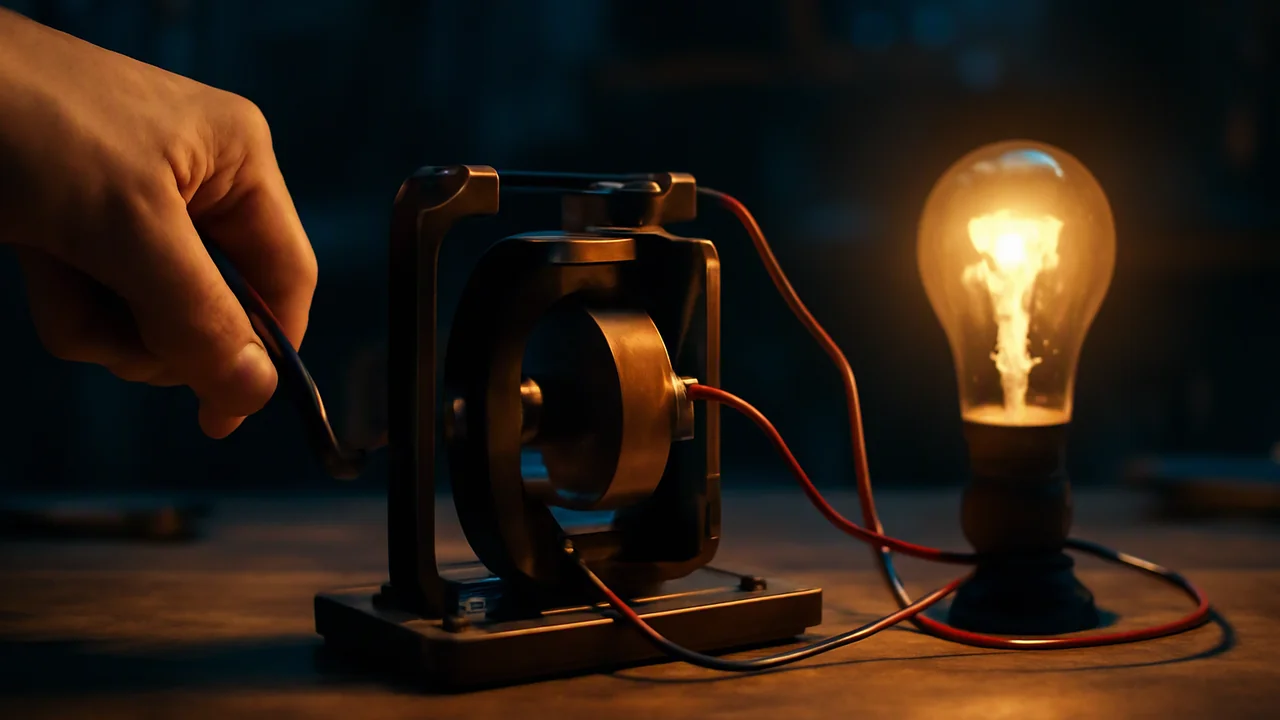
use a field model to explain how energy is stored and released as objects interacting through gravitational, electric or magnetic fields move, and model the energy transfers in a motor and a generator.
- I can develop a model that shows two objects, their initial positions and velocities in one dimension, and how they interact through electric or magnetic fields.
- I can describe the nature of the interaction (electric or magnetic) between the two objects and show the direction and relative magnitude of the net force on each object in my model.
- I can represent a field in my model as something that has both magnitude and direction at every point in space and contains energy.
- I can use my model to determine if the energy stored in the field increases, decreases, or stays the same when the two objects interact.
Phase 3: Make Sense
Warm-Up ~5 min
Do Now. Pull apart two magnets that are stuck together, then let them snap back. Where did the energy you put in go while they were apart?
You pull two opposite magnetic poles apart. The energy stored in the magnetic field
Instruction ~10 min
Energy in the arrangement. Pull two magnets apart that are stuck together: you have to push, so you do work, and the energy goes somewhere. Let go and they snap back together, and the energy reappears as motion and a click of sound. Where was it in between? The field model says it was stored in the field, in the arrangement of the two interacting objects. HS-PS3-5 asks you to model this for objects interacting through fields.
Three parallel cases.
- Gravity. Lifting a 2.0 kg backpack 1.5 m onto a shelf takes mgh = 2.0 × 9.8 × 1.5 = 29.4 J. That energy is stored in the gravitational field of the Earth-backpack system. If the pack falls, the field does work on it and the stored energy becomes kinetic energy.
- Electric. Pulling a negative charge away from a positive one takes work against their attraction; the energy is stored in the electric field. Pushing two like charges closer together stores energy too, because they repel. Released, they fly apart.
- Magnetic. Separating opposite poles or pushing like poles together stores energy in the magnetic field.
The rule in every case: when objects that attract are pulled apart, or objects that repel are pushed together, energy is stored in the field. When they move the way the force pushes them, the field gives energy back as kinetic energy (and eventually thermal energy and sound). Drawing field lines helps: they point the way a force would push, and they crowd together where the field is strong. A field has a size and a direction at every point, and it holds energy.
Worked example 1: energy and distance. For two charges, the energy stored in the field is U = kq1q2/r. Two +1.0 μC charges 0.10 m apart store 8.99 × 109 × 10−12 ÷ 0.10 ≈ 0.090 J. Released, they repel to 0.20 m, where U ≈ 0.045 J. The field’s energy fell by 0.045 J, and the charges’ kinetic energy rose by the same 0.045 J (ignoring losses). Energy left the field and appeared as motion.
The generator. On a ridge-top wind farm, wind pushes on turbine blades, which turn a shaft connected (usually through a gearbox) to a generator. In the generator, magnets and coils rotate relative to each other. Each time a coil turns, the magnetic field through it changes, which induces a current, the effect you measured in 2.03. But the induced current in the coil also creates its own magnetic field, and that field pushes back against the rotation. So the wind must keep doing work on the blades to keep them turning, and that work becomes the electrical energy sent to the grid. Energy flow: kinetic energy of air → kinetic energy of blades and rotor → (through the magnetic field) electrical energy → grid, with some energy lost as thermal energy and sound at every step.
The motor. Reverse the flow. A current sent through coils creates a magnetic field that pushes on permanent magnets, turning a shaft. Electrical energy → (through the field) kinetic energy of the shaft. An electric car’s motor does this, and many can run as generators when the car brakes, returning energy to the battery.
Why the field model matters. Without it, the energy seems to vanish and reappear. With it, you can account for every joule: it is stored in the arrangement of interacting objects, transferred through the field, and conserved overall. That is the systems thinking that Unit 3 builds on.
Reading: OpenStax Physics (high school), chapters 19 and 20 (CC BY 4.0).
Guided Exercises ~15 min
Draw a field model for each case before answering.
Independent Practice ~10 min
Model three interacting pairs.
Draw field diagrams for (a) Earth and a lifted backpack, (b) two opposite charges being pulled apart, (c) two like magnetic poles being pushed together. For each, show the force on each object with arrows of the right relative size, and say whether field energy increases or decreases.
Draw an energy-flow model of a generator and a motor side by side. Mark where the field transfers energy and where energy leaves the useful path.
Closure ~5 min
The field stores and passes on energy. Next class, we revise our model and brainstorm generator designs.
Exit ticket: why does a generator get harder to turn when it is lighting a bulb? Use the words field and work.
Teacher notes
Materials: pairs of ceramic magnets, a hand-crank generator or flashlight if available, devices for the sim, colored pencils for field diagrams.
Listen for: “the energy is in the magnet” (it is in the arrangement, the field); “generators create energy”; forgetting that the forces on the two objects are equal and opposite.
Support / stretch: give a three-row table (case, motion with or against force, field energy up or down). Stretch: calculate the energy stored when a 1,000 kg satellite moves from 7.0 × 10⁶ m to 1.4 × 10⁷ m from Earth’s center with U = −GMm/r.