1.07 Design and Prototype: Competing Cushions and a Decision Matrix
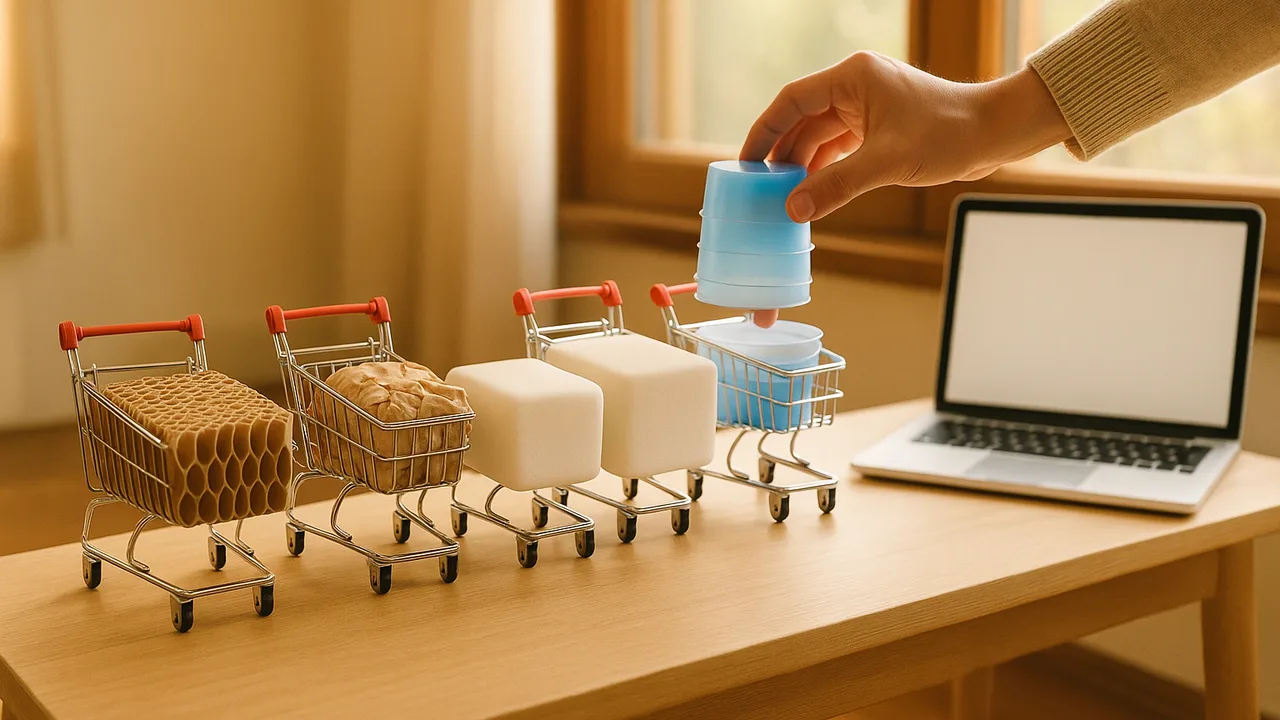
compare competing cushion designs in a weighted decision matrix, justify the chosen materials and structure with impulse, and build and run version 1.
- I can describe and justify my choices of materials and the structure of my device based on scientific reasoning.
- I can describe and, when possible, quantify the criteria and constraints for my device, including tradeoffs such as cost, mass, maximum force, and safety requirements.
- I can systematically evaluate my device design by explaining my choices and comparing the design to the criteria and constraints.
Phase 4: Build
Warm-Up ~5 min
Do Now. From the idea wall, pick the two designs you think will stop the cart over the longest time. Write one reason for each.
Design X weighs 120 g and crushes over 0.09 s (sample). What is its status?
Instruction ~10 min
Our class criteria and constraints. Criteria: (1) the egg survives 3 runs from the standard ramp height without cracking; (2) the cart’s stopping time, measured from slow-motion video, is as long as possible. Constraints: (3) cushion mass at most 100 g; (4) it extends no more than 15 cm in front of the cart; (5) only class materials (paper, cardboard, straws, tape, rubber bands, foam, bubble wrap); (6) the egg itself may not be wrapped, so the cushion does the work.
Competing solutions. Engineers rarely build the first idea. They sketch several, then score them against the criteria. Today each team takes its three strongest ideas into a weighted decision matrix: rows are designs, columns are criteria, and each criterion has a weight that shows how much it matters to the client.
| Design | Long stop (×3) | Mass under 100 g (×2) | Within 15 cm (×2) | Survives 3 runs (×3) | Easy to build (×1) | Total |
|---|---|---|---|---|---|---|
Score each cell 1–3, multiply by the weight, then add.
Worked example 1: a filled matrix (sample). Diego’s team scored a straw accordion (long stop 3, mass 3, length 2, survives 2, easy 2: total 9 + 6 + 4 + 6 + 2 = 27), a foam stack (2, 2, 3, 3, 3: total 6 + 4 + 6 + 9 + 3 = 28) and a rubber-band sling (3, 3, 1, 1, 1: total 9 + 6 + 2 + 3 + 1 = 21). The foam stack won by one point, but the accordion scored higher on the most heavily weighted criterion. They chose a hybrid: a foam stack behind a short straw accordion. A matrix informs a decision; it does not make it for you.
Worked example 2: justifying materials with science. Ava wrote: “Straws buckle one after another, so the cushion keeps collapsing over more time instead of all at once. Foam behind them crushes last, adding stopping time without bouncing back. Both are light, so we stay under 100 g.” Every material choice is tied to impulse and a constraint.
Worked example 3: predicting the force. If version 1 stops the 0.80 kg cart from 1.5 m/s in 0.040 s, the average force is 1.2 ÷ 0.040 = 30 N. Doubling the stop to 0.080 s would halve it to 15 N. Write your prediction before you test.
Build and test version 1. Build to the plan. Weigh and measure it first. Test with a hard-boiled egg or a water balloon before using a raw egg. Film every run in slow motion (many phones film at 240 frames per second, so each frame is about 0.004 s) and count frames from first contact to stop.
| Run | Cushion mass (g) | Length (cm) | Impact speed (m/s) | Frames in stop | Δt (s) | Average force (N) | Egg OK? |
|---|---|---|---|---|---|---|---|
| 1 | |||||||
| 2 | |||||||
| 3 |
Guided Exercises ~15 min
Complete your team matrix, then check each other’s reasoning.
Independent Practice ~10 min
Record version 1.
Paste your completed matrix and version 1 test table. Explain your design choice and your material choices with impulse, and compare the measured average force with your prediction.
Closure ~5 min
Version 1 exists and has data. Next class: gallery critique and version 2.
Exit ticket: which criterion did version 1 meet best, and which did it miss or barely meet? Give the numbers.
Teacher notes
Materials: ramp set to the standard height, carts, the class material bins, balances, rulers, hard-boiled eggs or water balloons for practice, a few raw eggs in zip-top bags, phones with slow-motion video, disinfecting wipes.
Setup: one ramp station per two teams. Measure the cart’s impact speed once for the class by timing it over the last 0.50 m.
Listen for: matrices filled to justify a favorite; materials chosen with no science reason; teams ignoring the mass limit.
Support / stretch: provide a pre-weighted matrix. Stretch: run a sensitivity check by changing one weight and seeing if the winner changes.