3.01 Storing Sunshine by Pumping Water Uphill
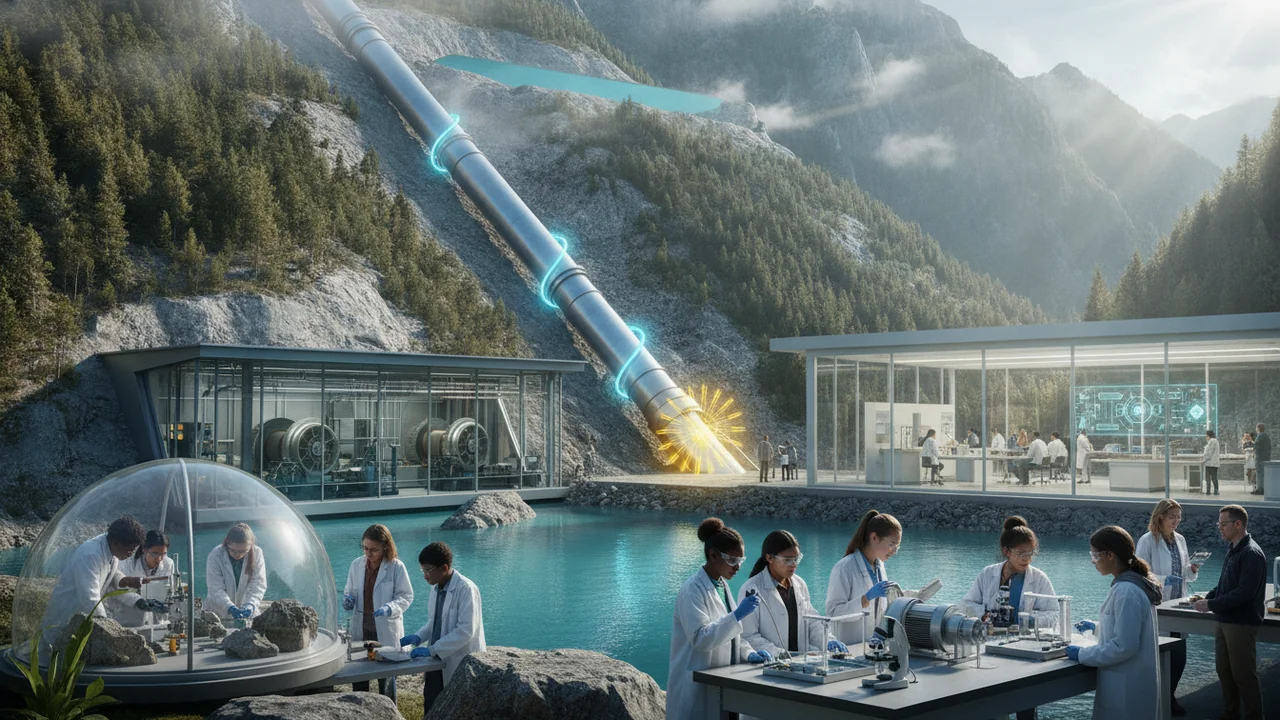
The Fuel-Free Kitchen
How can we design a low-cost solar oven that turns as much sunlight as possible into thermal energy in water, and account for where the rest of the energy goes?
The mystery: At a pumped-storage hydropower plant in a mountain range, water is pumped uphill when solar power is plentiful at midday and released through turbines in the evening, yet the plant always returns less electricity than it used.
Questions we will figure out together in this unit:
- Where exactly is the energy while the water sits in the upper reservoir?
- Why does a pumped-storage plant get back less energy than it used?
- Could we store sunshine as heat instead of as raised water?
- Why does a bouncing ball never reach its starting height?
- Does thermal energy always flow from hot to cold?
- How do engineers measure how efficient a machine is?
- Is any device 100% efficient?
- How could a family use sunlight to heat water during a power outage?
model energy as kinetic energy of motion or potential energy stored in fields, calculate both, and ask questions about how energy can be stored and recovered.
- I can describe how changes in the positions of objects in gravitational, magnetic, or electrostatic fields affect the energy stored in those fields.
- I can explain that thermal energy includes both the kinetic and potential energy of particle vibrations in solids or molecules, and the kinetic energy of freely moving particles in liquids and gases.
- I can describe how the total energy of a system and its surroundings is conserved at both the macroscopic and molecular/atomic levels.
- I can use my models to illustrate that energy at the macroscopic scale can be explained as a combination of energy from the motion of particles or objects and energy from their relative positions, at both the macroscopic and microscopic scales.
Phase 1: Spark
Warm-Up ~5 min
Do Now. Solar panels make the most electricity around midday, but people use the most in the early evening, when they get home, cook and turn on lights. Write one way you could save some of the midday energy for the evening, and one problem with your idea.
A pumped-storage plant uses 100 kWh of electricity to pump water uphill. How much electricity can it get back later?
Instruction ~10 min
The phenomenon. On grids with a lot of solar power, the panels produce the most electricity around midday, but demand peaks in the early evening, just as the sun sets. On many sunny afternoons the grid has more solar power than it can use. One old and simple answer is to store the energy by moving water uphill. At a pumped-storage hydropower plant in a mountain range, water is pumped from a lower reservoir up to a higher one when electricity is plentiful; later, it flows back down through the same machines, now running as turbines and generators, to supply power when it is needed. Where is the energy while the water waits at the top?
Two big categories. At the scale of objects you can see, all energy is one of two kinds:
- Kinetic energy, energy of motion: KE = ½mv2, in joules (J). A 1,000 kg car at 20 m/s has ½ × 1,000 × 202 = 200,000 J. Doubling the speed quadruples the kinetic energy, which is why speed matters so much in crashes.
- Potential energy, energy stored in the arrangement of objects that interact through a field. Near Earth’s surface, gravitational potential energy is PE = mgh. Lifting 1,000 kg of water (1 cubic meter) up 500 m stores 1,000 × 9.8 × 500 = 4,900,000 J (4.9 MJ). Elastic energy in a stretched spring and chemical energy in fuel are also field energy: stretched bonds and rearranged electrons, electric fields at the particle scale.
Where is zero? Height is measured from a reference level you choose, such as the surface of the lower reservoir. Only changes in potential energy matter, so any reference works as long as you use the same one throughout a problem.
Thermal energy is kinetic energy too. The “heat” in hot water is the kinetic energy of randomly moving particles, plus the energy stored in their interactions. When friction warms your hands, ordered motion becomes disordered particle motion. So even thermal energy fits the two categories once you look at the particle scale.
Worked example 1: pumped storage. How much electricity does 1 m3 of water store when lifted 500 m (illustrative height)? 4.9 MJ. One kilowatt-hour is 3.6 MJ, so that is 4.9 ÷ 3.6 = 1.36 kWh, enough to run a 1,000 W microwave for about 80 minutes. A plant must move enormous volumes of water to matter to the grid. And not all of it comes back: pumps, turbines, generators and pipe friction all turn some energy into thermal energy. Round-trip efficiencies of roughly 70–80% are commonly cited for pumped storage, so about three-quarters of the stored energy returns as electricity.
Conservation. Energy is never created or destroyed; it is transferred between objects and transformed between forms. As water falls, its potential energy becomes kinetic energy, then the kinetic energy of the turbine, then electrical energy, with some thermal energy at every step. If you account for every part of the system, the total stays the same. That accounting is what you will do all unit.
Worked example 2: a skateboarder. A 50 kg skateboarder drops into a 5.0 m deep half-pipe from rest. At the top: PE = 50 × 9.8 × 5.0 = 2,450 J, KE = 0. At the bottom, ignoring friction: PE = 0, so KE = 2,450 J, and ½ × 50 × v2 = 2,450 gives v = 9.9 m/s. Mass cancels, so a heavier rider reaches the same speed.
Your questions. Build the question board. What could we measure in class about energy changing form? What needs published data from a grid operator or an energy agency? What needs a model?
Reading: OpenStax Physics (high school), chapters 9 and 11 (CC BY 4.0).
Guided Exercises ~15 min
Work with a partner. Show the equation, the numbers and the units.
Independent Practice ~10 min
Start your Engineering Notebook.
Draw an energy chain for a pumped-storage plant over one day: pumping at midday, storing, and generating in the evening. At each arrow, name the energy form and where some energy becomes thermal energy. Choose and label your reference level for potential energy.
Add three questions to the class question board: one you could test in class, one that needs published data, and one that needs a model to answer.
Closure ~5 min
Energy can be stored and recovered, but never all of it as useful energy. Next class we meet our client and set up the project.
Exit ticket: explain in two sentences where the energy of the stored water is, and why the plant returns less electricity than it used.
How confident are you that you can model energy as kinetic energy or energy stored in fields and calculate each?
Teacher notes
Materials: a generic diagram of a pumped-storage plant (upper and lower reservoirs, tunnel, powerhouse), chart paper for the question board, devices for the PhET sim or printed bar-chart templates for the no-device version.
Setup: keep the question board posted all unit; 3.02 turns it into the Wonder Board and need-to-knows.
Facts note: the 70–80% round-trip figure is commonly cited, not a measurement of any one plant. Present it as approximate.
Listen for: “energy is used up”; “heavier skaters go faster at the bottom”; confusing power (W) with energy (J or kWh).
Support / stretch: give equation cards and a units checklist. Stretch: estimate the water volume a plant would need to lift 500 m to store 1,000 MWh, ignoring losses.