1.08 Critique and Iterate: Gallery Walk and Cushion Version 2
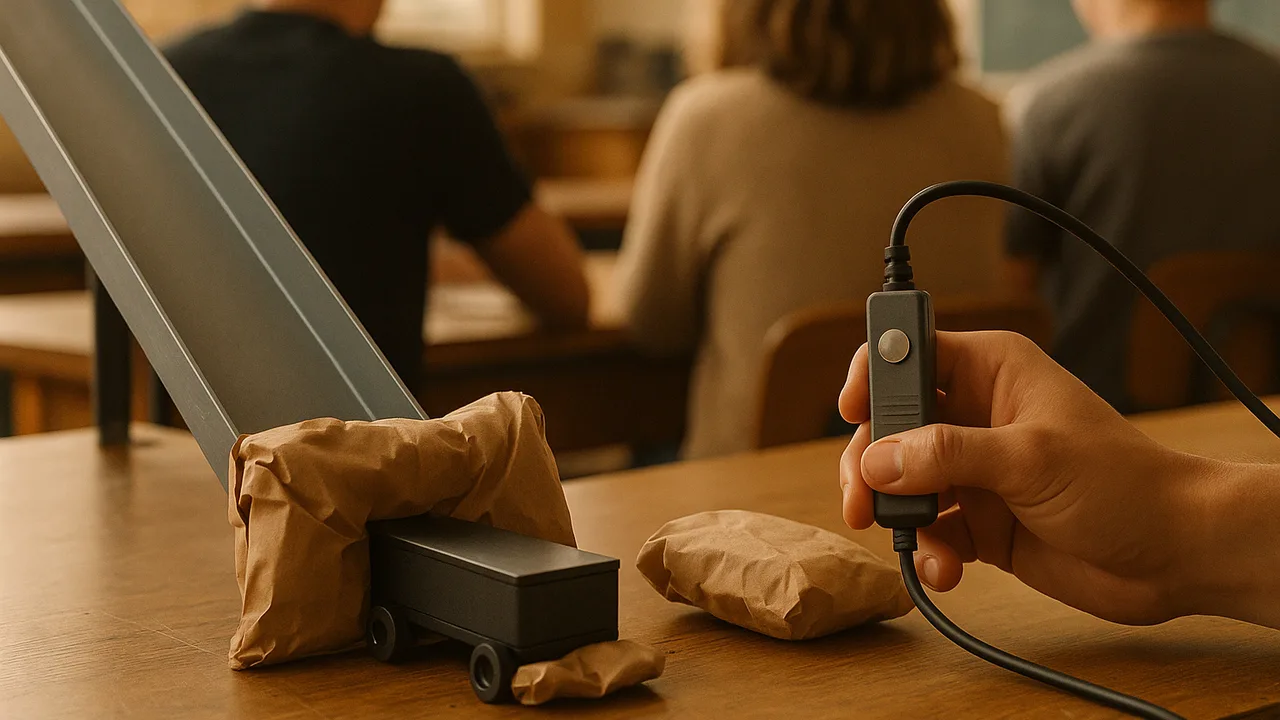
give and use evidence-based critique, test version 1 against every criterion, and use the results to build and test an improved version 2.
- I can systematically evaluate my device design by explaining my choices and comparing the design to the criteria and constraints.
- I can test my device to see how well it minimizes force during a collision and identify any unexpected effects or problems with its performance.
- I can use my test results to improve my device by increasing the impact time, reducing mass, or considering cost versus benefits.
Phase 4: Build
Warm-Up ~5 min
Do Now. Look at your version 1 data. Which run surprised you most? Write what happened and one possible cause.
Version 1 kept the egg safe but the cart bounced back 3 cm each run. What does the impulse model suggest?
Instruction ~10 min
Gallery critique. Each team sets out its cushion, matrix and version 1 data. Visitors leave three sticky notes per station: I like… (a strength tied to a criterion), I wonder… (a question about the data or the science), and What if… (one specific change). Feedback must point at evidence, not taste.
Test against the criteria. Before redesigning, check version 1 against every criterion and constraint, and look for unexpected effects: a rebound, the egg sliding into the cart frame, the cushion tearing off, or a stop that is long on run 1 but short on run 3 because the material stayed crushed.
Worked example 1: reading the evidence (sample data). Malik’s team measured version 1: mass 82 g, length 14 cm, stopping times 0.036 s, 0.032 s and 0.020 s, egg cracked on run 3. The falling times show the straws stayed crushed after each run. Average force rose from 1.2 ÷ 0.036 = 33 N to 1.2 ÷ 0.020 = 60 N. The failure is data: it tells them the cushion must recover or be replaceable.
Worked example 2: an evidence-based iteration. For version 2 they kept the 14 cm length but swapped the front straws for loops of card held by rubber bands, which spring back between runs, and added a thin foam pad behind them to stop the rebound. Version 2 (sample): 88 g, stopping times 0.060, 0.058 and 0.057 s, average force about 21 N, no cracks. Each change answered a specific failure, and they checked that mass stayed under 100 g.
Weighing cost and benefit. Every change costs something: mass, length, build time or materials. Ask: does this change buy enough stopping time to be worth its cost? Write the trade-off down.
| Criterion or constraint | Version 1 result | Met? | Change for version 2 | Version 2 result | Met? |
|---|---|---|---|---|---|
| Egg survives 3 runs | |||||
| Stopping time (s) | |||||
| Mass ≤ 100 g | |||||
| Length ≤ 15 cm | |||||
| Class materials, egg unwrapped | |||||
| Unexpected effects |
Guided Exercises ~15 min
Use your gallery notes and the version 1 table.
Independent Practice ~10 min
Build and test version 2.
Complete the version 1 / version 2 table. For each change, name the problem it solves, its cost (mass, length or time) and the measured benefit in stopping time and average force.
🔎 Mini case study: Sand-barrel crash cushions ~8 min
Rows of sand-filled plastic barrels have protected highway dividers and bridge supports for decades. They are often called inertial barriers, and they are linked to the engineer and former racing driver John Fitch, who worked on roadside safety in the 1960s. Each barrel holds a different amount of sand, usually lighter at the front and heavier toward the back.
The barrels do not work like springs. When a car strikes the first barrel, the barrel bursts and its sand is flung forward, gaining momentum that the car loses. Each barrel in turn takes another share, so the car slows in stages over several meters instead of stopping in a fraction of a second against concrete. Because the barrels shatter rather than spring back, the car does not rebound into traffic. Crews replace the broken barrels after an impact.
Think about it: Use momentum conservation and impulse to explain why the lightest barrels are placed at the front. What would a highway department need to weigh when choosing barrels versus a reusable folding cushion?
Closure ~5 min
Version 2 is tested. Next phase: Prove It, with the full design challenge and engineering report.
Exit ticket: what single change made the biggest difference between version 1 and version 2? Support it with stopping times and forces.
Teacher notes
Materials: sticky notes in three colors, version 1 cushions and data, ramp stations, material bins, balances, eggs in bags, slow-motion phones.
Setup: 15 minutes gallery, 10 minutes table and plan, 20 minutes build and test version 2, 5 minutes closure. Read the case study during set-up changes.
Case study note: keep it qualitative; do not quote barrel masses or crash statistics. The link to John Fitch is widely reported, but present the physics as the point.
Listen for: critique about looks; version 2 changes with no data reason; changes that break the mass or length limit.
Support / stretch: give a one-change-at-a-time rule. Stretch: plot stopping time against run number for both versions and comment on reliability.