4.05 Digital Signals and the Devices That Carry Them
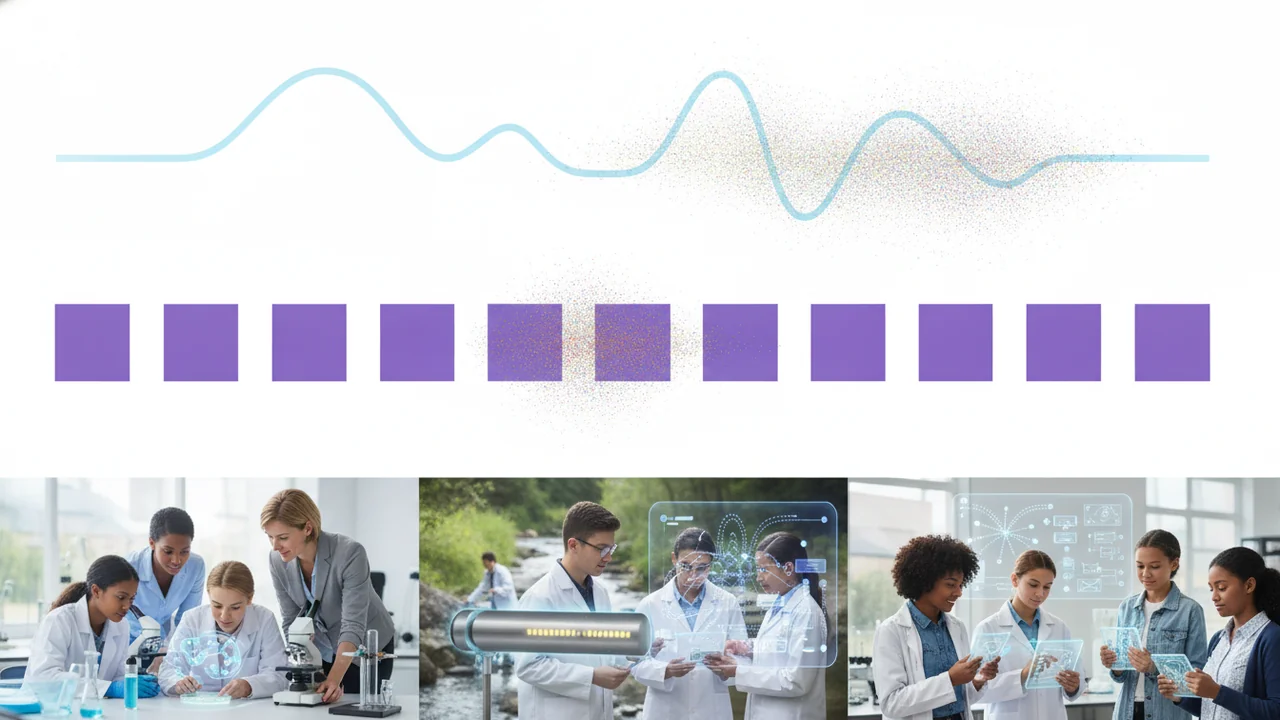
model how information is encoded as digital signals, evaluate the advantages and limitations of digital transmission and storage, and explain how devices use waves and their interactions with matter to carry information.
- I can provide examples of features of digital transmission and storage, such as reliable storage, easy transfer, rapid copying and sharing, easy deletion, risk of theft, and broad access.
- I can describe how the stability and importance of digital systems relate to the advantages and disadvantages of digital transmission and storage.
- I can discuss how answers to questions about digital transmission and storage connect to real-life situations, like emailing homework, copying music, researching online, or using social media.
- I can identify and explain the wave behavior or the absorption of photons and production of electrons that each device uses.
- I can qualitatively describe how basic physics principles were used in the design and development of each device to make it work.
Phase 3: Make Sense
Warm-Up ~5 min
Do Now. A photocopy of a photocopy of a photocopy gets blurry. A copy of a copy of a digital photo looks exactly like the original. Write one idea about why.
Which signal is digital?
Instruction ~10 min
From shaking to a message. An earthquake alert is information: an estimated location, magnitude and expected shaking. It travels from seismometers to processing centers and then to very many phones in seconds. How is information carried by waves, and why is almost all of it now sent as digital signals?
Analog and digital. An analog signal varies smoothly, like the changing voltage from a microphone that copies the shape of a sound wave. A digital signal represents information as a sequence of whole numbers, usually written in binary: 0s and 1s called bits. To digitize a sound, you sample it many times a second and record each sample as a number. With 8 bits you can represent 28 = 256 different levels; with 16 bits, 65,536.
Worked example 1: how much data? CD-quality audio samples 44,100 times per second, with 16 bits per sample, for two stereo channels: 44,100 × 16 × 2 = 1,411,200 bits per second. A 3-minute song (180 s) is 254,016,000 bits, or about 31.8 megabytes (8 bits = 1 byte). Streaming services compress this to much less by leaving out detail the ear barely notices.
Why digital wins for transmission. Every signal picks up noise, random disturbances, as it travels. An analog receiver cannot tell the noise from the signal, so every copy and every relay adds noise: think of a faint AM radio station hissing. A digital receiver only has to decide “is this a 0 or a 1?” A little noise does not change the decision, so the signal can be relayed and copied many times with no loss. Extra check bits let the receiver detect and even correct errors. Digital data can also be compressed, encrypted, stored for years and searched. Limitations: sampling cannot capture detail between samples; a weak digital signal fails suddenly (the video freezes) rather than getting gradually worse; data can be copied and spread without permission or stolen; and storage formats become obsolete. Evaluating digital transmission means weighing both lists.
Worked example 2: a parity check. Ava sends the 7 bits 1011001 and adds an even-parity bit: there are four 1s, already even, so the parity bit is 0, giving 10110010. If noise flips one bit, the receiver counts an odd number of 1s and knows something went wrong. It cannot tell which bit flipped, and two flips would slip through, so real systems use stronger codes.
Carrying bits on waves. Bits are sent by changing a property of a carrier wave: switching a light on and off, or shifting a radio wave’s amplitude, frequency or phase in patterns the receiver decodes. Higher-frequency carriers can switch faster, so they can carry more bits per second, which is one reason light in fibers carries so much data.
Devices that use wave interactions with matter.
- Fiber-optic cables. Light travels in a thin glass fiber, at about 2 × 10⁸ m/s (slower than in air, because glass slows light). Where light in the core meets the boundary with the surrounding cladding (glass in which light travels slightly faster) at a shallow angle, it is totally internally reflected and stays trapped in the fiber for kilometers. Much of the internet backbone, including links carrying seismic data to processing centers, runs on fiber.
- Seismometers. A mass on a spring stays nearly still while the ground moves under it; sensors turn the relative motion into a digital signal. This is wave interaction with matter at the start of the alert chain.
- Solar cells and camera sensors. Photons absorbed by silicon give electrons enough energy to move, producing a current: the photon model in action.
- Cell phones. Antennas convert electrical signals into radio waves and back, the electromagnetic induction of Unit 2 at very high frequency.
Reading: OpenStax Physics (high school), chapters 15 and 16 (CC BY 4.0).
Guided Exercises ~15 min
Work with a partner. Show your reasoning for each answer.
Independent Practice ~10 min
Write in your notebook.
Make a two-column table of advantages and disadvantages of digital transmission and storage, with at least three in each. Then connect two of them to real life: sending homework by email, and an earthquake alert reaching a phone.
Closure ~5 min
Bits ride on waves, and noise rarely flips them. Next class: one model of the whole alert chain, and ideas for our alert link.
Exit ticket: why would an emergency alert be sent digitally rather than as an analog signal? Give one advantage and one limitation.
Teacher notes
Materials: devices for the PhET sim, a clear glass of water and a flashlight for the no-device version, a length of optical fiber or a fiber-optic toy if available.
Setup: demonstrate a parity check live by flipping one bit on the board.
Listen for: “digital signals have no noise”; “light in a fiber bounces off a mirror coating”; confusing bits and bytes.
Support / stretch: give a binary-to-decimal table. Stretch: compute the data rate of a link that sends one bit every 0.25 s and how long a 16-bit code takes.