1.02 Project Brief and Wonder Board: The Safer Off-Ramp
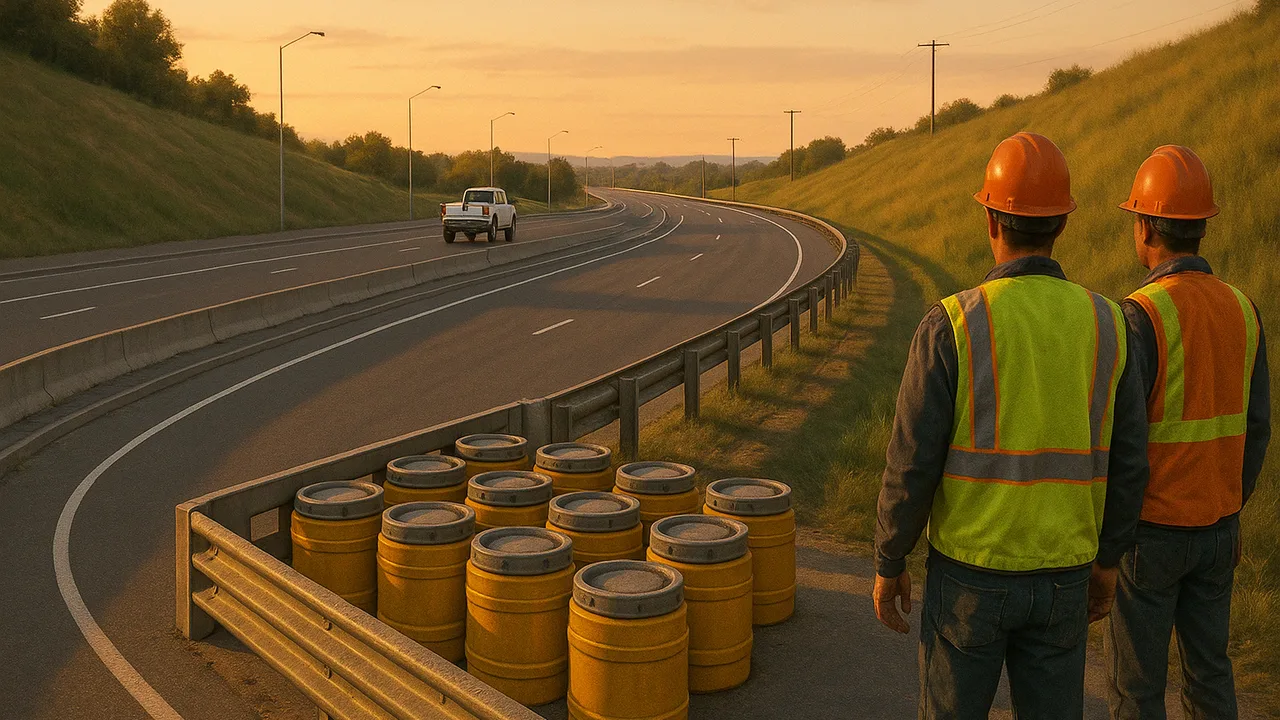
The Safer Off-Ramp: A Crash Cushion Design Challenge
How can we design a crash cushion that stretches a collision’s stopping time enough to protect the people inside a car?
The mystery: Rows of sand-filled barrels and folding crash cushions sit in front of concrete dividers where highway off-ramps split from the main lanes. A car that hits bare concrete stops almost instantly; a car that hits the cushion stops over a longer distance and time, and the people inside feel a much smaller force.
Questions we will figure out together in this unit:
- How much does stretching the stop reduce the force?
- Which cheap material stretches a stop the most for its mass?
- How can we measure a stop that lasts a fraction of a second?
- Does adding mass to the cushion help or hurt?
- Is anything conserved when the cart hits the wall?
- Why would a cushion that bounces back be worse than one that crumples?
define the crash-cushion problem as a system with boundaries, criteria and constraints, and organize the class questions into need-to-knows.
- I can describe and, when possible, quantify the criteria and constraints for my device, including tradeoffs such as cost, mass, maximum force, and safety requirements.
- I can define the boundaries and initial conditions of a system made up of two interacting objects.
Phase 1: Spark
Warm-Up ~5 min
Do Now. Reread your three questions from 1.01. Circle the one you most want answered, and write what kind of evidence would answer it.
Which is a constraint, not a criterion, for a highway crash cushion?
Instruction ~10 min
Meet the client. A regional highway department’s roadside-safety team has asked our class for help. They maintain crash cushions in front of concrete dividers at off-ramps, and they want young engineers to show, with tests and calculations, what makes a cushion protect the people in a car. Our job is to design, test and explain a scaled crash cushion, then report to the team.
Driving question. How can we design a crash cushion that stretches a collision’s stopping time enough to protect the people inside a car?
The scale model. Real crash tests use full-size cars and cost a great deal. We use a lab cart rolling down a ramp into a wall, carrying a raw egg in a sealed bag. The egg stands in for a passenger: fragile, and unprotected unless the cushion works.
Our class criteria and constraints. Criteria: (1) the egg survives 3 runs from the standard ramp height without cracking; (2) the cart’s stopping time, measured from slow-motion video, is as long as possible. Constraints: (3) cushion mass at most 100 g; (4) it extends no more than 15 cm in front of the cart; (5) only class materials (paper, cardboard, straws, tape, rubber bands, foam, bubble wrap); (6) the egg itself may not be wrapped, so the cushion does the work.
Worked example 1: defining the system. A system is the set of objects we choose to analyze. Jamal drew the cart-egg-cushion system inside a dashed boundary, with the ramp and wall outside it. He listed the initial conditions: the cart’s mass (0.80 kg, sample), its speed at the bottom of the ramp (1.5 m/s, sample) and the wall at rest. Drawing the boundary tells us which forces count as outside forces: the wall’s push on the cushion is one.
Worked example 2: criteria and constraints with numbers. Priya wrote “the cushion should be light.” She revised it: “the cushion may add at most 100 g, because extra mass adds momentum and makes the stop harder.” A good constraint is measurable and has a reason.
Wonder Board and need-to-knows. Sort the class questions into three columns: What we know, What we need to know, and How we will find out (lab, data, simulation or model). The need-to-knows become our investigation plan for Phase 2.
Teams and roles. Teams of four rotate weekly through Project Manager (keeps time and the criteria list), Test Engineer (runs trials safely), Data Analyst (tables, graphs and calculations) and Communications Lead (notebook, photos and the team’s report to the client).
Guided Exercises ~15 min
Work in your new team. Agree on each answer before you move on.
Independent Practice ~10 min
Write the project page of your Engineering Notebook.
Draw the cart-egg-cushion system with its boundary, label the initial conditions, and list every outside force that acts during the collision.
Rank the six criteria and constraints from most to least important to the client, and give a reason for your top two.
Closure ~5 min
We have a client, a driving question and need-to-knows. Next phase, we investigate: first, how force changes a cart’s motion.
Exit ticket: write the one need-to-know your team most needs answered before you can design, and say how you will find out.
How confident are you that you can define a design problem with a system boundary, criteria and constraints?
Teacher notes
Materials: the 1.01 question board, sticky notes, chart paper with three columns (Know / Need to know / How we will find out), role cards, a sample cart and a bagged egg to show the scale model.
Setup: post the six criteria and constraints where every team can see them all unit; 1.07 to 1.09 test against these exact values. If your ramp differs, fix the standard ramp height now and record it on the poster.
Listen for: criteria with no number; teams that treat the wall as part of the system; “heavier cushions are always safer.”
Support / stretch: give a sentence frame (“The cushion must ___ because ___”). Stretch: add a cost constraint with a sample price list and justify the limit.