2.09 Performance Task: From Wind to Wire
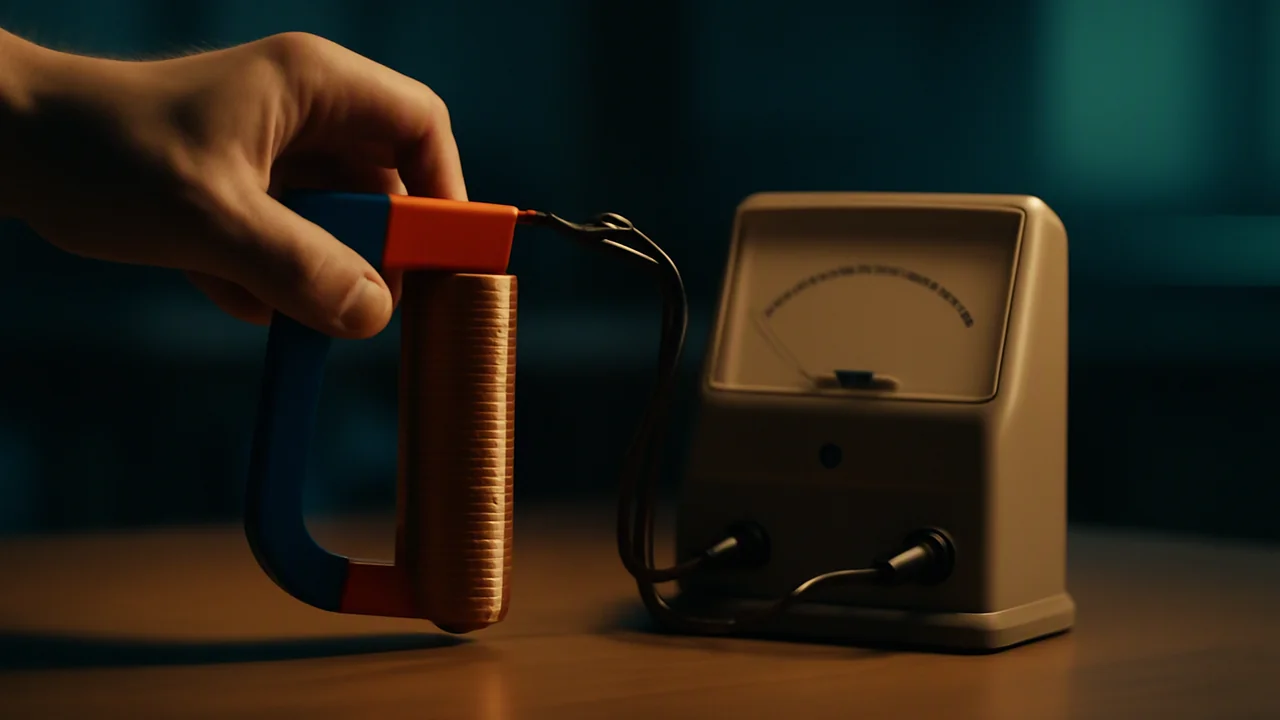
explain with a field model and lab evidence how a wind turbine produces electric current, trace the energy transfers, and compare magnetic, electric and gravitational forces.
- I can use my model to support the claim that the change in energy stored in the field matches the change in energy of the objects.
- I can explain how an electric current produces a magnetic field and how a changing magnetic field can produce an electric current.
- I can use the gravitational or electrostatic force formulas to calculate and predict the force between two objects.
Phase 5: Prove It
Warm-Up ~5 min
Do Now. Explain how a turbine makes current to an imaginary 10-year-old visitor in three sentences, without the words field or induction. Then underline the idea that needs one of those words.
A generator produces current because
Instruction ~10 min
The context. Wind power has grown from a few early wind farms in the late 20th century to a common sight on ridges and plains; at many older sites, small early turbines have been replaced by fewer, larger ones. Most people drive past without knowing how a spinning blade turns into the current in their wall socket. Your job, for the co-op’s visitor center, is to explain it clearly and correctly for an audience of curious adults and students, using the models you built in this unit and your working generator.
What the explainer must do.
- Show the evidence for induction (HS-PS2-5). Describe your electromagnet and moving-magnet results: a current produces a magnetic field (compass, clip counts), and a changing magnetic field produces a current (meter readings, and your generator’s voltage at different speeds). Use at least two numbers from your data.
- Model the generator with fields (HS-PS3-5). Draw and label a diagram: blades, shaft, magnet, coils, and field lines. Explain why the field through the coils must keep changing, why the induced current pushes back against the rotation, and therefore why the wind must keep doing work. Trace the energy from moving air to the grid, naming where energy leaves the useful path (thermal energy in coils and gears, sound).
- Compare the forces (HS-PS2-4). Include one inverse-square calculation, for example how the gravitational force on a satellite changes with distance, or how the electric force between two charges changes, and explain in a paragraph why electric and magnetic forces dominate inside the generator while gravity dominates in orbits.
Reading and sources. Summarize accurately how one source explains generators, such as OpenStax Physics (high school), chapter 20, or a U.S. Department of Energy wind energy page, and say whether its explanation matches your model. Do not state figures about any real wind farm (turbine counts, output) unless you cite a source for them.
Quality bar. A strong explainer never says the magnet “makes electricity out of nothing”; it follows the energy. It uses one accurate diagram rather than several vague ones. It defines field, induction and current in plain language before using them.
Worked example: one energy chain (sample). “Moving air pushes the blades (kinetic energy of air → kinetic energy of the rotor). The rotor spins magnets past coils; the changing field induces a current, and the current’s own field pushes back, so the rotor’s energy passes through the field into electrical energy. Some energy warms the coils and gears and makes sound.”
Stages. Plan, draft, peer review (your partner reads it as a non-scientist and marks every sentence they cannot follow), revise, and present for four minutes beside your working generator, answering one question about your model.
Guided Exercises ~15 min
Plan your explainer with your partner.
Independent Practice ~10 min
Write the explainer.
Write the field-model section: your labeled generator diagram in words, why the field must keep changing, the push-back of the induced current, and the full energy chain with losses.
From Wind to Wire explainer (900–1,200 words) + four-minute presentation with the working generator
Task: For the electric co-op’s visitor center, explain how a wind turbine produces electric current for a public audience. Use your lab evidence that currents make magnetic fields and changing fields make currents; draw and explain a labeled field model of the generator with the energy transfers from wind to grid; include one inverse-square calculation comparing forces; and demonstrate your working model generator against the class criteria. Cite at least two sources.
Submission workflow
- Stage 1 — Plan. Diagram sketch, the lab data you will cite, your energy-flow chain and your inverse-square example.
- Stage 2 — Peer-reviewed draft. A partner reads as a non-scientist and checks every energy claim for a destination; submit their notes and your revision plan.
- Stage 3 — Final explainer. 900–1,200 words with the labeled diagram, lab evidence, calculation and cited sources.
- Stage 4 — Presentation and defense. Four minutes, live or recorded, beside the working generator, answering one question about your model.
How it is scored
| Criterion | What proficient looks like |
|---|---|
| Field model and energy (HS-PS3-5) | Correct field diagram; traces energy from wind to grid, including losses and the push-back of the induced current. |
| Evidence for induction (HS-PS2-5) | Accurately uses lab and generator data for both current-to-field and changing-field-to-current. |
| Forces compared (HS-PS2-4) | Correct inverse-square calculation and a sound comparison of force strengths and scales. |
| Sources and communication | Summarizes a source accurately and compares it with the model; clear for a public audience; answers a question with evidence. |
Closure ~5 min
You explained a power source to the public with your own evidence. Next: the unit checkpoint.
Exit ticket: which Wonder Board question can you now answer? Write the question and your answer.
Teacher notes
Timing: Poly gave this task three sessions. Here, one 50-minute period covers planning and peer review; drafting and presentations continue as homework and in a later period.
Materials: working generators from 2.08, multimeters, the 2.03 data, devices for sources, rubric copies.
Setup: invite a staff member or family volunteer to play the co-op’s visitor-center manager.
Listen for: “the magnet makes electricity”; energy claims with no destination; figures about real wind farms with no source.
Support / stretch: give a section outline with sentence starters. Stretch: add a paragraph on how a gearbox changes rotation speed and why that matters for induction.