3.03 Mixing Hot and Cold Water
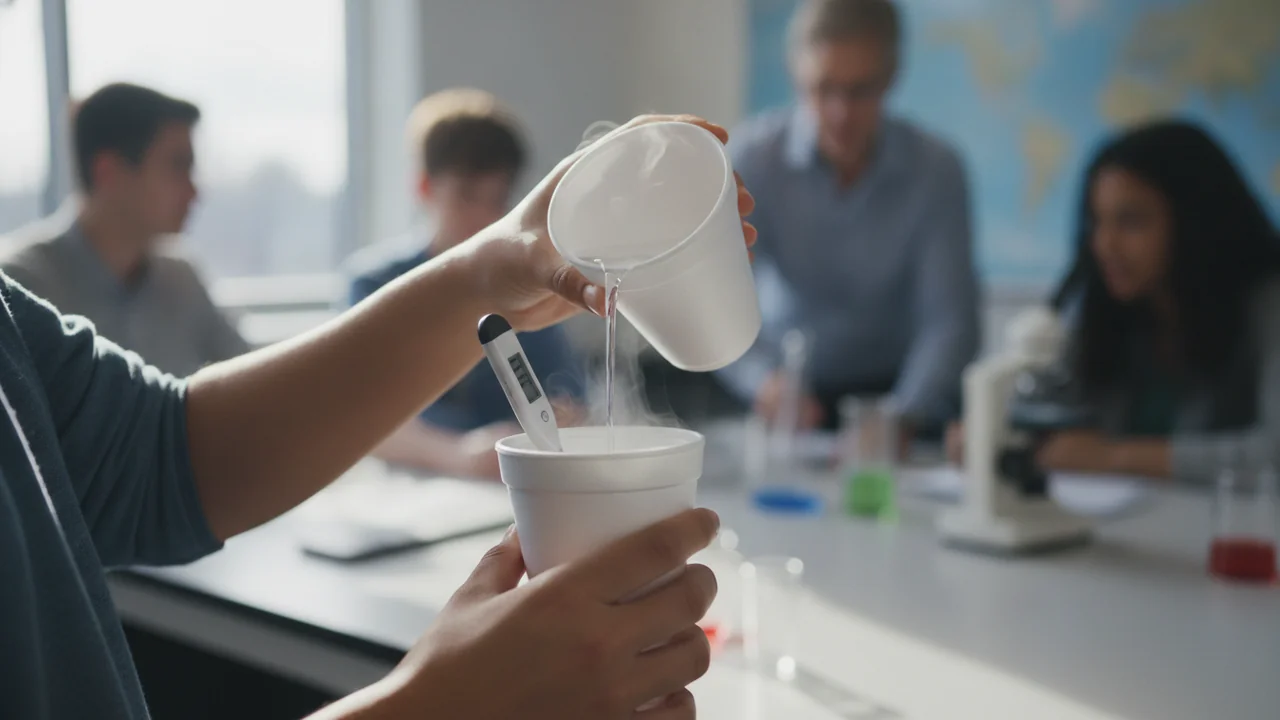
predict and measure the final temperature when hot and cold water are mixed, calculate the thermal energy transferred, and explain why energy flows from hot to cold until temperatures even out.
- I can explain that when two objects at different temperatures are combined in a closed system, thermal energy transfers between them until their energy is more evenly distributed, as described by the second law of thermodynamics.
- I can plan an investigation to measure how the temperature of a hot object decreases and the temperature of a cold object increases when they are combined in a closed system.
- I can use temperature data and heat capacity values from scientific sources to show that the thermal energy lost by the hot object equals the energy gained by the cold object, resulting in a more uniform energy distribution.
- I can collect and record the data needed to calculate the change in thermal energy for each component in the system.
Phase 2: Investigate
Warm-Up ~5 min
Do Now. A bathtub of warm water and a mug of very hot tea: which is hotter, and which holds more thermal energy? Write your answer and one reason.
You mix 200 g of water at 40 °C with 100 g at 10 °C. The final temperature will be
Instruction ~10 min
The investigation question. When you combine two things at different temperatures, what happens to the energy? HS-PS3-4 asks for evidence that thermal energy transfers from the hotter to the colder component until the temperature is more uniform, the second law of thermodynamics in its everyday form.
Temperature and thermal energy are different. Temperature measures the average kinetic energy of the particles. Thermal energy is the total. A bathtub of warm water holds far more thermal energy than a cup of boiling water, even though the cup is hotter. When hot and cold water mix, fast particles collide with slow ones and share energy, until the average is the same everywhere.
Quantifying the transfer. The energy needed to change the temperature of a mass of water is Q = mcΔT, where m is the mass in grams, ΔT the temperature change in °C, and c the specific heat: for water, 4.18 J/(g·°C). It takes 4.18 J to warm 1 g of water by 1 °C. Water’s specific heat is unusually high, because of the hydrogen bonds between its molecules, which is why large lakes and the ocean keep nearby coastal towns’ temperatures mild.
Predicting the final temperature. If no energy escapes, the energy lost by the hot water equals the energy gained by the cold water. For two samples of water, c cancels and the final temperature is a mass-weighted average: Tfinal = (m1T1 + m2T2) ÷ (m1 + m2).
Worked example 1. 100 g at 45 °C with 100 g at 15 °C gives (4,500 + 1,500) ÷ 200 = 30.0 °C, exactly halfway. Energy check: the hot water loses 100 × 4.18 × 15 = 6,270 J; the cold water gains 100 × 4.18 × 15 = 6,270 J. Balanced.
Worked example 2. 150 g at 45 °C with 50 g at 10 °C gives (6,750 + 500) ÷ 200 = 36.25 °C, closer to the hot water because there is more of it.
Why real results fall short. Your measured final temperature will usually be a little below the prediction, for example 29 °C instead of 30 °C. Some energy goes into warming the cup and thermometer, and some escapes to the room air. That is not a failure of conservation; it means the system you calculated for (just the water) was not the whole system. Foam cups with lids make a nearly closed system and reduce the loss. Pour quickly, stir gently, and read the highest steady temperature.
The one-way direction. You will never see mixed 30 °C water spontaneously separate into 45 °C and 15 °C layers, even though that would not break conservation of energy. Energy spreads out; it does not spontaneously concentrate. That one-way direction is why a cold drink warms up on the table, and why engineers must supply energy (a refrigerator’s compressor) to move thermal energy from cold to hot.
Lab procedure: Thermal Energy Transfer When Hot and Cold Water Mix. Question: when hot and cold water are mixed, is the thermal energy lost by the hot water equal to the energy gained by the cold water, and what final temperature results? Materials: three nested pairs of foam cups with lids (a hole for the thermometer); two thermometers or digital probes reading to 0.1–0.5 °C; a balance reading to 1 g (or a 100 mL graduated cylinder, taking 1 mL of water as 1 g); hot tap water (no hotter than about 45 °C) and cold tap or chilled water; a stirring stick, paper towels and splash goggles for every student.
- Measure 100 g of cold water into one cup and 100 g of hot water into another. Record both temperatures.
- Predict the final temperature with the mass-weighted average and record the prediction.
- Pour the hot water into the cold, put on the lid, stir gently and record the highest steady temperature.
- Repeat with 150 g hot and 50 g cold water, then with 50 g hot and 150 g cold water, predicting first each time.
- For each mixture calculate the energy lost by the hot water and gained by the cold water with Q = mcΔT (c = 4.18 J/g·°C).
- Calculate the difference between predicted and measured final temperatures.
| Mixture | Hot mass (g) and temp (°C) | Cold mass (g) and temp (°C) | Predicted final (°C) | Measured final (°C) | Energy lost by hot (J) | Energy gained by cold (J) |
|---|---|---|---|---|---|---|
| 1: 100 + 100 | ||||||
| 2: 150 hot + 50 cold | ||||||
| 3: 50 hot + 150 cold |
No lab space? Use the teacher’s recorded demonstration with on-screen thermometers and the provided class data set, and complete the same predictions and energy calculations.
Reading: OpenStax Physics (high school), chapter 11 (CC BY 4.0).
Guided Exercises ~15 min
Use your data table. Check each calculation with a teammate.
Independent Practice ~10 min
Finish the lab analysis in your notebook.
Explain why mixture 2 ended closer to the hot temperature than mixture 3 did. Then name two sources of error and say whether each makes the measured final temperature higher or lower than predicted.
Use the idea that energy spreads out as thermal energy to explain why a pumped-storage plant, or a solar oven, cannot deliver all the energy put into it as useful energy.
Closure ~5 min
Thermal energy flows from hot to cold until temperatures even out, and the total is conserved. Next class: where does a bouncing ball’s energy go?
Exit ticket: your energy lost by the hot water and gained by the cold water were probably not equal. Give the difference in joules and say where it went.
Teacher notes
Timing: Poly ran this lab over two 50-minute periods. Day 1: set-up and three mixtures. Day 2: energy calculations, the CER and the “why not exactly equal?” discussion.
Materials (per team): six foam cups with two lids, two thermometers, balance or graduated cylinder, hot and cold tap water, stirrer, paper towels, goggles. Check the hot tap with a thermometer before class.
Listen for: “cold flows into the hot water”; treating temperature and thermal energy as the same; averaging temperatures without weighting by mass.
Support / stretch: give a filled worked row for mixture 1. Stretch: add 50 g of metal washers at room temperature to the cup and use a specific heat of about 0.45 J/(g·°C) for steel to account for the cup’s contents.