3.09 Performance Task: Energy Device Design Report
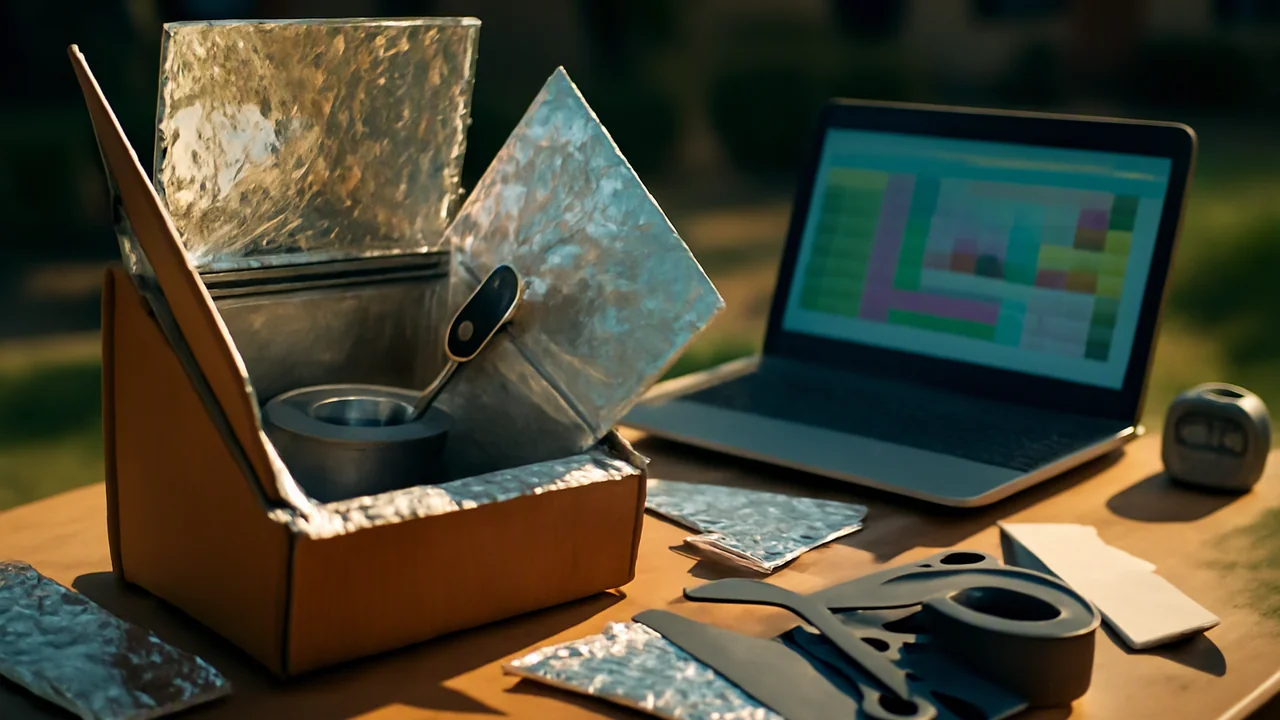
refine an energy-conversion device through tested iterations, use a spreadsheet model to predict the effect of changes, and evaluate the final design against prioritized criteria and constraints.
- I can systematically and quantitatively evaluate how well my device meets the criteria and constraints.
- I can use my test results to improve my device’s energy conversion efficiency, considering the criteria, constraints, and any tradeoffs from my changes.
- I can use a computational model to predict the maximum possible change in the energy of one component in a system for a given set of energy flows.
Phase 5: Prove It
Warm-Up ~5 min
Do Now. In one sentence each, state what your oven does, the number that best shows it works, and the number that shows its biggest limitation.
A spreadsheet model predicts that a second reflector raises the water's temperature rise from 18 °C to 24 °C, and the test gives 21 °C. What is the best conclusion?
Instruction ~10 min
The challenge. Take your solar oven from version 2 and make it the best you can, then write the report an engineering team would write for the client’s outage-readiness workshops. (With your teacher’s approval, a team may instead refine a different energy-conversion device built from class materials, such as a small wind turbine that lifts a load or a rubber-band-powered car, as long as input and output energy can be measured.)
Our class criteria and constraints. Criteria: (1) 200 g of water in a dark container rises at least 20 °C in 30 minutes of full sun (our class target); (2) efficiency at least 10%, and higher is better; (3) a family can build it in under 30 minutes from the listed materials. Constraints: (4) one pizza box or similar cardboard box, at most 1 m2 of foil, one sheet of clear plastic film, black paper, tape and newspaper; (5) no glass mirrors, and one person can carry it; (6) the container is handled only with an oven mitt.
1. Criteria and constraints (HS-ETS1-1). Start by stating them precisely, with numbers. Connect your device to a real need: in places without reliable electricity or clean fuel, solar cookers and water heaters can reduce smoke from burning wood indoors, and during outages they heat water with no fuel at all. Name one societal criterion (such as cost, or ease of building from household materials) alongside the technical ones.
2. Model before you build (HS-ETS1-4, HS-PS3-1). Build a spreadsheet model of your oven. Inputs: opening area, reflector boost (a multiplier, for example 1.3 if the flap adds 30% more light), sunlight intensity, time, the fraction of light absorbed, and the fraction lost through the walls. Outputs: energy entering, energy reaching the water, predicted temperature rise (ΔT = Q ÷ (mc)). Worked example (illustrative): 0.090 m2 × 1,000 W/m2 × 1.3 × 1,800 s = 210,600 J in; with 60% absorbed and 80% of that lost, the water gets 210,600 × 0.60 × 0.20 = 25,272 J, a predicted rise of 25,272 ÷ 836 = 30 °C. This is the maximum the model allows for those flows. Use the model to compare at least two proposed changes before building either. Afterward, compare the prediction with your test: a model is useful if it predicts the right direction and roughly the right size of the change, and you should state the assumptions that limit it.
3. Refine and test (HS-PS3-3). Build the final version with the change your model favored and test it under the same conditions, with a control. Report temperatures, energy gained and efficiency for every iteration. Change one feature per iteration where possible, so you know what caused the difference.
4. Account for the energy (HS-PS3-1, HS-PS3-2). Draw the energy-flow diagram for the final design with numbers: energy in, energy to the water, and your estimate of each loss, adding to the total input. If they do not add up, say which loss you could not measure.
5. Evaluate (HS-ETS1-3). Rank your criteria and constraints, score the final design, and state the trade-offs (a larger reflector collects more light but catches the wind; more insulation keeps heat but takes longer to build). Compare your results with another team’s and with one published source on solar cookers, noting where findings agree and why they might differ.
Stages. Plan, draft report, peer review, revise, and present as a team, each member answering a question.
Guided Exercises ~15 min
Prepare your report and presentation with your team.
Independent Practice ~10 min
Write the design report.
Write the model section: show your spreadsheet's inputs and formulas, its prediction for two proposed changes, the test result for the change you built, and two assumptions that limit the model.
Energy Device Design Report (900–1,300 words) + four-minute team presentation
Task: Refine your energy-conversion device through at least two tested iterations. State criteria (including one societal criterion) and constraints; build a spreadsheet model and use it to compare proposed changes before building; report temperatures (or other measurements), energy and efficiency for each iteration; draw a numbered energy-flow diagram; and evaluate the final design against ranked criteria, comparing with another team and a published source. Present your recommendation to the client’s emergency-preparedness program.
Submission workflow
- Stage 1 — Plan. Criteria and constraints, the spreadsheet model’s inputs and outputs, and the change you will test first.
- Stage 2 — Peer-reviewed draft. Another team checks your model’s formulas, your energy calculations and your fair-test design; submit their notes and your revision plan.
- Stage 3 — Final report. 900–1,300 words with data from every iteration, the model and its predictions, the energy-flow diagram and the evaluation.
- Stage 4 — Presentation and defense. Four minutes as a team, live or recorded, with a demonstration; each member answers one question.
How it is scored
| Criterion | What proficient looks like |
|---|---|
| Design and refinement (HS-PS3-3) | Two tested iterations with controls; changes justified by the energy model and measured; efficiency improved or the reason it did not is explained. |
| Criteria, constraints and evaluation (HS-ETS1-1, HS-ETS1-3) | Quantitative criteria including a societal one; ranked evaluation with honest trade-offs; comparison with another team and a published source. |
| Model (HS-ETS1-4, HS-PS3-1) | Working spreadsheet model used to compare changes before building; prediction compared with results; assumptions and limits stated. |
| Energy accounting and communication (HS-PS3-2) | Numbered energy-flow diagram showing every store and transfer; clear report and a presentation that answers questions with evidence. |
Closure ~5 min
You designed, modeled and defended an energy device with real physics. Next: the unit checkpoint.
Exit ticket: which Wonder Board question can you now answer? Write the question and your answer with one number.
Teacher notes
Timing: Poly gave this task four sessions. Here, one 50-minute period runs the final test and launches the report and model; drafting, peer review and presentations continue as homework and in a later period.
Materials: each team’s oven, thermometers, timers, oven mitts, devices with a spreadsheet, a model template, rubric copies.
Setup: invite a staff member or family volunteer to role-play the emergency-preparedness program for presentations.
Listen for: reports that skip failed tests; models with no stated assumptions; efficiency claims with no control; “the oven created heat.”
Support / stretch: give a report outline and a spreadsheet template with the formulas in place. Stretch: add a heat-loss term that grows with the temperature difference and see whether the model predicts the leveling-off.