2.02 Project Brief and Wonder Board: From Wind to Wire
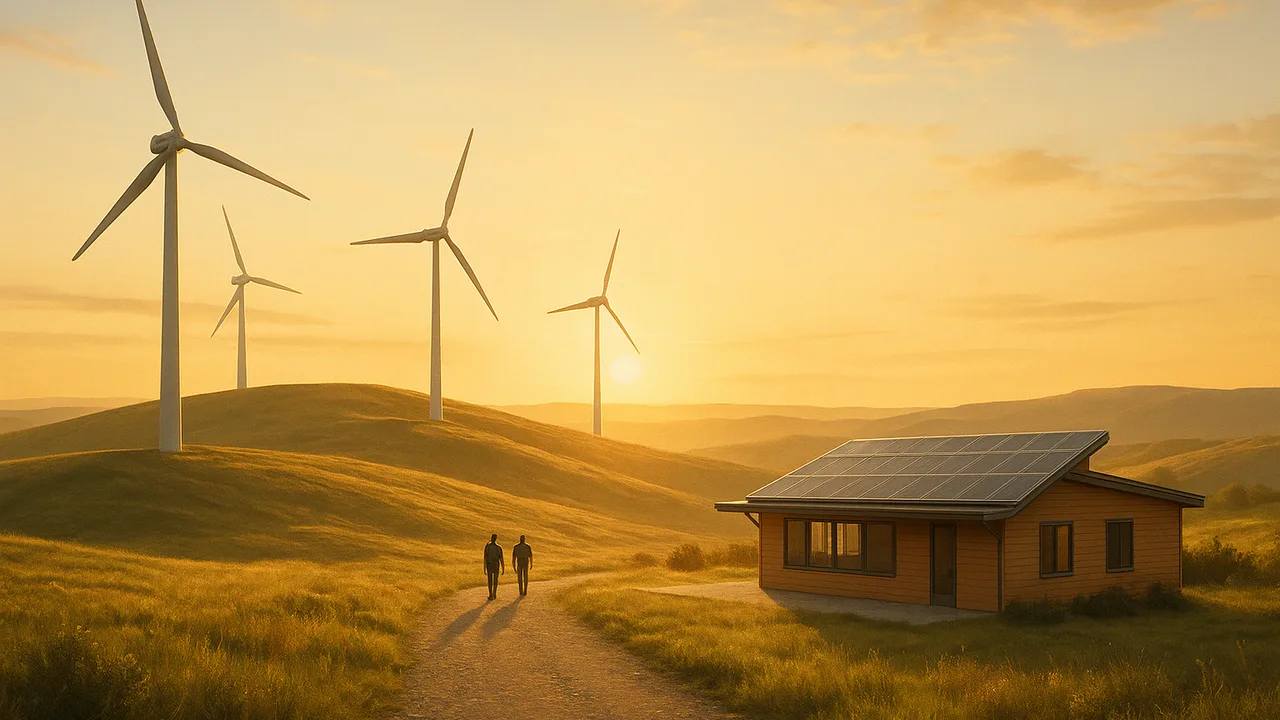
From Wind to Wire: A Visitor-Center Generator and Explainer
How can we show visitors, with a working model and a field model, how a spinning turbine turns moving air into electric current?
The mystery: A satellite circles Earth for years with its engine off, and on a windy ridge, turbine blades spin magnets past coils of wire and push current into power lines without anything touching. Gravity, electricity and magnetism all act across empty space.
Questions we will figure out together in this unit:
- How fast must the magnet move to make 0.50 V?
- Do more coils always make more voltage?
- Why does a generator get harder to turn when it lights a bulb?
- Can the same device be a motor and a generator?
- Where is energy stored when two magnets are pulled apart?
- How can we explain fields to a visitor who has never heard the word?
define the visitor-center generator project as a system with criteria and constraints, and turn the class questions into need-to-knows.
- I can clearly define the two objects in a system that interact through gravitational or electrostatic forces.
- I can explain how an electric current produces a magnetic field and how a changing magnetic field can produce an electric current.
Phase 1: Spark
Warm-Up ~5 min
Do Now. Bring a magnet near a paper clip, then near a piece of aluminum foil. Write what happens and one question it raises.
Which pair interacts mainly through an electric or magnetic force rather than gravity?
Instruction ~10 min
Meet the client. A rural electric cooperative, a member-owned utility, is opening a visitor center at its wind farm on a ridge. School groups and families will visit. The co-op has asked our class for two things: a working model generator that visitors can crank or blow on to make current, and a short public explainer of how moving air becomes electricity on the grid.
Driving question. How can we show visitors, with a working model and a field model, how a spinning turbine turns moving air into electric current?
Our class criteria and constraints. Criteria: (1) the model generator is turned by a hand crank or a desk fan; (2) it produces at least 0.50 V peak on a multimeter (our class target); (3) a visitor can see the magnet, the coil and the meter. Constraints: (4) at most 30 m of magnet wire and only the kit’s magnets; (5) it fits inside a 30 cm cube; (6) no exposed sharp wire ends and no loose magnets.
Worked example 1: two-object systems. Each interaction we study has two objects. Satellite and Earth: gravitational, always attractive. Two charged balloons: electric, attractive or repulsive. Magnet and coil: magnetic, and when the magnet moves, a current appears in the coil. Mei drew each pair inside a dashed boundary and labeled the kind of interaction. That habit will make every model this unit clearer.
Worked example 2: a first look at the big idea. In 1820 a compass needle was seen to swing near a wire carrying current: a current makes a magnetic field. About ten years later, moving a magnet near a coil was shown to make a current: a changing magnetic field makes a current. Our generator depends on the second idea; electromagnets and motors depend on the first. Phase 2 tests both.
Wonder Board and need-to-knows. Sort the class questions into What we know, What we need to know and How we will find out (lab, simulation, calculation or source).
Teams and roles. Teams of four rotate weekly: Project Manager (time, criteria), Lab Engineer (circuits and safety), Data Analyst (tables, graphs, calculations) and Communications Lead (notebook, diagrams, explainer).
Guided Exercises ~15 min
Work in your new team.
Independent Practice ~10 min
Write the project page of your Field Notebook.
Draw three two-object systems from this unit (gravitational, electric, magnetic). For each, label the objects, the interaction and whether it attracts, repels or can do both.
Rank the six generator criteria and constraints by importance to the co-op's visitors, and explain your top choice.
Closure ~5 min
We have our client and our need-to-knows. Next phase: build electromagnets and make current with a moving magnet.
Exit ticket: name the two objects in the system inside a generator and the kind of interaction between them.
How confident are you that you can define two-object systems and a design problem with criteria and constraints?
Teacher notes
Materials: the 2.01 question board, magnets, paper clips, foil, role cards, a sample hand-crank generator or flashlight to show the goal.
Setup: post the generator criteria; 2.07 to 2.09 test against these exact values. The 0.50 V peak is a class target; adjust it once after a test with your kit’s magnets and keep it fixed afterwards.
Listen for: “magnets contain electricity”; treating a still magnet as enough to make current.
Support / stretch: give a two-object system template. Stretch: add a cost constraint for magnets and wire and justify it.