4.03 Waves on a Spring
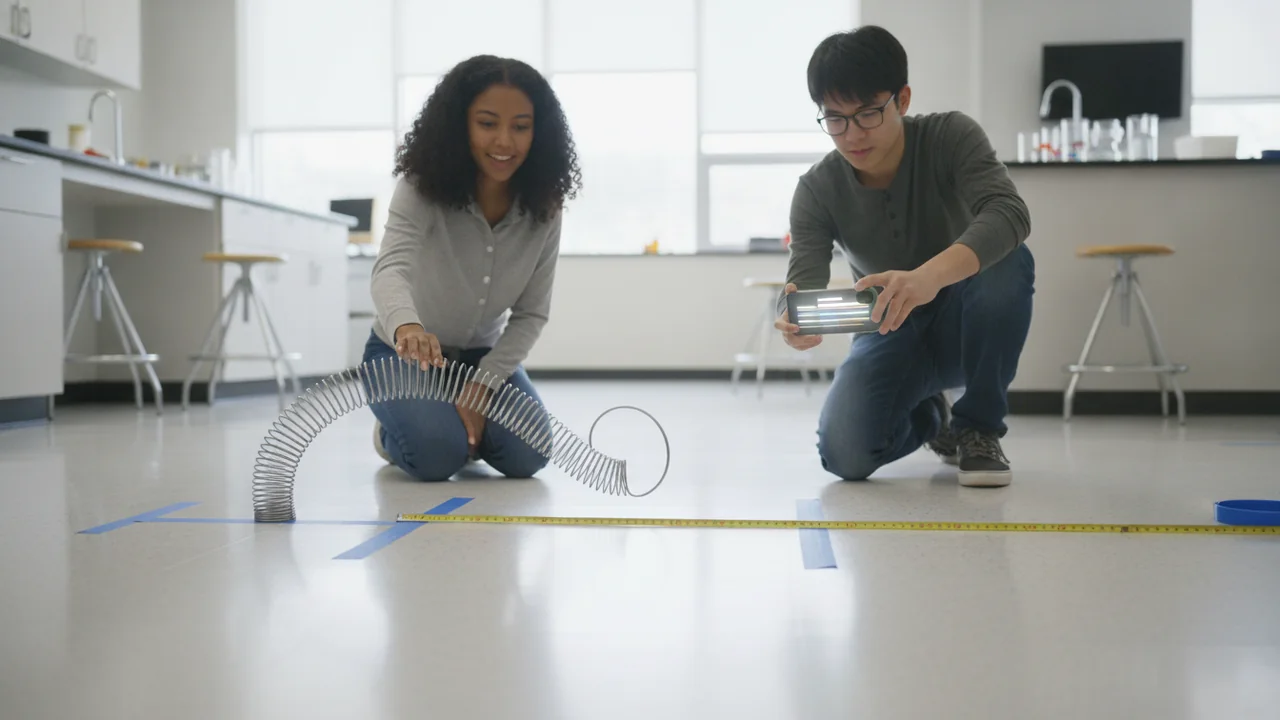
measure the speed of a pulse on a stretched spring, measure the frequency and wavelength of standing waves, and test whether v = fλ holds and how the medium affects speed.
- I can use data to show that the speed of a wave changes when it travels through different media.
- I can predict how the wavelength of a wave will change when it moves from one medium to another, using the equation v = fλ.
- I can explain that changing the medium causes a change in wavelength, while the frequency stays the same.
- I can use mathematical relationships to distinguish between cause and correlation when supporting claims about waves.
Phase 2: Investigate
Warm-Up ~5 min
Do Now. You flick one end of a stretched rope gently, then hard. Predict whether the bigger pulse reaches the far end sooner, later or at the same time, and give a reason.
If you shake a stretched spring with a bigger amplitude, the pulse will travel
Instruction ~10 min
The investigation question. Does v = fλ really describe waves you can make? And what sets a wave’s speed: how hard you shake, or the medium? A long spring toy stretched along the floor lets you see waves travel and measure them with a meter stick and a phone.
Two kinds of wave on one spring. Flick one end sideways and a transverse pulse travels along, the coils moving at right angles to the direction of travel, like an S wave. Push one end forward sharply and a longitudinal (compressional) pulse travels, the coils bunching and spreading along the direction of travel, like a P wave or sound. On most springs the longitudinal pulse is easier to see as a moving bunch of coils.
Method 1: pulse speed. Stretch the spring to a measured length, for example 5.0 m, on a smooth floor. Send a single transverse pulse and time how long it takes to travel to the far end and back (10.0 m in total), filming with a phone to reduce reaction-time error. Speed = distance ÷ time. Worked example 1: 10.0 m in 1.70 s gives 5.9 m/s. Repeat with a larger flick (bigger amplitude): the speed stays about the same. Then stretch the spring farther (more tension) and repeat: the speed increases. The medium, not the amplitude, sets the speed.
Method 2: standing waves. With the far end held still, shake your end steadily from side to side. At certain frequencies the reflected wave and the incoming wave combine into a standing wave with points that do not move (nodes) and points that swing the most (antinodes). With one loop, the spring’s length is half a wavelength; with two loops, one wavelength. Count the shakes in 10 seconds to get the frequency. Worked example 2: two loops on a 5.0 m spring (λ = 5.0 m) at 12 shakes in 10 s (f = 1.2 Hz) gives v = 1.2 × 5.0 = 6.0 m/s, agreeing with method 1 to within about 2%.
Comparing methods. Two independent methods that agree are much stronger evidence than one. The percent difference is |v1 − v2| ÷ average × 100%: here |5.9 − 6.0| ÷ 5.95 × 100% ≈ 1.7%. If yours differ by more than about 10%, look for a cause: a miscounted loop, uneven tension, or timing error.
Same frequency, new medium. When a wave passes into a new medium, the source keeps shaking at the same rate, so the frequency stays the same; the speed changes, so the wavelength must change: λ = v ÷ f. Tie a light spring to a heavier one and send a steady wave across the joint: the waves bunch closer in the slower spring.
Cause or correlation? If you only noticed that faster waves on different springs also had longer wavelengths, you could not tell what causes what. Holding the frequency fixed and changing only the tension shows that the medium causes the speed change, and the equation then explains the longer wavelength.
Connecting to the phenomenon. The same spring carries longitudinal and transverse waves at different speeds, and in rock P waves always outrun S waves. The difference in speed is exactly what gives an early-warning system its warning time. Seismologists also use it in reverse: the time gap between P and S arrivals at a station tells them how far away the earthquake was.
Lab procedure: Measuring Wave Speed Two Ways on a Stretched Spring. Materials: a long metal or plastic spring toy (or a long, soft coil spring) stretched to about 5 m; meter sticks or a measuring tape and masking tape to mark the ends and the midpoint; a stopwatch or phone with slow-motion video; safety goggles for every student.
- With a partner holding the far end still, stretch the spring along the floor to 5.0 m and mark both ends with tape.
- Send a single sideways pulse and time the round trip (10.0 m). Film it if possible. Repeat three times and average; calculate speed.
- Repeat step 2 with a pulse of about twice the amplitude, and record the speed.
- Shake one end steadily to make a standing wave with one loop, then two loops. For each, count shakes in 10 s to find the frequency, and record the wavelength (2 × length for one loop, 1 × length for two loops).
- Calculate v = fλ for each standing wave and compare it with the pulse speed (percent difference).
- Stretch the spring to 6.0 m (more tension) and repeat step 2.
| Trial | Spring length (m) | Distance or λ (m) | Time (s) or frequency (Hz) | Speed (m/s) |
|---|---|---|---|---|
| Pulse, normal amplitude | 5.0 | 10.0 | ||
| Pulse, double amplitude | 5.0 | 10.0 | ||
| Standing wave, 1 loop | 5.0 | 10.0 | ||
| Standing wave, 2 loops | 5.0 | 5.0 | ||
| Pulse, more tension | 6.0 | 12.0 |
No lab space? Use the PhET Wave on a String simulation (fixed end, no damping) with its ruler and timer to measure pulse speed and standing-wave frequency and wavelength at two tensions, and complete the same analysis.
Reading: OpenStax Physics (high school), chapter 13 (CC BY 4.0).
Guided Exercises ~15 min
Use your data table. Check each calculation with a teammate.
Independent Practice ~10 min
Finish the lab analysis in your notebook.
Identify the largest source of uncertainty in each method and one way to reduce it. Then explain how the difference in speed between P and S waves lets seismologists estimate how far away an earthquake was.
A classmate claims: “Longer wavelengths cause faster waves.” Use your tension data and v = fλ to explain what really causes what.
Closure ~5 min
The medium sets the speed, the source sets the frequency, and the wavelength follows. Next class: is light a wave at all?
Exit ticket: if a P wave and an S wave have the same frequency, which has the longer wavelength in the same rock, and why?
Teacher notes
Timing: Poly ran this lab over two 50-minute periods. Day 1: pulse speeds and amplitude. Day 2: standing waves, tension and the CER.
Materials (per team): long spring toy, measuring tape, masking tape, phone or stopwatch, goggles; two springs of different weight tied together for the demonstration.
Setup: a hallway or cleared floor; one spring per team of four. Practice the walk-the-ends-together release before anyone stretches a spring.
Listen for: “faster shaking makes faster waves”; using the one-loop length as the full wavelength; counting half-shakes as shakes.
Support / stretch: give a filled worked row. Stretch: measure speed at three tensions and graph speed against spring length.