1.01 Crash Cushions at the Off-Ramp
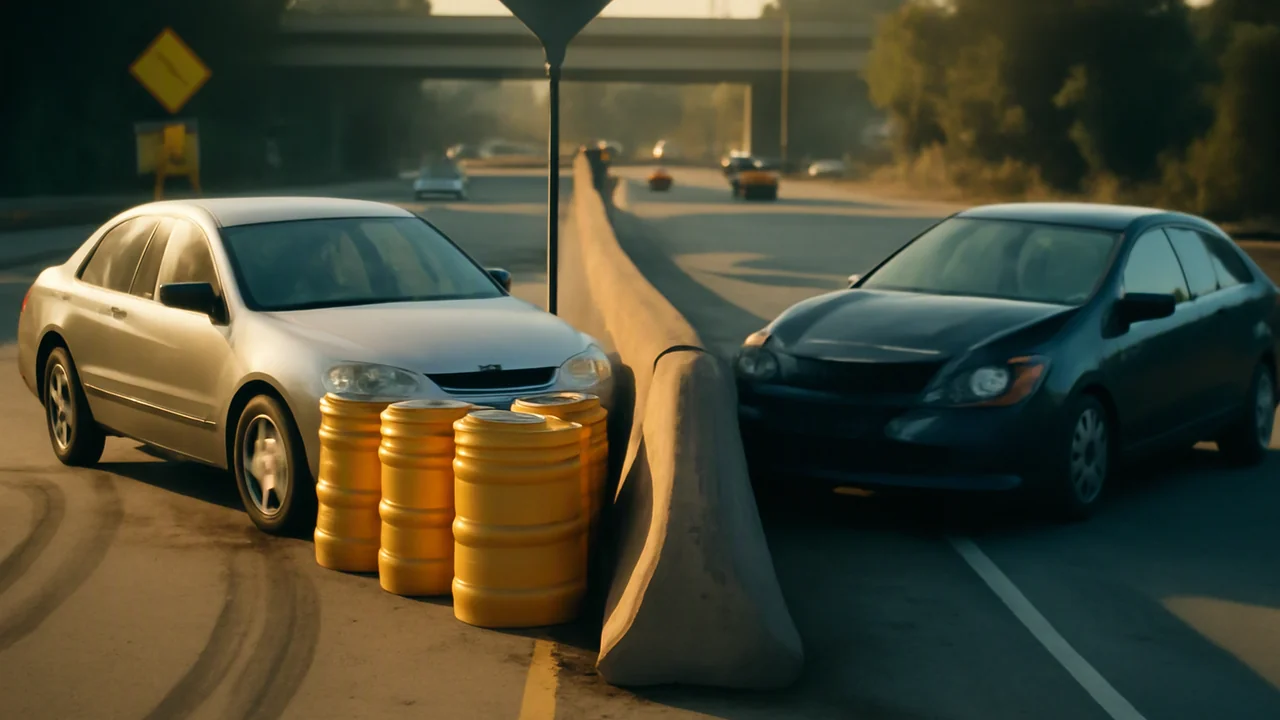
The Safer Off-Ramp: A Crash Cushion Design Challenge
How can we design a crash cushion that stretches a collision’s stopping time enough to protect the people inside a car?
The mystery: Rows of sand-filled barrels and folding crash cushions sit in front of concrete dividers where highway off-ramps split from the main lanes. A car that hits bare concrete stops almost instantly; a car that hits the cushion stops over a longer distance and time, and the people inside feel a much smaller force.
Questions we will figure out together in this unit:
- Why are the barrels filled with sand instead of water or air?
- How much force does a person feel in a sudden stop compared with a gentle one?
- Does a heavier car need a bigger cushion?
- Where does the car’s motion go when it stops?
- Why does a seatbelt stretch a little in a crash?
- Can we measure stopping time without expensive sensors?
- Do the two cars in a collision push on each other equally hard?
- How do engineers test a cushion before it goes on the road?
describe motion with position, velocity and acceleration, calculate acceleration from a change in velocity, and explain why an object’s motion changes only when a net force acts on it.
- I can express that a net force on an object causes the object to accelerate, using the relationship Fnet = ma.
- I can organize data showing the net force, mass (held constant), and acceleration of a macroscopic object using tables, graphs, charts, or vector drawings.
Phase 1: Spark
Warm-Up ~5 min
Do Now. Picture the place where a highway off-ramp splits from the main lanes. In front of the concrete divider there is often a row of yellow sand-filled barrels or a long folding cushion. Write two things you notice about where they sit and one question you have about why they are there.
Two identical cars moving at 25 m/s stop, one against concrete in 0.10 s and one in a crash cushion in 0.50 s. How does the force on each driver compare?
Instruction ~10 min
The phenomenon. On highways around the world, look where an off-ramp splits from the main lanes. In front of the concrete divider there is often a row of yellow plastic barrels filled with sand, or a long folding metal-and-plastic cushion. Highway engineers call these impact attenuators. A car that hits the bare concrete stops almost instantly; a car that hits the barrels stops over a longer distance and time. Why does that difference matter so much to the people inside? To answer, we need a language for motion and a rule connecting motion to force.
Describing motion. Position is where an object is, measured from a reference point. Velocity is how fast position changes, with a direction: average velocity = change in position ÷ time. A car that travels 150 m north in 6.0 s has an average velocity of 25 m/s north. (25 m/s is 90 km/h, about 56 mph.) Acceleration is how fast velocity changes: acceleration = change in velocity ÷ time. Its unit is meters per second per second, m/s2.
Worked example 1. A car speeds up from 0 to 26.8 m/s (60 mph) in 8.0 s. Its acceleration is (26.8 − 0) ÷ 8.0 = 3.35 m/s2: every second it gains 3.35 m/s. Slowing down is acceleration too, in the direction opposite the motion.
Worked example 2. A car moving at 25 m/s that stops in 0.10 s against concrete has an acceleration of (0 − 25) ÷ 0.10 = −250 m/s2, about 25 times the acceleration of gravity (9.8 m/s2). The same car stopped by a cushion over 0.50 s has an acceleration of −50 m/s2, five times smaller. These numbers are illustrative, but the comparison is the point.
Graphs. On a velocity-time graph, a horizontal line means constant velocity (zero acceleration), a line sloping up means speeding up, and the slope of the line is the acceleration. A steep drop to zero is a sudden stop; a gentle slope to zero is a gradual one. You will read and draw these graphs all unit.
Forces change motion. A force is a push or a pull, measured in newtons (N). Several forces usually act on an object at once: gravity, the push of the road (normal force), friction, air resistance. What matters is the net force, the combined effect with directions taken into account. Newton’s first law says that an object keeps moving at constant velocity, or stays at rest, unless a net force acts on it. This tendency is called inertia. A passenger in a crash keeps moving forward at 25 m/s until something (a seatbelt, an airbag, the dashboard) exerts a force to stop them.
Newton’s second law. The acceleration of an object is proportional to the net force and inversely proportional to its mass: a = Fnet ÷ m, or Fnet = ma. For a 70 kg person to decelerate at 250 m/s2, the net force on them must be 70 × 250 = 17,500 N, roughly 25 times their weight. At 50 m/s2 it is 3,500 N. So a cushion that reduces the acceleration also reduces the force on every person in the car. That is the logic of every safety device in this unit.
Your questions. Build the question board. Which questions could you test with carts and a ramp? Which need published crash-test data? Which need a model, such as momentum, to answer?
Reading: OpenStax Physics (high school), chapters 2 and 4 (CC BY 4.0).
Guided Exercises ~15 min
Work with a partner. Show the equation and units for every calculation.
Independent Practice ~10 min
Start your Engineering Notebook.
Sketch two velocity-time graphs on the same axes: a car stopping from 25 m/s against concrete in 0.10 s and in a cushion in 0.50 s. Label the slope of each and use Fnet = ma to compare the force on a 70 kg driver.
Add three questions to the class question board: one you could test with carts, one that needs published data, and one that needs a model to answer.
Closure ~5 min
We can now describe a stop with numbers. Next class we meet our client and set up the project.
Exit ticket: using Fnet = ma, explain in two sentences why a cushion that stretches the stop protects a passenger.
How confident are you that you can describe motion, calculate acceleration, and explain changes in motion with net force?
Teacher notes
Materials: two generic photos or drawings of off-ramp crash cushions (sand barrels and a folding cushion), chart paper for the question board, devices for the PhET sim or printed values for the no-device version.
Setup: keep the question board posted all unit; 1.02 turns it into the Wonder Board and need-to-knows.
Sensitivity: some students or families may have been in car crashes. Keep the focus on how engineers protect people, and let students pass on sharing.
Listen for: “a moving object needs a force to keep moving” (Newton’s first law says otherwise) and “slowing down is not acceleration.”
Support / stretch: give a calculation frame (a = (___ − ___) ÷ ___). Stretch: convert 60 mph to m/s from scratch, showing unit analysis.