2.07 Design and Prototype: Competing Generators and a Decision Matrix
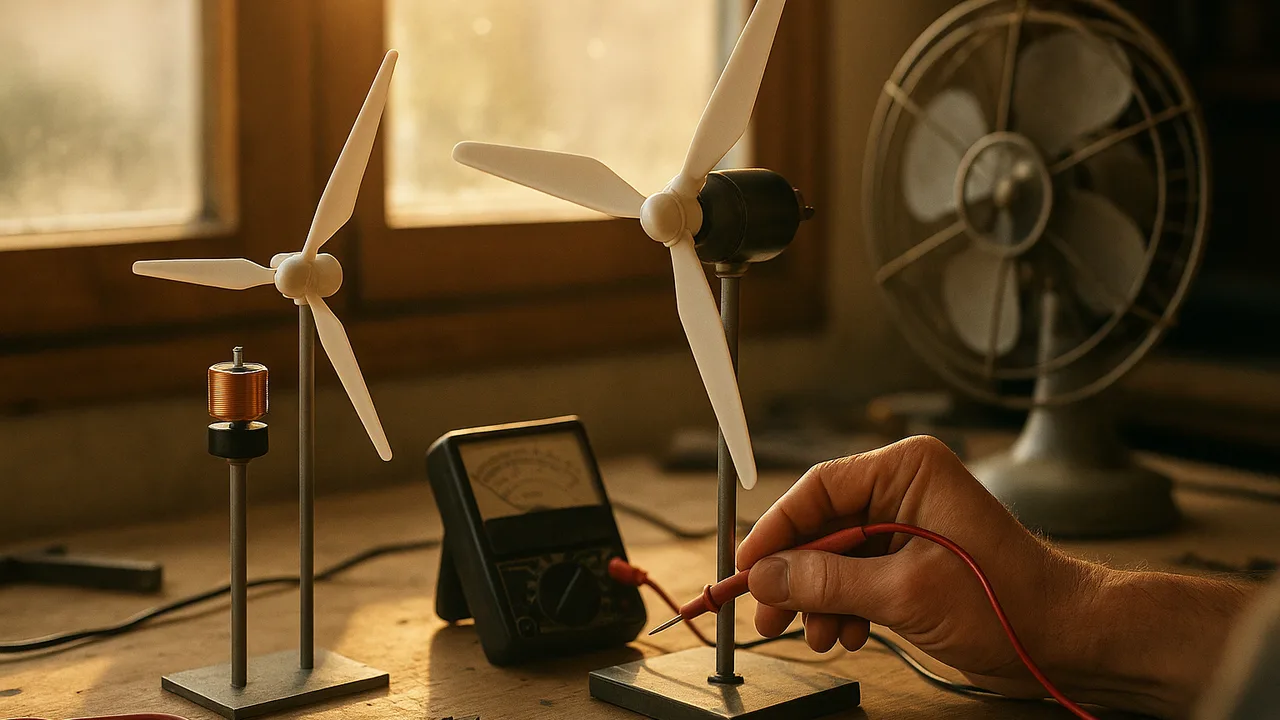
compare competing model-generator designs in a weighted decision matrix, write an investigation plan for testing them, and build and test version 1.
- I can include in my investigation plan the use of an electric circuit, a source of electrical energy, the shape and orientation of the wire, and the types and positions of detectors.
- I can describe how I will indicate or measure when electric current is flowing through the circuit.
- I can describe how I will indicate or measure the presence of a local magnetic field near the circuit, and how I will design a system to change the magnetic field in a nearby circuit and measure when the magnetic field is changing.
- I can state in my investigation plan whether I will conduct the investigation individually or collaboratively.
Phase 4: Build
Warm-Up ~5 min
Do Now. From the idea wall, pick the design you think will make the biggest voltage. Name the one thing about it that makes the field through the coil change fastest.
Which change should increase a model generator's peak voltage?
Instruction ~10 min
Our class criteria and constraints. Criteria: (1) the model generator is turned by a hand crank or a desk fan; (2) it produces at least 0.50 V peak on a multimeter (our class target); (3) a visitor can see the magnet, the coil and the meter. Constraints: (4) at most 30 m of magnet wire and only the kit’s magnets; (5) it fits inside a 30 cm cube; (6) no exposed sharp wire ends and no loose magnets.
Competing solutions. Each team takes three strong ideas into a weighted decision matrix. The co-op cares most about a reliable 0.50 V and about visitors seeing the parts, so those criteria carry the heaviest weights.
| Design | Reaches 0.50 V (×3) | Visible parts (×2) | Wire ≤ 30 m (×2) | Safe, no loose magnets (×3) | Easy to build (×1) | Total |
|---|---|---|---|---|---|---|
Score each cell 1–3, multiply by the weight, then add.
Worked example 1: a filled matrix (sample). Malik’s team scored a spinning-cork rotor inside a coil (voltage 3, visible 2, wire 3, safe 2, easy 2: 9 + 4 + 6 + 6 + 2 = 27), a shake tube (2, 3, 3, 3, 3: 6 + 6 + 6 + 9 + 3 = 30) and a fan-driven rotor (3, 3, 2, 2, 1: 9 + 6 + 4 + 6 + 1 = 26). The shake tube won on safety and ease, but its voltage was the least certain. They chose to build the shake tube first and test the rotor as a backup. A matrix guides a decision; data finishes it.
Worked example 2: the investigation plan. To test any design, a plan must name: the circuit (coil leads to the multimeter, no battery); the source of energy (hand crank, shaking or fan); the shape and orientation of the coil and where the magnets pass it; the detectors (multimeter on the AC or DC millivolt range with peak hold, a compass to check the magnets’ poles); how the team will know current is flowing (a nonzero reading that tracks the motion); how it will show the field is changing (reading zero when the rotor is still); and who does what. Ava’s team wrote: “We work as a team: Lab Engineer cranks at a counted 2 turns per second, Data Analyst reads peak voltage, Project Manager times, Communications Lead records.”
Worked example 3: which variables matter. Induced voltage grows with the number of turns, the strength of the magnets, and how fast the field changes (rotation speed). The wire constraint limits turns; the kit fixes the magnets; so speed and coil placement are the team’s best levers.
Build and test version 1. Wind the coil neatly in one direction, sand the enamel off the lead ends, connect to the meter, and test at three speeds.
| Speed (turns or shakes per s) | Peak V trial 1 | Peak V trial 2 | Peak V trial 3 | Average | Reading when still |
|---|---|---|---|---|---|
| 1 | |||||
| 2 | |||||
| 3 |
Guided Exercises ~15 min
Complete your matrix and plan, then build.
Independent Practice ~10 min
Record version 1.
Write your full investigation plan (circuit, energy source, coil shape and orientation, detectors and their positions, how you know current flows, how you know the field changes, roles). Then record version 1's data and compare it with the 0.50 V target.
Closure ~5 min
Version 1 has data. Next class: gallery critique and version 2.
Exit ticket: did version 1 read zero when still and more when faster? Explain what that shows about cause and effect.
Teacher notes
Materials: magnet wire (30 m per team), neodymium or ceramic magnets, corks or wooden dowels, cardboard tubes, sandpaper, multimeters with peak or min/max hold, small desk fans, hand cranks if available, goggles, tape.
Setup: test the class target with one teacher-built generator before this lesson; keep the 0.50 V target fixed after 2.02.
Listen for: plans that include a battery; coils wound back and forth (fields cancel); unsanded leads giving zero readings.
Support / stretch: give a plan template. Stretch: predict the voltage at double the turns and test it.