3.07 Design and Prototype: Competing Ovens and a Decision Matrix
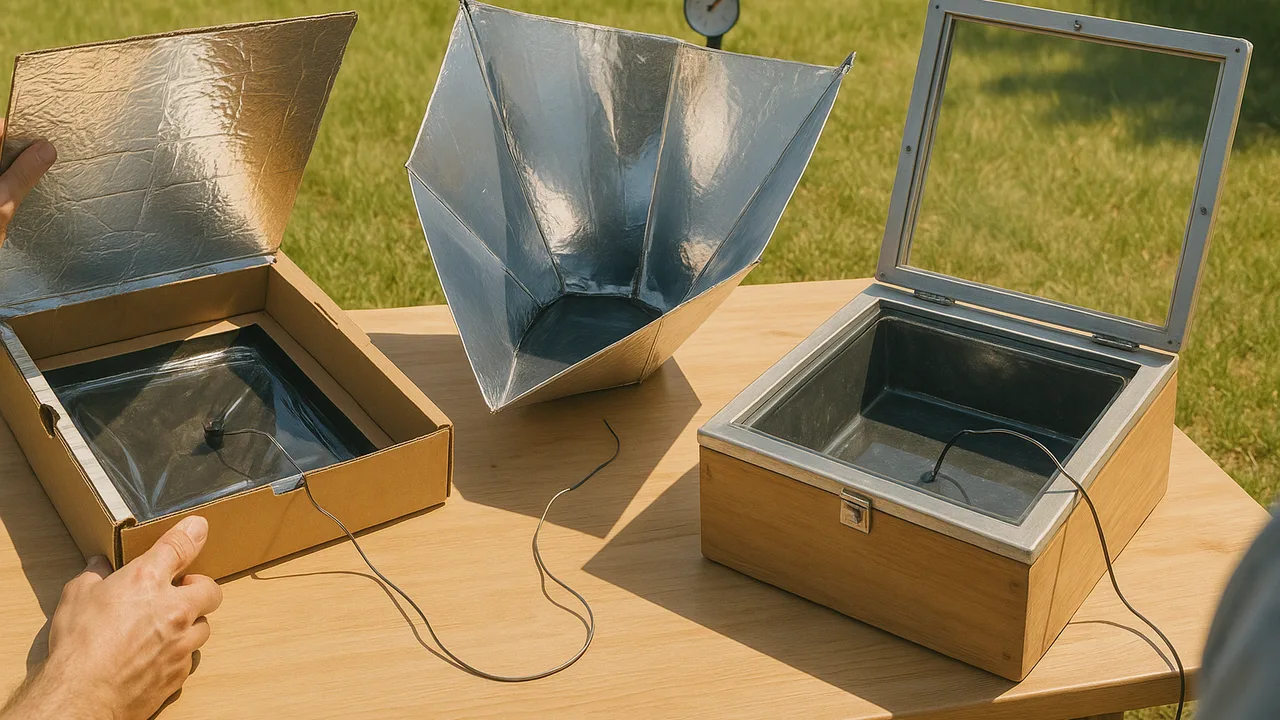
compare competing oven designs in a weighted decision matrix, justify the chosen materials and structure with energy-transfer science, and build and run version 1 of the team’s improved oven.
- I can describe and measure the most important criteria and constraints for my device, such as cost and efficiency, and explain the tradeoffs involved in my design choices.
- I can identify and explain the scientific principles that support my device’s energy conversion design.
- I can describe the forms of energy my device converts, the energy losses to the environment, and the scientific reasons for my choices of materials and structure, including how my own evidence influenced my design.
- I can explain how my device shows that applying scientific knowledge and engineering design can increase benefits and reduce costs or risks for society.
- I can build and test my device according to my plan.
Phase 4: Build
Warm-Up ~5 min
Do Now. From the idea wall, pick the two ideas you think will raise efficiency the most. Write the energy flow each one changes.
Design X uses a glass picture-frame mirror as a reflector and doubles the light entering. What is its status?
Instruction ~10 min
Our class criteria and constraints. Criteria: (1) 200 g of water in a dark container rises at least 20 °C in 30 minutes of full sun (our class target); (2) efficiency at least 10%, and higher is better; (3) a family can build it in under 30 minutes from the listed materials. Constraints: (4) one pizza box or similar cardboard box, at most 1 m2 of foil, one sheet of clear plastic film, black paper, tape and newspaper; (5) no glass mirrors, and one person can carry it; (6) the container is handled only with an oven mitt.
Competing solutions. Engineers rarely build the first idea. They sketch several, then score them against the criteria. Today each team takes its three strongest ideas into a weighted decision matrix: rows are designs, columns are criteria, and each criterion has a weight that shows how much it matters to the client. The client cares most that families can actually build and use it, and that it heats the water.
| Design | Temperature rise (×3) | Efficiency (×2) | Family can build it in 30 min (×3) | Materials and size limits (×2) | Safe to handle (×1) | Total |
|---|---|---|---|---|---|---|
Score each cell 1–3, multiply by the weight, then add.
Worked example 1: a filled matrix (sample). Priya’s team scored a four-flap reflector oven (rise 3, efficiency 2, build 1, limits 2, safe 2: total 9 + 4 + 3 + 4 + 2 = 22), a double-box oven with newspaper between the boxes (2, 3, 2, 3, 3: total 6 + 6 + 6 + 6 + 3 = 27) and a dark jar inside a sealed clear bag on a foil panel (2, 2, 3, 3, 2: total 6 + 4 + 9 + 6 + 2 = 27). Two designs tied. They chose the double box, because their energy model showed loss through the walls was their largest loss, and added one foil flap because it was quick to build. A matrix informs a decision; it does not make it for you.
Worked example 2: justifying materials with science. Diego wrote: “Crumpled newspaper traps still air, and still air is a poor conductor, so the gap between the boxes slows conduction out through the walls. The inner box is lined with black paper so light becomes thermal energy where the water is. The flap’s foil reflects light that would have missed the opening.” Every choice is tied to an energy flow and stays inside a constraint.
Worked example 3: predicting the result. If the double box cuts wall losses enough to deliver 20,900 J to the water instead of 16,720 J from the same 162,000 J of light, the rise becomes 20,900 ÷ (200 × 4.18) = 25 °C and the efficiency about 13%. Write your prediction before you test.
Build and test version 1. Build to the plan and time the build (criterion 3). Test beside a control and, if possible, beside a team’s iteration 1 oven at the same time, so sky conditions are shared.
| Design | Build time (min) | Opening area (m2) | Start (°C) | End (°C) | Control rise (°C) | Energy to water (J) | Efficiency (%) |
|---|---|---|---|---|---|---|---|
| Iteration 1 | |||||||
| Version 1 (new) |
Guided Exercises ~15 min
Complete your team matrix, then check each other’s reasoning.
Independent Practice ~10 min
Record version 1.
Paste your completed matrix and version 1 test table. Explain your design choice and your material choices with energy transfer, and compare the measured rise and efficiency with your prediction.
Closure ~5 min
Version 1 exists and has data. Next class: gallery critique and version 2.
Exit ticket: which criterion did version 1 meet best, and which did it miss or barely meet? Give the numbers.
Teacher notes
Materials: extra pizza boxes or two nesting boxes per team, foil, plastic wrap, black paper, newspaper, tape, rulers, dark containers, thermometers, timers, oven mitts; a stopwatch to time each build.
Setup: run all version 1 tests in the same 30-minute sunny window, with one class control. On a cloudy day, use the lamp set-up for every team.
Listen for: matrices filled to justify a favorite; materials chosen with no energy reason; teams ignoring the family build-time criterion.
Support / stretch: provide a pre-weighted matrix. Stretch: change one weight and see if the winner changes (a sensitivity check).