4.06 One Model of the Alert Chain: CER and Link Ideas
combine the unit’s evidence into one model of the alert chain, argue which model of light (wave or particle) best explains each device, evaluate digital transmission for alerts, and brainstorm designs for the light-signal link.
- I can identify the reasoning used to support claims about modeling electromagnetic radiation as a wave or a particle.
- I can evaluate claims and reasoning for using both wave and particle models to describe electromagnetic radiation.
- I can explain why the wave model is more useful for some aspects of energy and information transfer, and the particle model is more useful for others.
- I can identify and communicate the cause and effect relationships that allow each device to function.
Phase 3: Make Sense
Warm-Up ~5 min
Do Now. List every kind of wave in the alert chain, from the earthquake to the phone in someone’s hand.
Which model of light best explains why a solar cell at a remote seismic station needs light above a certain frequency to make current?
Instruction ~10 min
One model of the whole chain. Today you combine everything into one labeled model: seismic waves (mechanical, P then S) → seismometer (inertia of a mass) → electrical signal → digitized bits → light pulses in fiber (total internal reflection) → radio waves to phones (antennas) → sound, light and vibration. For every arrow, name the wave, the device and the cause-and-effect link that makes the next step happen.
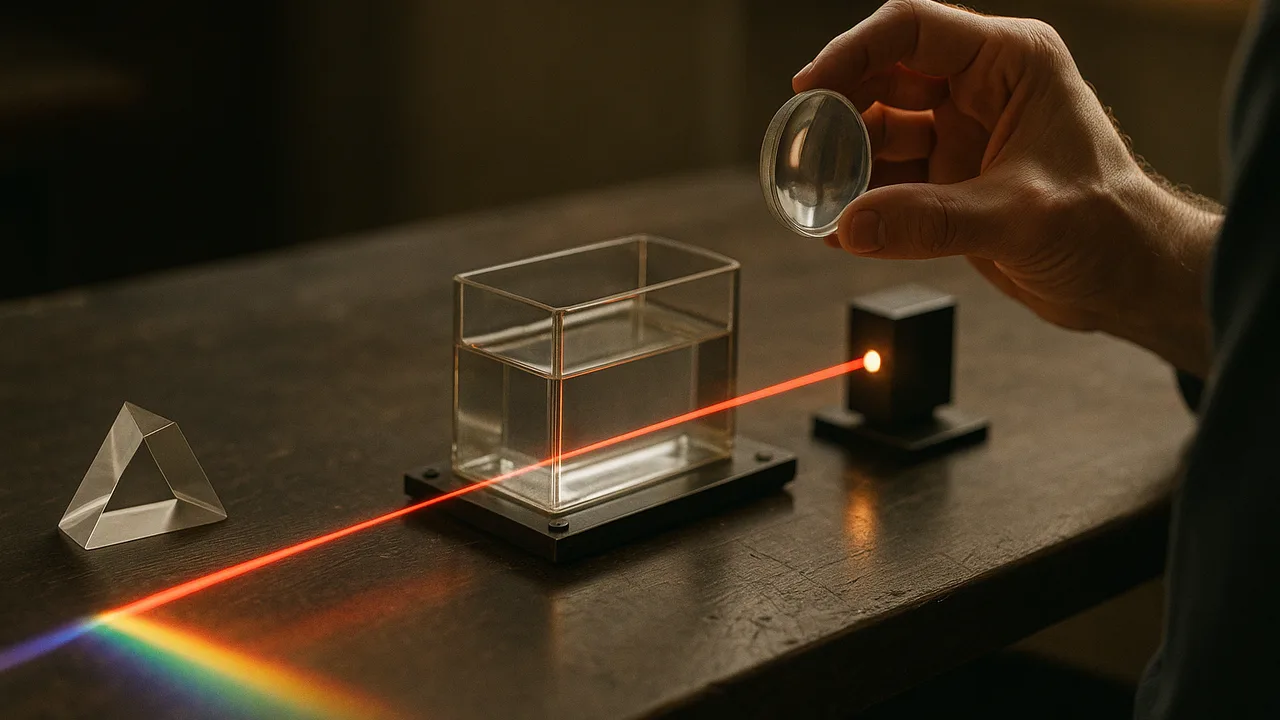
Which model of light, where? A model is a tool, and scientists choose the tool that explains the evidence best. The wave model is more useful for how light travels: refraction, total internal reflection in fibers, interference and the way radio waves spread from an antenna. The particle model is more useful for how light delivers energy to matter: solar cells, camera sensors, glow material and why UV damages skin while radio does not. Both describe the same light.
Worked example 1: a CER about models. Claim: the alert chain needs both models of light. Evidence: the beam in the Bending Light sim stayed inside glass beyond a critical angle (wave behavior at a boundary); in our glow lab, dim blue light charged the material and bright red light did not (photon energy). Reasoning: the wave model explains how a fiber guides light over kilometers; the photon model explains how a solar cell turns that same kind of light into current, one photon at a time. Each model is more useful for one part of the chain.
Worked example 2: is digital the right choice for alerts? Diego turned features into testable questions. “Can a digital alert be relayed without losing detail?” Test: copy a code through five relays in class and compare. “Does it fail suddenly when the signal is weak?” Test: move the receiver farther away and record where decoding stops. A good evaluation asks whether each answer actually shows a feature is an advantage or a disadvantage.
Sentence starters. “The ___ model explains ___ because ___.” “The evidence is ___.” “A digital alert is better/worse here because ___.” “This device works because ___ causes ___.”
Ideate: the light-signal link. Brainstorm at least six ways to send our 16-bit alert code with light. Ideas to spark you: on-off flashes with a fixed beat (on = 1, off = 0); short and long flashes; two colors of LED for 0 and 1; two lights sending two bits at once; a cardboard tube to aim the light and block room light; a phone light-meter app as the receiver. For each idea, write how it handles noise and how fast it could go.
| Idea | How a 0 and a 1 look | Bits per second (estimate) | How it handles noise | Constraint check |
|---|---|---|---|---|
Guided Exercises ~15 min
Build the chain model with your team, then test it with these questions.
Independent Practice ~10 min
Finish the chain model and the idea table.
Draw your final alert-chain model with every wave and device labeled and a one-line cause-and-effect statement on each arrow. Then fill the Ideate table with six link ideas.
Closure ~5 min
One model explains the whole chain. Next phase: build, test and improve competing light-signal links.
Exit ticket: circle your team's two best link ideas and explain how each would keep noise from changing the alert.
How confident are you that you can explain which model of light fits each device and evaluate digital transmission for alerts?
Teacher notes
Materials: chart paper and markers, each team’s glow-lab and Bending Light results, idea-table copies, sticky notes for the idea wall.
Setup: 10 minutes chain model, 15 minutes CER, 10 minutes digital evaluation, 15 minutes Ideate. Post each team’s best two ideas for 4.07.
Listen for: “light is really a particle” or “really a wave”; confusing seismic waves with electromagnetic waves; ideas that need lasers.
Support / stretch: give a chain diagram with blank labels. Stretch: estimate how long the alert takes to cross 100 km of fiber at 2 × 10⁸ m/s and compare it with the S wave’s travel time.