1.09 Performance Task: Crash Cushion Design Challenge
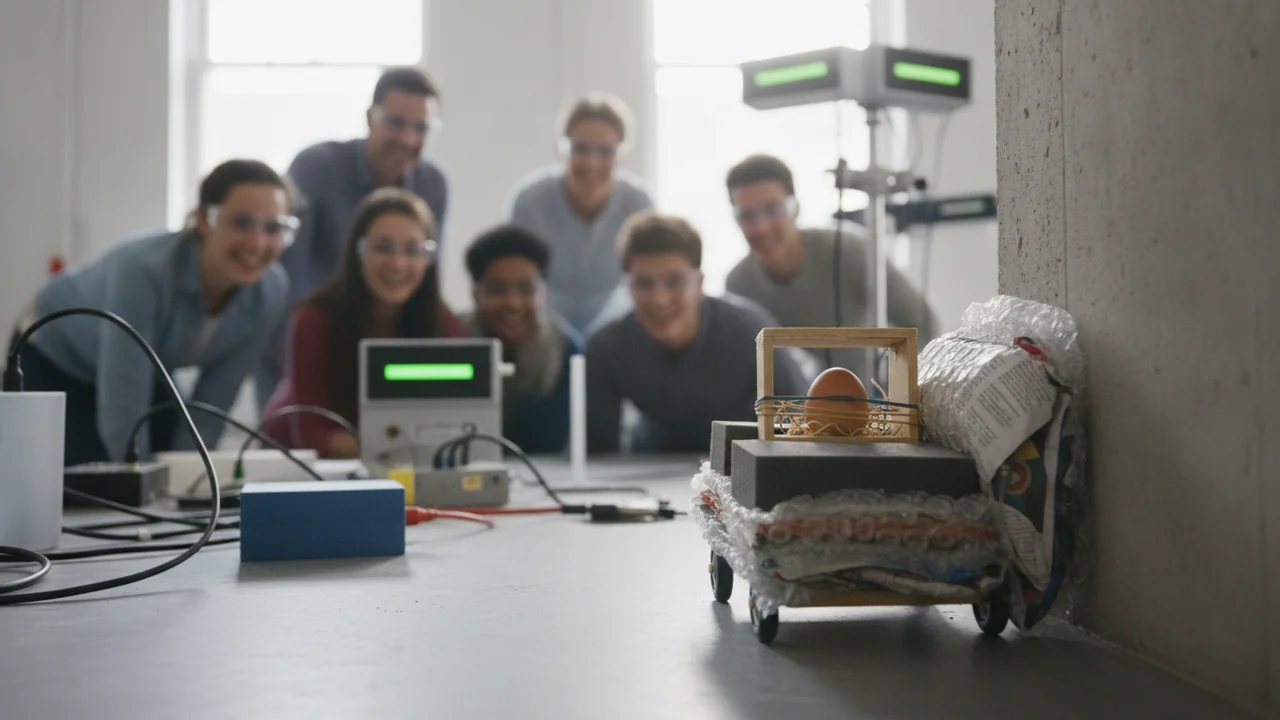
design, build, test and refine a cushion that protects an egg in a cart collision, use momentum and impulse to explain its performance, model it with a simulation, and evaluate it against prioritized criteria.
- I can systematically evaluate my device design by explaining my choices and comparing the design to the criteria and constraints.
- I can use my test results to improve my device by increasing the impact time, reducing mass, or considering cost versus benefits.
- I can use calculations of total momentum to support the claim that the system’s momentum is the same before and after the interaction.
Phase 5: Prove It
Warm-Up ~5 min
Do Now. In one sentence each, state what your cushion does, the number that best shows it works, and the number that shows its biggest limitation.
A 0.80 kg cart at 1.5 m/s stops in 0.040 s. The average force on it is
Instruction ~10 min
The challenge. A cart carrying a raw egg sealed in a zip-top bag rolls down a ramp and hits a wall. Your team’s job is to design a cushion, attached to the front of the cart, so that the egg survives. It is the highway crash-cushion problem at tabletop scale, and your report goes to the client’s roadside-safety team.
Our class criteria and constraints. Criteria: (1) the egg survives 3 runs from the standard ramp height without cracking; (2) the cart’s stopping time, measured from slow-motion video, is as long as possible. Constraints: (3) cushion mass at most 100 g; (4) it extends no more than 15 cm in front of the cart; (5) only class materials (paper, cardboard, straws, tape, rubber bands, foam, bubble wrap); (6) the egg itself may not be wrapped, so the cushion does the work.
Your teacher sets the ramp height; the cart’s speed at the bottom is measured in a trial run by timing it over the last 0.50 m.
Process. (1) Use your sub-problem breakdown from 1.05. (2) Use your two tested iterations from 1.07 and 1.08. (3) Run the final cushion for the official three runs. (4) Film each test in slow motion and measure the stopping time frame by frame. Record every test, including failures; failed tests are data.
Calculations the report must include. The cart’s momentum at impact (p = mv with measured mass and speed); the average force for each design (F = Δp ÷ Δt, using the measured stopping time); and a comparison of the two iterations. Worked example with illustrative numbers: a 0.80 kg cart and egg at 1.5 m/s has momentum 1.2 kg·m/s; stopping in 0.020 s gives 60 N, while stopping in 0.080 s gives 15 N.
Model it (HS-ETS1-4). Use the PhET Collision Lab to model your crash: a ball with your cart’s mass and speed hitting a very heavy ball, first perfectly elastic and then perfectly sticky. Compare the momentum change in each and explain why a cushion that absorbs the collision (sticky) rather than bouncing back halves the momentum change the egg experiences. State one way the simulation does not match your real test.
Evaluate (HS-ETS1-3). Rank your criteria and constraints, score your final design against them, and state the trade-offs you made (for example, a longer cushion stops more gently but risks breaking the size limit; stiffer materials survive more runs but stop faster). Compare your design with one other team’s.
Stages. Plan, draft report, peer review, revise, and present with the team, each member answering a question. Follow every step of the test procedure exactly so your results can be compared across teams.
Guided Exercises ~15 min
Prepare your report and presentation with your team.
Independent Practice ~10 min
Write the engineering report.
Write the evaluation section: rank your criteria and constraints, score the final design against each, state two trade-offs, and compare your design with another team's using their data.
Crash Cushion engineering report (900–1,300 words) + four-minute team presentation
Task: Build and test at least two iterations of a cushion (at most 100 g, at most 15 cm long) that stops a cart carrying a raw egg in a sealed bag. Report the measured impact speed, momentum, stopping times and average forces for each iteration; model the collision in the PhET Collision Lab; and evaluate the final design against ranked criteria and constraints, comparing it with another team’s. Present your recommendation to the client’s roadside-safety team.
Submission workflow
- Stage 1 — Plan. Sub-problem breakdown, two sketched designs with predictions, the test procedure and a data table.
- Stage 2 — Peer-reviewed draft. Another team checks your calculations from your raw data and your reasoning with impulse; submit their notes and your revision plan.
- Stage 3 — Final report. 900–1,300 words with data from every test, calculations, the simulation comparison and the criteria evaluation.
- Stage 4 — Presentation and defense. Four minutes as a team, live or recorded, with a demonstration video; each member answers one question.
How it is scored
| Criterion | What proficient looks like |
|---|---|
| Design and refinement (HS-PS2-3) | Two tested iterations; changes justified by data and impulse reasoning; unexpected effects identified and addressed. |
| Calculations (HS-PS2-2, HS-PS2-3) | Momentum, stopping time and average force computed correctly from measured values, with units and signs. |
| Problem breakdown and modeling (HS-ETS1-2, HS-ETS1-4) | Sub-problems tested separately; simulation used to model the crash with its limits stated. |
| Evaluation and communication (HS-ETS1-3) | Ranked criteria and constraints, honest trade-offs, comparison with another design; clear report and presentation. |
Closure ~5 min
You designed, tested and defended a safety device with real physics. Next: the unit checkpoint.
Exit ticket: which Wonder Board question can you now answer? Write the question and your answer with one number.
Teacher notes
Timing: Poly gave this task four sessions. Here, one 50-minute period runs the official tests and launches the report; drafting, peer review and presentations continue as homework and in a later period.
Materials: ramp at the standard height, raw eggs in zip-top bags, balances, rulers, slow-motion phones, devices for the PhET sim, rubric copies.
Setup: invite a staff member or family volunteer to role-play the client’s roadside-safety team for presentations.
Listen for: reports that skip failed runs; forces calculated with speed instead of momentum; “the cushion absorbed the momentum.”
Support / stretch: give a report outline with section headings and a calculation table. Stretch: estimate the stopping distance from d = ½vΔt and compare with how far the cushion actually crushed.