2.06 One Model of Fields: Model Revision and Generator Ideas
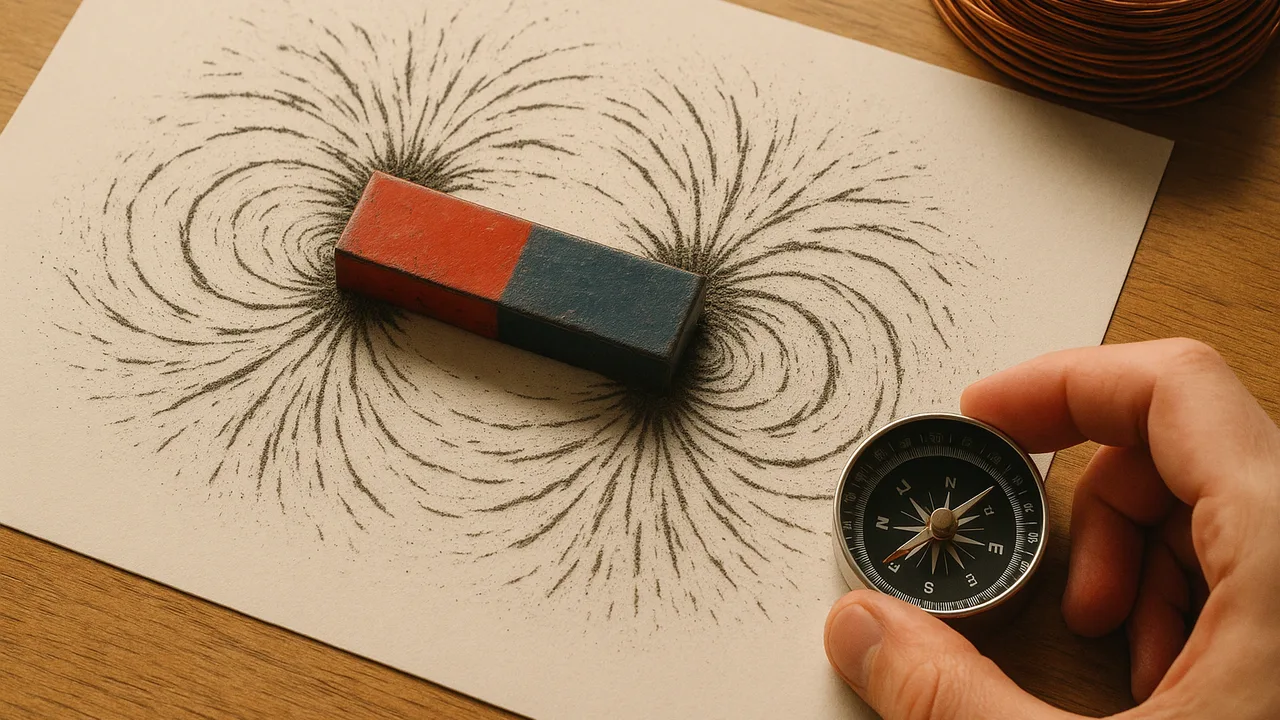
revise our field model to connect forces, energy and induction, use it to explain energy changes with distance, refine our investigation plan, and brainstorm generator designs.
- I can use force formulas to explain how the energy of objects interacting through gravitational or electric forces changes as the distance between them changes.
- I can use my model to support the claim that the change in energy stored in the field matches the change in energy of the objects.
- I can refine my investigation plan to improve the accuracy, precision, and usefulness of my data so that I can clearly measure or indicate the presence of electric current and magnetic fields.
Phase 3: Make Sense
Warm-Up ~5 min
Do Now. Look at your first two-object drawings from 2.02. Add one thing you now know about each: the force law, the energy, or the field.
When a ball falls, the energy stored in the Earth-ball gravitational field decreases by the same amount the ball's kinetic energy increases (ignoring air resistance).
Instruction ~10 min
Model revision. Our unit model now has three linked layers:
- Force laws. Gravity and the electric force both fall as 1/r2; gravity only attracts, electric forces attract or repel (2.01, 2.04).
- Field energy. Moving objects against the force stores energy in the field; moving with it releases energy as kinetic energy (2.05).
- Induction. A current makes a magnetic field; a changing magnetic field makes a current, which pushes back on the motion that caused it (2.03, 2.05).
Explore first: energy cards. Teams sort six sample cards, each showing two objects before and after they move. Before anyone explains, fill in the table.
| Card | Objects and interaction | Move with or against the force? | Field energy: up, down or same? | Where the energy goes or comes from |
|---|---|---|---|---|
| 1 Ball falls 2 m | ||||
| 2 Satellite pushed to a higher orbit | ||||
| 3 Two like charges released | ||||
| 4 Opposite charges pulled apart | ||||
| 5 Magnet pushed into a coil | ||||
| 6 Magnets snap together |
Worked example 1: gravity far from Earth. Near the surface we use mgh. Far away, the energy in the Earth-satellite field is U = −GMm/r. For a 1,000 kg satellite, GM = 3.99 × 10¹⁴ N·m2/kg: at r = 7.0 × 10⁶ m, U ≈ −5.7 × 10¹⁰ J; at twice that distance, U ≈ −2.85 × 10¹⁰ J. U rose (became less negative) by about 2.85 × 10¹⁰ J: raising the satellite stores energy in the field, supplied by the rocket’s work.
Worked example 2: a CER on field energy. Claim: when a magnet is pushed into a coil connected to a bulb, the push does work that becomes electrical energy. Evidence: in 2.03 the meter read only while the magnet moved, and in the sim the bulb glowed brighter with faster motion. Reasoning: the induced current’s field opposes the magnet, so the hand must push against a force; that work is transferred through the field into the current. The change in field energy plus the energy the objects gain or lose balances to zero.
Worked example 3: refining the investigation plan. Priya’s 2.03 induction data was noisy: readings of 2, 5 and 3 mV for “fast” pushes. She revised her plan: drop the magnet through the tube from a fixed height so its speed is the same each time, use the meter’s min/max hold to catch the peak, and record five trials. A refined plan makes the data more precise and more useful.
Ideate. Brainstorm model generators for the co-op exhibit. Rules: quantity first, build on ideas, no judging yet. Each idea names how it makes the field through the coil change fast. Starters: magnets on a spinning cork inside a coil; a coil spun between two magnets; a shake tube; a fan-driven rotor with magnets on the blades passing a fixed coil.
Guided Exercises ~15 min
Use the energy cards and your revised model.
Independent Practice ~10 min
Ideate and plan.
Sketch at least three model generator ideas. For each, name the magnet arrangement, the coil, what makes it spin, and how it makes the field through the coil change quickly.
Rewrite your 2.03 induction plan so it gives more precise data: what you will control, how you will measure the peak, and how many trials.
Closure ~5 min
Our model connects forces, energy and induction. Next phase: choose a generator design with evidence and build it.
Exit ticket: explain how the energy of two attracting objects changes as the distance between them increases.
How confident are you that you can use a field model to explain energy changes and plan a better investigation?
Teacher notes
Materials: six printed energy cards, idea-wall chart paper, the 2.03 data, a magnet and tube for a quick drop demo.
Setup: run the card sort before naming anything. Keep the idea wall up; 2.07 builds the decision matrix from it.
Listen for: “negative energy means no energy” (it is a reference choice: zero when infinitely far apart); “the coil creates energy.”
Support / stretch: give a CER frame with starters. Stretch: show that the 2.85 × 10¹⁰ J in worked example 1 equals mgh for a 1,000 kg mass raised only about 2,900 km at a constant 9.8 m/s2, though the satellite actually rose 7,000 km, and explain the difference with the inverse-square law.