3.02 Project Brief and Wonder Board: The Fuel-Free Kitchen
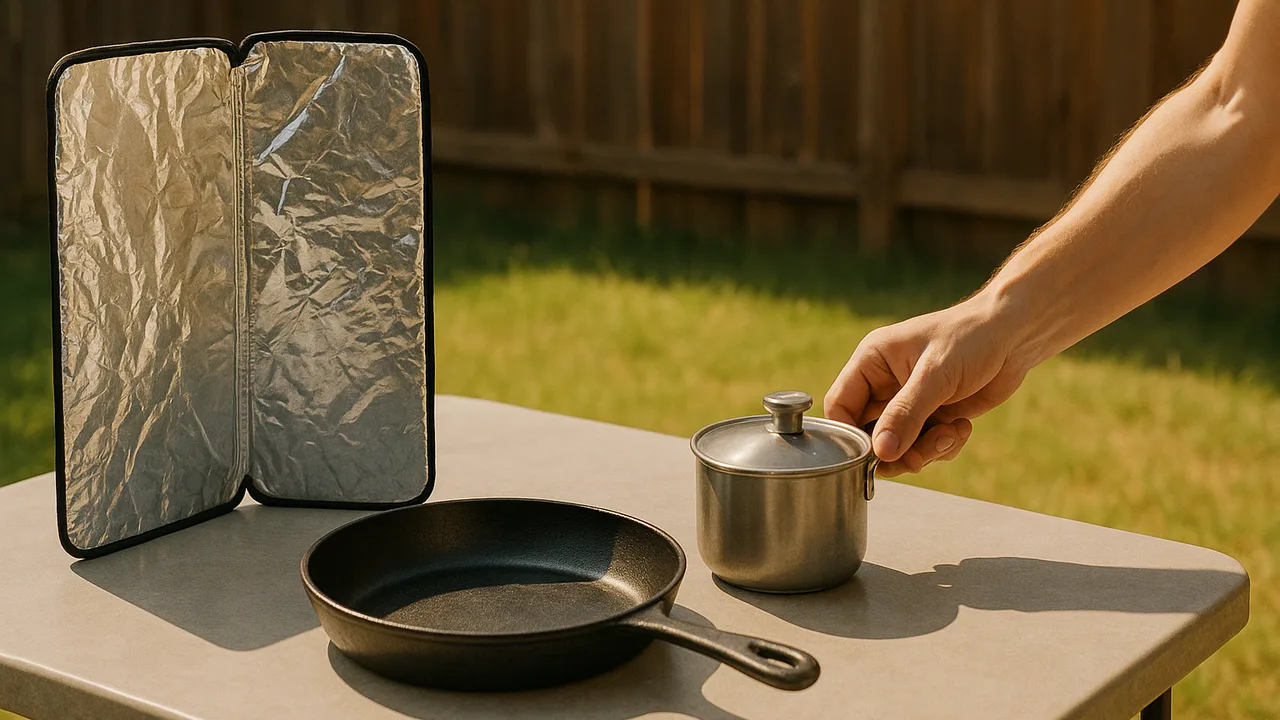
The Fuel-Free Kitchen
How can we design a low-cost solar oven that turns as much sunlight as possible into thermal energy in water, and account for where the rest of the energy goes?
The mystery: At a pumped-storage hydropower plant in a mountain range, water is pumped uphill when solar power is plentiful at midday and released through turbines in the evening, yet the plant always returns less electricity than it used.
Questions we will figure out together in this unit:
- How much energy does it take to warm 200 g of water by 20 °C?
- Why does hot water cool down and cold water warm up when they meet?
- Which matters most: collecting light, absorbing it or keeping the heat in?
- How much sunlight lands on the opening of a pizza box?
- Where does the energy go that does not warm the water?
- Can a spreadsheet predict how hot the water will get?
define the solar-oven problem as an energy system with boundaries, criteria and constraints, and organize the class questions into need-to-knows.
- I can identify and describe the boundaries of a system and explain how the reference level for potential energy is set to zero.
- I can quantify and express the initial energies of each component in a system using algebraic descriptions, including thermal, kinetic, and potential energies.
- I can describe and quantify energy flows into or out of a system using algebraic expressions, and I can calculate the total final energy of the system’s components.
- I can describe and measure the most important criteria and constraints for my device, such as cost and efficiency, and explain the tradeoffs involved in my design choices.
Phase 1: Spark
Warm-Up ~5 min
Do Now. Imagine the power is out at home for two days in summer. List three things you would need warm water for, and one way to heat water with no stove, no electricity and no fire.
Which is a constraint, not a criterion, for a family solar oven?
Instruction ~10 min
Meet the client. A community emergency-preparedness program runs power-outage readiness workshops for families. During an outage, families still need warm water for washing and for preparing food, and burning fuel indoors is dangerous. The program has asked our class to design, test and explain a low-cost solar oven that families can build at home, and to show honestly how much of the sunlight’s energy it really captures.
Driving question. How can we design a low-cost solar oven that turns as much sunlight as possible into thermal energy in water, and account for where the rest of the energy goes?
The test. Every oven heats 200 g of water in a dark container for 30 minutes in full sun, beside an identical container in the sun with no oven (the control). The temperature rise, the energy gained by the water and the efficiency are our measures of success.
Our class criteria and constraints. Criteria: (1) 200 g of water in a dark container rises at least 20 °C in 30 minutes of full sun (our class target); (2) efficiency at least 10%, and higher is better; (3) a family can build it in under 30 minutes from the listed materials. Constraints: (4) one pizza box or similar cardboard box, at most 1 m2 of foil, one sheet of clear plastic film, black paper, tape and newspaper; (5) no glass mirrors, and one person can carry it; (6) the container is handled only with an oven mitt.
Worked example 1: defining the system. Mei drew the oven-container-water system inside a dashed boundary. Sunlight crosses the boundary going in; warm air, radiation from the walls and conduction through the cardboard cross it going out. She listed the initial conditions: 200 g of water at 22 °C (sample), the box and air at the same temperature, and the opening’s area. Anything crossing the boundary is an energy flow; everything inside is an energy store.
Worked example 2: criteria with numbers and a trade-off. Jamal wrote “the oven should get hot.” He revised it: “the water should rise at least 20 °C in 30 minutes, measured against a control.” Then he spotted a trade-off: a bigger reflector collects more light (criterion 1) but uses more foil and may make the oven hard to carry (constraints 4 and 5). Good criteria are measurable, and good teams write their trade-offs down.
Wonder Board and need-to-knows. Sort the class questions into three columns: What we know, What we need to know, and How we will find out (lab, data, simulation or model). The need-to-knows become our investigation plan for Phase 2.
Teams and roles. Teams of four rotate weekly through Project Manager (keeps time and the criteria list), Test Engineer (runs trials safely), Data Analyst (tables, graphs and the spreadsheet) and Communications Lead (notebook, photos and the team’s report to the client).
Guided Exercises ~15 min
Work in your new team. Agree on each answer before you move on.
Independent Practice ~10 min
Write the project page of your Engineering Notebook.
Draw the oven-container-water system with its boundary. Label the initial conditions, every energy store inside the boundary and every energy flow you expect across it.
Rank the six criteria and constraints from most to least important to the client, and give a reason for your top two.
Closure ~5 min
We have a client, a driving question and need-to-knows. Next phase, we investigate: first, how thermal energy moves when hot meets cold.
Exit ticket: write the one need-to-know your team most needs answered before you can design, and say how you will find out.
How confident are you that you can define an energy design problem with a system boundary, criteria and constraints?
Teacher notes
Materials: the 3.01 question board, sticky notes, chart paper with three columns (Know / Need to know / How we will find out), role cards, a sample pizza box with a foil flap to show the scale of the project.
Setup: post the six criteria and constraints where every team can see them all unit; 3.07 to 3.09 test against these exact values. Check the weather forecast now and book a sunny window; if sun is unreliable, plan the lamp alternative from 3.05.
Sensitivity: some families have lived through long outages. Keep the focus on preparation and let students pass on sharing.
Listen for: criteria with no number; teams that leave the sunlight out of the system diagram; “a hotter oven is always better” with no thought for safety.
Support / stretch: give a sentence frame (“The oven must ___ because ___”). Stretch: add a cost constraint with a sample price list and justify the limit.