3.05 Designing a Solar Oven
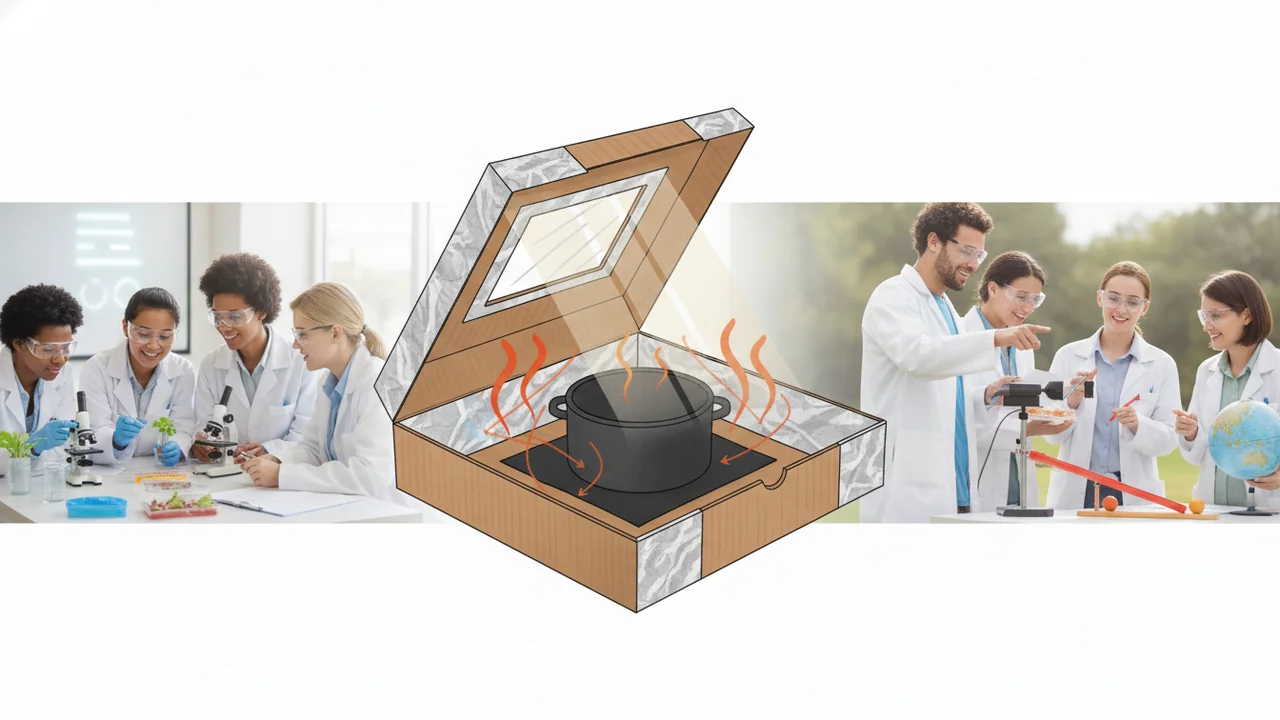
build a solar oven that converts light energy into thermal energy, measure its temperature rise, estimate its efficiency, and break the design problem into parts that can be improved separately.
- I can design a device that converts one form of energy into another.
- I can identify and explain the scientific principles that support my device’s energy conversion design.
- I can describe the forms of energy my device converts, the energy losses to the environment, and the scientific reasons for my choices of materials and structure, including how my own evidence influenced my design.
- I can explain how my device shows that applying scientific knowledge and engineering design can increase benefits and reduce costs or risks for society.
- I can build and test my device according to my plan.
Phase 3: Make Sense
Warm-Up ~5 min
Do Now. A car parked in the sun with its windows closed gets much hotter inside than the air outside. Write two reasons why.
Which surface turns the most visible sunlight into thermal energy?
Instruction ~10 min
The design problem. Sunlight carries energy. On a clear day near midday, sunlight delivers roughly 1,000 watts on every square meter facing the sun (a widely used round figure; it is less in the morning, in winter and through haze or smoke). A solar oven is a device that converts that light into thermal energy and keeps it, so food or water gets hot. HS-PS3-3 asks you to design, build and refine a device that converts one form of energy into another within constraints.
How a box oven works: three sub-problems (HS-ETS1-2). Break the design into parts, each with its own physics:
- Collect. Foil-covered flaps reflect extra sunlight into the box, increasing the light energy entering. A bigger opening or better-angled reflectors collect more.
- Absorb. Black surfaces absorb most visible light and turn it into thermal energy; white or shiny surfaces reflect it. A black paper floor and a dark container convert more light.
- Keep. A clear plastic-film window lets light in but slows the escape of warm air, and newspaper insulation around the walls slows conduction. Every gap lets warm air out.
Because the sub-problems are separate, you can test one change at a time: add a reflector, keep everything else the same, and measure the difference.
Measuring performance. Put 200 g of water in a dark container inside the oven, with a thermometer. Record the water temperature every 5 minutes for 30 minutes, and do the same for an identical container of water sitting in the sun outside the oven, as a control. The difference between the two temperature rises is the oven’s effect.
Worked example 1: estimating efficiency. Efficiency = useful energy out ÷ energy in × 100%. With illustrative numbers: the opening is 0.30 m × 0.30 m = 0.090 m2, so at 1,000 W/m2 the light power entering is about 90 W (ignoring the reflectors). In 30 minutes (1,800 s) that is 90 × 1,800 = 162,000 J. The 200 g of water warms from 20 °C to 40 °C: Q = 200 × 4.18 × 20 = 16,720 J. Efficiency = 16,720 ÷ 162,000 ≈ 10%. The rest of the energy warmed the box and the air, was reflected away, or leaked out. A 10% oven is a respectable first iteration; the design challenge is to raise it.
Worked example 2: an energy model. Draw the energy flow: light from the Sun → (reflect, pass through the window) → absorbed by dark surfaces → thermal energy of air, container and water → some lost through walls, gaps and window. Label where each design feature acts, and show both scales: the large-scale flow of light and warm air, and the particle-scale picture of absorbed light making the particles of the black paper move faster. This diagram guides your refinements: attack the largest loss first.
Lab procedure: Build and Test a Solar Oven (Iteration 1). Question: how much of the sunlight entering a box solar oven can it convert into thermal energy in 200 g of water in 30 minutes? Materials: a pizza box or similar cardboard box, aluminum foil, clear plastic wrap or a clear sheet protector, black construction paper, newspaper, tape and a ruler; two identical small dark containers with 200 g of water each; two thermometers, a timer and an oven mitt; a hat, sunscreen and a shaded spot for waiting between readings.
- Cut a flap in the lid, cover its inner side with foil, and prop it at an angle to reflect sunlight into the box. Line the box floor with black paper and insulate the walls with rolled newspaper.
- Tape clear plastic film tightly over the opening under the flap to make a window; seal the gaps with tape.
- Measure the opening’s length and width and calculate its area in square meters.
- Place one container of water (200 g) with a thermometer in the oven, and the other container in full sun beside it as a control. Record both starting temperatures.
- Aim the oven at the sun and record both temperatures every 5 minutes for 30 minutes, re-aiming the oven as the sun moves.
- Calculate the energy gained by the water in the oven, the light energy entering the opening (area × 1,000 W/m2 × 1,800 s), and the efficiency.
| Time (min) | 0 | 5 | 10 | 15 | 20 | 25 | 30 |
|---|---|---|---|---|---|---|---|
| Oven water (°C) | |||||||
| Control water (°C) |
Opening area: ____ m2. Energy gained by oven water: ____ J. Light energy in: ____ J. Efficiency: ____ %. Sky conditions: ________
No usable sun? Use a desk lamp with a 60 W incandescent or halogen bulb 30 cm above the opening as the light source (teacher-positioned; the bulb gets hot), or analyze the provided data set from a sunny-day class and complete the same calculations.
Guided Exercises ~15 min
Use your oven data. Show units in every calculation.
Independent Practice ~10 min
Complete the iteration 1 analysis.
Claim: how well does your oven convert light energy into thermal energy? Evidence: temperature rise compared with the control, and your efficiency. Reasoning: explain the energy flow with your diagram, and identify the largest energy loss.
The 1,000 W/m2 figure is a round estimate. Explain how haze, time of day or season would change your efficiency calculation if you kept using 1,000 W/m2.
Closure ~5 min
Iteration 1 works and has numbers. Next class: we pull the unit’s science into one energy model and brainstorm improvements.
Exit ticket: which sub-problem will you improve first, and what result would prove the change worked?
Teacher notes
Timing: Poly ran this workshop over two 50-minute periods. Day 1: build and the energy model. Day 2: the 30-minute sun test and the efficiency calculation.
Materials (per team): pizza box, foil, plastic wrap, black paper, newspaper, tape, ruler, two dark containers, two thermometers, timer, oven mitt; craft knives with a cutting mat for the teacher or trained students.
Facts note: 1,000 W/m2 is a standard round figure for clear-sky sunlight at midday. Have students record sky conditions so they can discuss it honestly.
Listen for: “the foil heats the box” (it reflects); comparing ovens without a control; efficiency greater than 100%.
Support / stretch: give a calculation table with the light-energy row filled. Stretch: estimate the extra light the reflector adds by measuring the reflector’s area and its angle.