1.06 One Model of a Collision: CER and Cushion Ideas
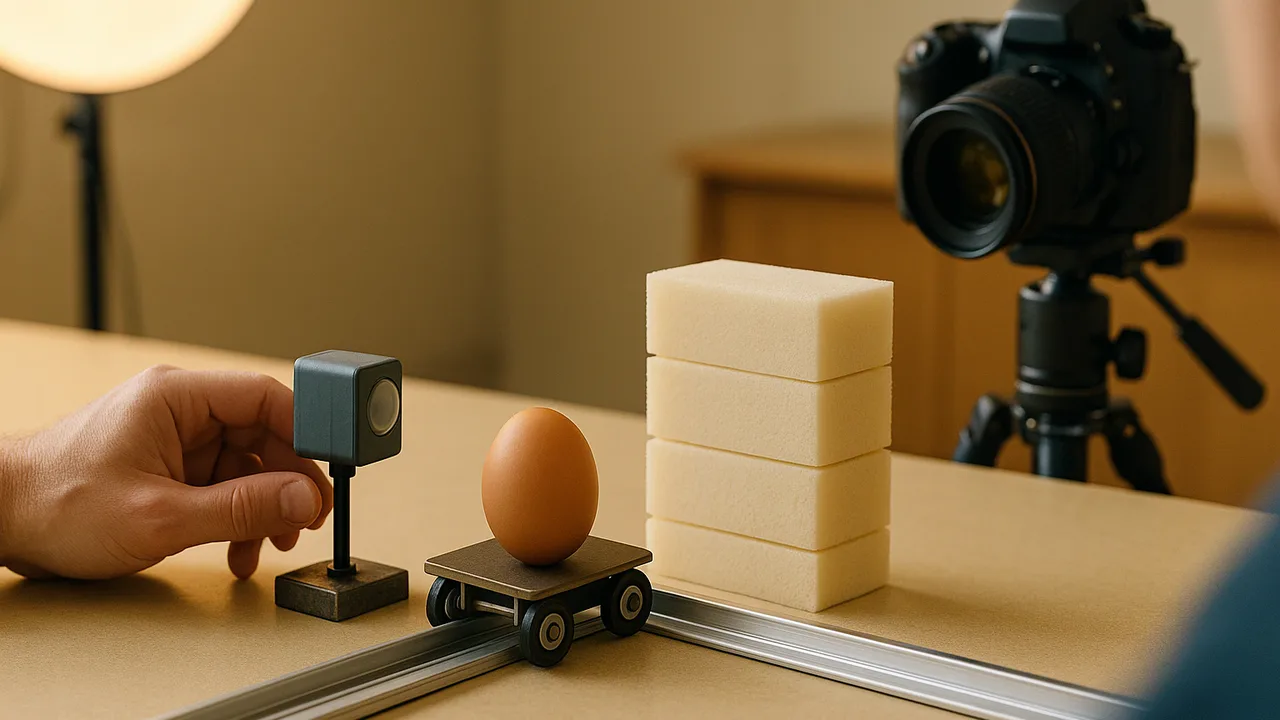
pull force, momentum and impulse into one revised collision model, write a claim-evidence-reasoning argument about cushions, and brainstorm cushion designs grounded in that model.
- I can use data to explain the difference between causal and correlational relationships among force, mass, and acceleration.
- I can analyze the motion of two objects before they interact to show that there is essentially no net force on the system.
- I can identify and explain the claim that the total momentum of a two-object system stays constant when there is no net force.
Phase 3: Make Sense
Warm-Up ~5 min
Do Now. Look back at your first velocity-time sketch from 1.01. Write one thing it got right and one thing you would now add to it.
A cushion reduces the force on the egg by reducing the cart's momentum before it reaches the wall.
Instruction ~10 min
Model revision. Scientists improve models when new evidence arrives. Our first model said “a gentle stop is safer.” Now we can say why, with three linked ideas:
- Force causes acceleration. Fnet = ma (1.03). A larger net force on the same mass means a larger change in velocity each second.
- Momentum is conserved in a closed system. Before a collision, steady motion shows there is no net outside force; during it, the objects exchange equal and opposite momentum (1.04).
- Impulse links them. FΔt = Δp. The cart’s Δp is fixed by its mass and impact speed, so the cushion’s job is to make Δt as long as possible (1.05).
Explore first: rank the stops. Teams get four sample force-time cards (A to D) for the same cart. Each shows a stop with a different duration. Before anyone explains, rank them from gentlest to harshest and fill in the table.
| Card | Stopping time (s) | Δp (kg·m/s) | Average force (N) | Rank (1 = gentlest) |
|---|---|---|---|---|
| A | 0.010 | 1.2 | ||
| B | 0.040 | 1.2 | ||
| C | 0.080 | 1.2 | ||
| D | 0.020 | 1.2 |
Sample cards for a 0.80 kg cart at 1.5 m/s (Δp = 1.2 kg·m/s).
Worked example 1: a CER. Claim: a cushion that crushes over more time reduces the force on the egg. Evidence: card C (0.080 s) gives 1.2 ÷ 0.080 = 15 N, while card A (0.010 s) gives 120 N; in the padding test, foam made shallower dents than bare clay. Reasoning: the egg’s momentum change is the same in every stop, and impulse says F = Δp ÷ Δt, so eight times the time means one-eighth the force.
Worked example 2: cause or correlation? Mei found a news chart showing that cars with longer hoods had fewer serious injuries in one sample of crashes. That is a correlation: longer hoods might mean bigger crumple zones, but those cars might also be newer, heavier or have more airbags. Our cart lab is different: we changed only the stopping time and measured the effect, so it supports a causal claim. Good engineers know which kind of evidence they hold.
Worked example 3: bounce or crumple? If the cart bounces back at 0.5 m/s, its momentum goes from +1.2 to −0.4 kg·m/s, a change of 1.6 kg·m/s. A cushion that crumples without bouncing back keeps the change to 1.2. Less momentum change, longer time: both help the egg.
Ideate. Now brainstorm. Rules: go for quantity, build on others’ ideas, no judging yet. Every idea must name how it stretches the stopping time. Aim for at least six ideas per team, such as a straw accordion, a crumple-cone of folded card, a rubber-band sling, stacked foam layers, a bubble-wrap pillow in a frame, or a sliding sleeve that rubs as it moves.
Guided Exercises ~15 min
Use your ranked cards and your model.
Independent Practice ~10 min
Ideate in your notebook.
Brainstorm at least three cushion designs. For each, sketch it, name the materials, estimate its mass against the 100 g limit, and explain how it stretches the stopping time.
Draw your revised collision model: the cart-cushion-wall system, the forces during the stop, and a force-time graph for your favorite idea.
Closure ~5 min
Our model is ready and our idea wall is full. Next phase, teams choose a design with evidence and build version 1.
Exit ticket: explain why a correlation from crash records is weaker evidence than our cart test, and name one confounding variable.
How confident are you that you can connect force, momentum and impulse in one model and use it to generate design ideas?
Teacher notes
Materials: printed force-time cards A to D, idea-wall chart paper, sticky notes, the 1.03 to 1.05 lab notebooks.
Setup: run the card ranking before naming anything. Keep the idea wall up; 1.07 builds the decision matrix from it.
Listen for: “the cushion absorbs momentum” (it spreads the momentum change over time; energy is what it absorbs, the subject of Unit 3); treating any data pattern as proof of cause.
Support / stretch: give a CER frame with starters (“Our data shows…”, “This happens because…”). Stretch: calculate the force for the bouncing cart if it rebounds in 0.040 s.