4.09 Showcase: The Colony Comeback Report
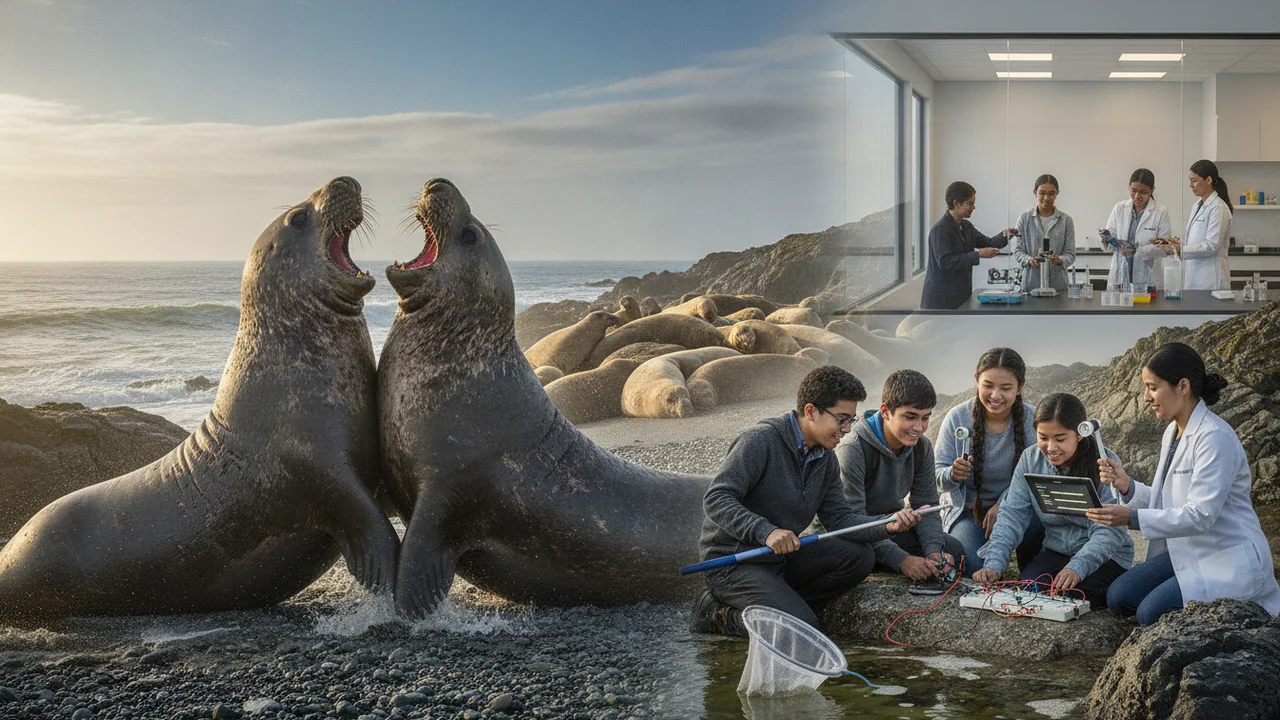
construct and defend a report that uses population models, behavioral evidence and population genetics to explain the recovery of the northern elephant seal and the risks that remain, and present our plan to the sanctuary.
- I can use data analysis to explain how having a certain trait affects an organism’s chances of surviving and reproducing.
- I can use evidence from trait distribution changes to argue that natural selection causes increases or decreases in heritable traits when those traits impact reproductive success.
- I can explain how adaptations in anatomy, behavior, or physiology change in a population by analyzing shifts in trait distributions.
- I can use my additional evidence to analyze how valid and reliable the given evidence is, and discuss its strengths and weaknesses in supporting arguments about group behavior outcomes.
Phase 5: Prove It
Warm-Up ~5 min
Do Now. The sanctuary team has four minutes for your team. Write the one sentence you most want them to remember.
Why can a population of 200,000 elephant seals still have low genetic variation?
Instruction ~10 min
The question. How did the northern elephant seal come back from near extinction, and what does its history mean for its future? You are writing for the sanctuary’s visitor center and management team, whose staff want an accurate, readable explanation for the public and a plan they can act on.
What a strong report contains.
- The numbers. Model the recovery with an exponential or logistic model, stating your starting assumption (estimates of the surviving remnant range from a few dozen to about a hundred) and citing NOAA’s population estimate. Use the colony table (sample data) to show growth slowing, and name factors that could set a carrying capacity for a breeding beach.
- Behavior (HS-LS2-8). Explain how the dominance hierarchy and harem system affect which males reproduce, and evaluate the evidence about costs and benefits of breeding in dense colonies. Use evidence from the pill bug lab or the group-behavior cases to show how group behavior can affect survival and reproduction, and say which evidence shows cause and which only correlation.
- Genes (HS-LS4-3). Use the Hardy-Weinberg model and your bead drift results to explain why a bottleneck and a mating system in which few males father most pups reduce genetic variation. Include at least one calculation, such as Ne or the fraction of heterozygosity kept per generation.
- Risk. Explain why low genetic variation could matter if the seals meet a new disease or a changing ocean, connecting to natural selection (HS-LS4-2): selection can only act on variation that exists. Use the dune-mouse data to show how a trait that affects survival shifts a trait distribution, when variation is present.
- Your plan. Present your version 2 viewing-and-monitoring plan with its matrix, stress-test result and sample-size calculation.
- Accuracy. Label every figure as a published estimate (with its source) or sample data. Where the evidence is uncertain, say so.
Worked example: one link. Claim: the bottleneck left northern elephant seals with little genetic variation. Evidence: in the bead model, a draw of 5 beads from a cup with four colors often kept only two or three colors; with 20 breeders, 0.97510 ≈ 0.78 of heterozygosity remains after 10 generations. Studies have found far less genetic variation in northern than in southern elephant seals. Reasoning: only the alleles carried by the few survivors could be passed on, and drift in the small population removed more, so today’s large population descends from a narrow genetic base.
Presentation. In four minutes, live or recorded, present your two key displays and your plan, and answer one question about your evidence.
Guided Exercises ~15 min
Rehearse and check your report with your team.
Independent Practice ~10 min
After the presentations, reflect.
What question did the sanctuary team ask, and how well did your evidence answer it? What would you change in your report?
Name one idea from another team's plan that you would borrow, and explain the evidence behind it.
Project task: The Colony Comeback Report
Write a report of 900–1,300 words, with at least two data displays, explaining how the northern elephant seal recovered from near extinction and what risks remain, for the sanctuary’s visitor center and management team. Model the population’s growth, explain how the seals’ group breeding behavior affects which individuals reproduce, and use the Hardy-Weinberg equations and a genetic-drift model to explain why a bottleneck reduces genetic variation. Use evidence from the pill bug behavior lab, the group-behavior argument, the bead drift model and the trait-distribution analysis, and state clearly which figures are published estimates and which are sample data. Include your version 2 viewing-and-monitoring plan as an appendix. Then present in four minutes, live or recorded.
Submission workflow
- Stage 1: Plan. Your growth graph with model, your genetics calculation, and an outline linking each section to evidence.
- Stage 2: Peer-reviewed draft. A partner recomputes your growth rate and genetics figures, checks that every number has a source or a sample-data label, and marks claims that confuse correlation with cause; submit their notes and your revision plan.
- Stage 3: Final report. 900–1,300 words with revised displays, calculations, the plan appendix, citations and a limitations paragraph.
- Stage 4: Presentation and defense. Four minutes, live or recorded, answering one question about your evidence.
How it is scored
| Criterion | What proficient looks like |
|---|---|
| Growth model (HS-LS2-1) | Fits an exponential or logistic model correctly, states the starting assumption, and names factors that could set a carrying capacity. |
| Behavior and survival (HS-LS2-8) | Explains how group breeding behavior affects which individuals reproduce and survive; evaluates evidence for cause versus correlation and compares individuals in groups and alone. |
| Population genetics (HS-LS4-3) | Uses Hardy-Weinberg, a drift model and statistics correctly to explain lost variation; organizes and describes data over time. |
| Risk and selection (HS-LS4-2) | Explains, with trait-distribution evidence, why selection needs existing variation and what that means for the seals. |
| Plan and revision | The viewing-and-monitoring plan follows from the matrix, the stress test and the sample-size calculation. |
| Evidence and communication | Every figure labeled as a published estimate or sample data; uncertainty stated; the presentation answers a question accurately. |
Closure ~5 min
You gave the sanctuary an accurate report and a plan it can use. Next: the unit checkpoint.
Exit ticket: which Wonder Board question can you now answer best? Write the question and your answer.
How confident are you that you can explain a population's recovery and genetic risk with growth models, behavior and population genetics?
Teacher notes
Timing: the task spans about three periods (planning, peer review, presentations); this lesson is the presentation day, with drafting done in class and at home.
Setup: invite staff or family to role-play the sanctuary team, in person or by video. Visitors can score the communication row.
Listen for: unlabeled numbers; “the seals are fine because there are lots of them”; behavior explained as “for the good of the species”.
Support / stretch: give a section-by-section outline with sentence frames. Stretch: compare the northern elephant seal with another bottlenecked species (for example, the cheetah) and evaluate the evidence for each one’s genetic risk.