4.03 Pill Bug Choices: Investigating Behavior
design and carry out a choice-chamber investigation of pill bug behavior, test whether the result differs from chance with chi-square, and explain how the behavior and grouping help the animals survive.
- I can find and describe additional evidence, such as data or information, that shows a connection between specific group behaviors and survival or reproduction rates.
- I can use basic statistics and probability to analyze data and identify patterns in how traits change in a population over time.
- I can compare trait distributions across different time periods or populations using statistical and graphical methods.
Phase 2: Investigate
Warm-Up ~5 min
Do Now. You lift a flat stone and find a cluster of pill bugs underneath, on damp soil. List two reasons they might be there, and one way to test each.
Ten pill bugs are placed in a chamber with a damp side and a dry side. After 10 minutes, what do you predict?
Instruction ~10 min
Meet the pill bug. Pill bugs (roly-polies, Armadillidium vulgare) are not insects but land-dwelling crustaceans, relatives of crabs and shrimp. They breathe with gill-like structures that must stay moist, and they lose water quickly through their exoskeleton in dry air. They live under logs, stones and leaf litter in almost every schoolyard, feeding on decaying plant matter, which makes them important decomposers. Their behavior is easy to observe and harmless to test.
Kinds of behavior. Some behaviors are innate: they are inherited and appear without learning, such as a pill bug rolling into a ball when touched. Some are learned. Pill bugs show a simple innate behavior called a kinesis: in unfavorable conditions, such as dry air, they move faster and turn more, and in favorable conditions they slow down and stay. The result is that they end up where it is moist, without “choosing” in any human sense. Pill bugs also aggregate, clustering together. Studies have found that a cluster of pill bugs loses less water per individual than the same bugs kept apart, because each bug exposes less of its surface to dry air. That is a group behavior with a measurable survival benefit, the kind of evidence HS-LS2-8 asks about.
Lab procedure. (This lab spans two 50-minute periods.)
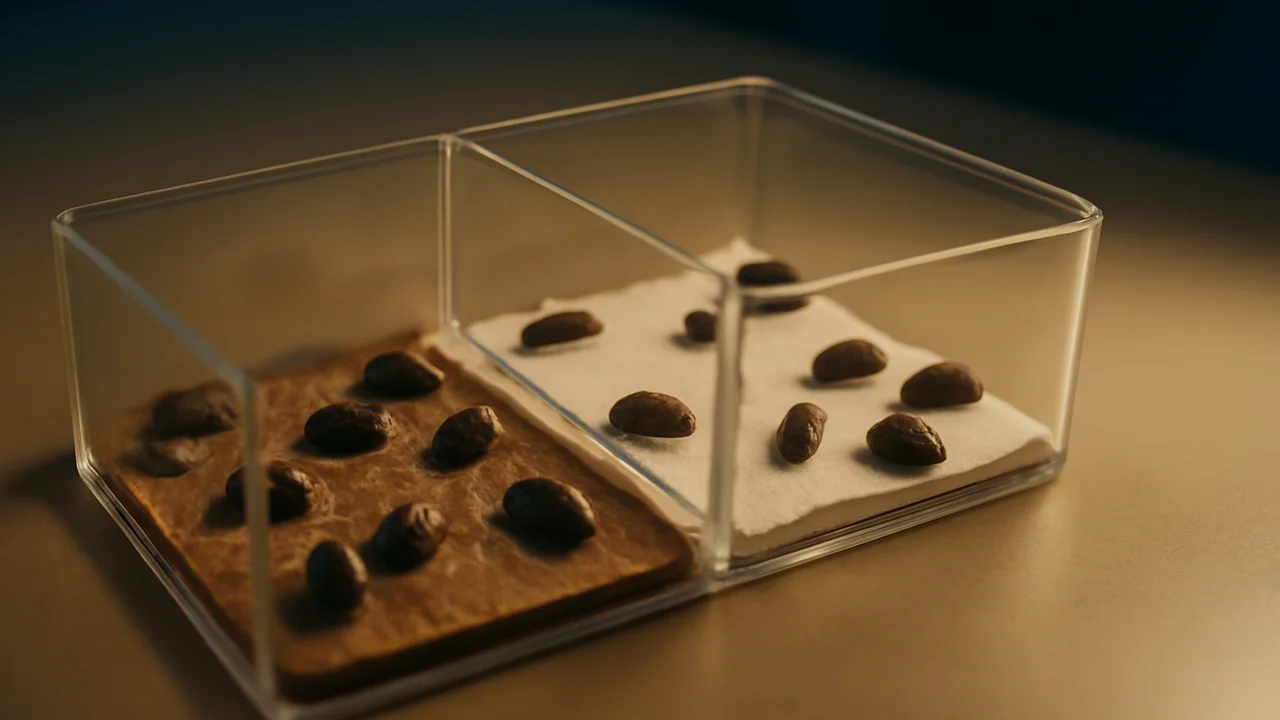
- Line both halves of a two-chamber dish with paper towel. Dampen one half with 5 mL of water; leave the other dry.
- Place ten pill bugs in the center gap with a soft brush. Cover the chamber so light is even.
- Count the bugs on each side every minute for 10 minutes. Record each count.
- Swap which side is damp and repeat, so that a preference for one end of the chamber is not mistaken for a preference for moisture.
- Note any clusters: how many bugs touch at least one other bug at minute 10.
- Run a second variable (light versus dark) the same way, then pool class data and run chi-square tests.
| Minute | Trial 1 damp side | Trial 1 dry side | Trial 2 damp side | Trial 2 dry side | Bugs in clusters |
|---|---|---|---|---|---|
| 1 | |||||
| 2 | |||||
| … | |||||
| 10 | |||||
| Total |
Worked example 1: is the result more than chance? If pill bugs have no preference, we expect half on each side. Suppose ten counts of ten bugs give 72 observations on the damp side and 28 on the dry side, out of 100. Expected: 50 and 50. χ2 = (72 − 50)2/50 + (28 − 50)2/50 = 484/50 + 484/50 = 19.36. With 1 degree of freedom the critical value at the 0.05 level is 3.84; 19.36 is far larger, so we reject “no preference” (illustrative data).
Worked example 2: a result that could be chance. A light-versus-dark trial gives 44 and 56: χ2 = 36/50 + 36/50 = 1.44, below 3.84, so that difference could be chance. Counting the same bugs repeatedly means the observations are not fully independent, so treat the test as a guide rather than a proof, and pool several groups’ data.
Groups versus alone (sample data). In a published-style experiment, bugs were weighed before and after two hours in dry air, either alone or in groups of ten. Isolated bugs lost about 9% of body mass; grouped bugs about 4%. You will not run this test in class, because it stresses the animals; use the sample numbers to compare individuals in groups with individuals alone.
Caring for animals. Handle pill bugs gently, keep them moist and out of the sun, keep trials short, and return them to where you found them the same day. Animal investigations in this course never cause pain or death.
Guided Exercises ~15 min
Use the illustrative data or your own pooled counts.
Independent Practice ~10 min
Lab analysis (in your Colony Notebook).
Write a CER conclusion: do pill bugs show a moisture preference? Report your pooled counts, your chi-square value and the critical value, and explain the result as a behavior that improves survival.
Find one more piece of evidence (from the cluster counts, the sample water-loss data or a reliable source) that connects pill bug grouping to survival, and say whether it shows cause or only correlation.
Closure ~5 min
A simple behavior, tested with statistics, has a survival payoff. Next: when does group behavior pay for animals that take risks to help others?
Exit ticket: what does a chi-square value larger than 3.84 tell you, and what does it NOT tell you?
How confident are you that you can design a behavior investigation and use chi-square to decide whether a behavior differs from chance?
Teacher notes
Timing: spans two 50-minute periods: day 1 runs the moisture trials; day 2 runs the light trial, pools class data and writes the analysis.
Materials: pill bugs collected from the schoolyard (10 per group), two-chamber dishes or two Petri dishes joined with tape, paper towels, droppers, soft brushes, covers, timers, calculators.
Animal care: collect bugs the same day, keep them in a container with damp soil and leaves, and release them where found after class.
Data note: the 72 : 28 and 44 : 56 splits and the water-loss percentages are illustrative.
Listen for: “the bugs like water” (feelings language); “chi-square proves it”; forgetting to swap sides.
Support / stretch: give a chi-square table with the (O − E)2/E column built. Stretch: test whether bugs cluster more in dry than damp chambers, and predict the result from the water-loss data.