2.01 From Kelp Forest to Urchin Barren
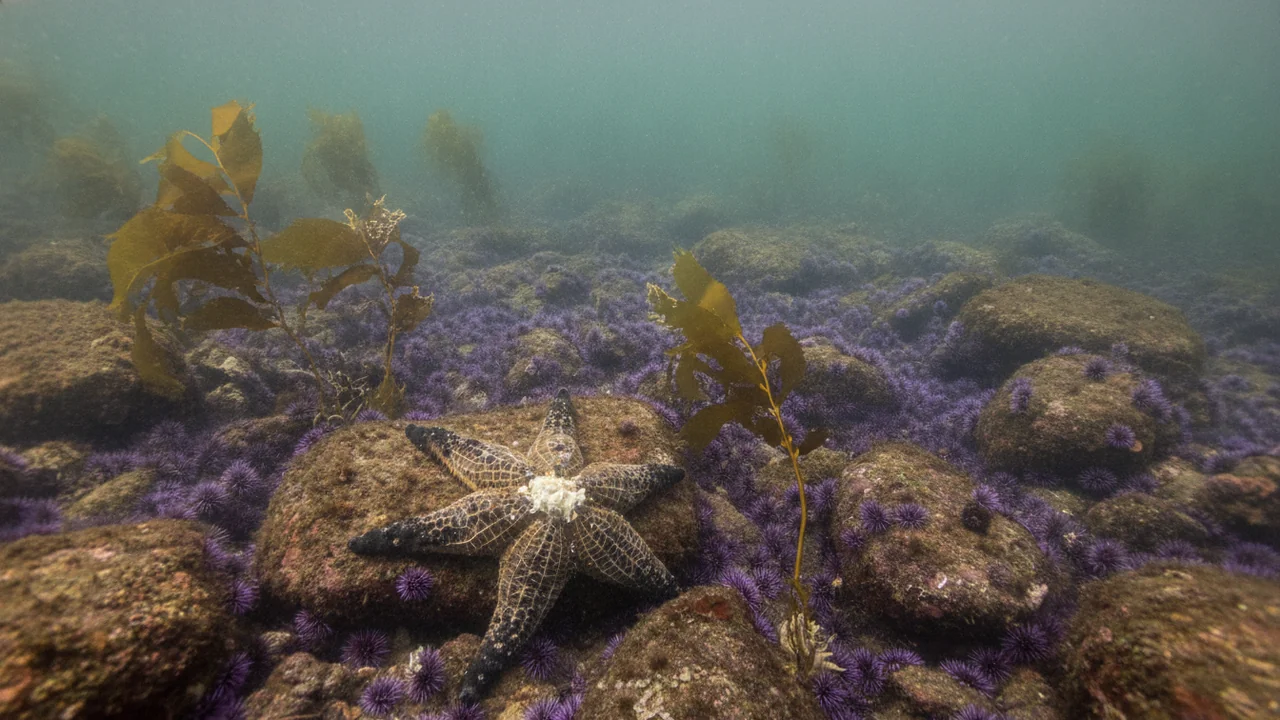
Restore the Balance
How can we design a solution that reduces a human impact on an ecosystem and helps it regain stability?
The mystery: Along a stretch of temperate Pacific coast, dense kelp forests turned into bare reefs carpeted with purple sea urchins after predator loss and a marine heat wave, and many reefs stayed that way after the water cooled.
explain how interactions in a food web keep an ecosystem relatively stable, describe how a chain of changes turned kelp forests into urchin barrens, and ask questions about whether the change can be reversed.
- I can explain how complex interactions in ecosystems help keep the numbers and types of organisms stable, and how changing conditions can lead to a new ecosystem.
Phase 1: Spark
Warm-Up ~5 min
Do Now. Look at two images of the same rocky reef: one a tall, golden-brown kelp forest full of fish; the other bare rock carpeted with purple sea urchins. Write three things you notice and one question you have.
Ocean temperatures along the coast return to normal after a heat wave. What do you predict happens to an urchin barren?
Instruction ~10 min
The phenomenon. Along one stretch of temperate Pacific coast, bull kelp once grew in dense forests, anchored to rock and rising to spread across the surface each summer. Kelp forests shelter fish, feed abalone and sea urchins, and support fishing and diving towns. Within a few years after 2014, most of the kelp canopy along that coast disappeared. Divers found reefs covered with purple sea urchins and almost no kelp: an urchin barren. Abalone, which also eat kelp, starved, and the fishery for them had to close. Our question for the unit: what keeps an ecosystem stable, what pushes it into a new state, and what can people do about it?
A food web in balance. Kelp is the producer. Purple sea urchins graze on kelp, mostly on drift pieces that break off, when kelp is plentiful. Predators keep urchin numbers in check. On this coast the main urchin predator was the sunflower sea star, a large, fast (for a sea star) predator. On other coasts, sea otters eat urchins, crabs and abalone. A predator whose effect on a community is much larger than its numbers would suggest is called a keystone species. In a stable ecosystem, these interactions keep the numbers and kinds of organisms roughly consistent from year to year, even as individuals are born and die. That is the first half of HS-LS2-6.
A chain of changes. The second half is that changing conditions can create a new ecosystem. Three changes arrived close together. Starting in 2013, sea star wasting disease killed sea stars along the Pacific coast of North America, and sunflower sea stars declined by more than 90 percent across much of their range. From 2014 to 2016 a marine heat wave in the northeast Pacific, nicknamed “the Blob,” brought warm, nutrient-poor water that stressed kelp. And this coast had no sea otters: the fur trade had wiped them out there in the 1800s. With their main predator gone and drift food scarce, purple urchins left their crevices and grazed the remaining living kelp down to bare rock. Their numbers rose many times over.
Why barrens persist. Even after the water cooled, many barrens did not recover. Starving urchins can survive for a long time on very little food, and they eat young kelp as soon as it appears. The barren has its own stability. This is a regime shift, not just a bad year. Returning to a kelp forest may need a push, such as removing urchins, and that is where engineering comes in.
Otters as evidence. Sea otters were hunted almost to extinction for their fur. Where they have been protected and have recovered, scientists have compared reefs with and without otters; reefs with otters tend to have fewer urchins and more kelp. Comparing places like this is one way to test the keystone idea.
Asking questions. Can the kelp come back? is a start. Does kelp regrow faster on reefs where divers have removed urchins than on nearby reefs where they have not? is testable, and restoration teams are testing it.
Reading: OpenStax Biology 2e, Sections 44.4 (Aquatic Biomes) and 45.6–45.7 (Community Ecology) and Chapter 47 (Conservation Biology and Biodiversity), CC BY 4.0.
Guided Exercises ~15 min
Work with a partner and sketch as you go.
Independent Practice ~10 min
Model the reef.
Draw two food-web models of the reef, one before 2013 and one after 2016, using arrow thickness to show how strong each interaction is. Then write two testable questions your models raise.
Explain in a paragraph how food-web interactions kept the kelp forest stable, and how three changing conditions together produced a new ecosystem.
Closure ~5 min
We have a phenomenon about stability and change. Next lesson, we meet the client and choose our ecosystems.
Exit ticket: why might returning ocean temperatures to normal NOT be enough to bring the kelp back?
How confident are you that you can explain how food-web interactions keep an ecosystem stable and how changing conditions produced urchin barrens?
Teacher notes
Materials: two reef images (generic kelp forest and urchin barren), a short reading on the kelp-to-barren chain, Wonder Board chart paper.
Fact notes: sea star wasting disease (from 2013) and the 2014–2016 northeast Pacific marine heat wave are widely documented; the coast itself is left generic.
Listen for: “urchins are bad” (they are part of a healthy forest; the problem is the lost control); single-cause explanations.
Support / stretch: give a food-web card sort (kelp, urchin, abalone, sea star, otter, fish). Stretch: read a short summary of the classic otter, urchin and kelp studies from the Aleutian Islands and compare.