3.04 Many Lines, One Conclusion: The Evidence for Common Ancestry
analyze fossil, anatomical, embryological, molecular and biogeographic evidence, compare DNA sequences, and argue in more than one format that independent lines of evidence support common ancestry.
- I can identify and explain evidence for common ancestry and biological evolution from DNA sequences, including similarities and differences among species.
- I can identify and explain evidence from patterns of amino acid sequences, including how different DNA sequences can code for the same amino acid.
- I can identify and explain evidence from the fossil record and anatomical or embryological similarities that support common ancestry and biological evolution.
- I can explain how each line of evidence—such as DNA sequences, amino acid patterns, fossil records, and anatomical or embryological similarities—supports the claim of common ancestry and biological evolution.
- I can communicate how patterns observed at different spatial and temporal scales, like DNA sequences, embryological development, and fossil records, together provide evidence for causal relationships in biological evolution and common ancestry.
Phase 2: Investigate
Warm-Up ~5 min
Do Now. A detective has a fingerprint, a camera image and a receipt that all point to the same person. Why is that stronger than three fingerprints? Write two sentences.
Why are several INDEPENDENT lines of evidence stronger than one?
Instruction ~10 min
Why several lines of evidence? A conclusion supported by one kind of evidence could be wrong if that evidence is misleading. A conclusion supported by several independent kinds, gathered by different methods, is far stronger. Common ancestry, the idea that living species descend with modification from shared ancestors, is supported by at least five. Today you visit an evidence gallery with a station for each.
1. Fossils. Rock layers preserve a sequence, with older layers generally below younger ones. Fossils show that life has changed over time and include forms that link groups. The early whales are a well-studied example: Pakicetus, a land mammal with an ear structure found only in whales, from about 50 million years ago; Ambulocetus, which could walk and swim; Rodhocetus, with shorter legs; and Basilosaurus and Dorudon, fully aquatic whales about 40 million years old that still had tiny hind limbs. Ice-age fossil sites across North America preserve animals such as mammoths and saber-toothed cats that are now extinct.
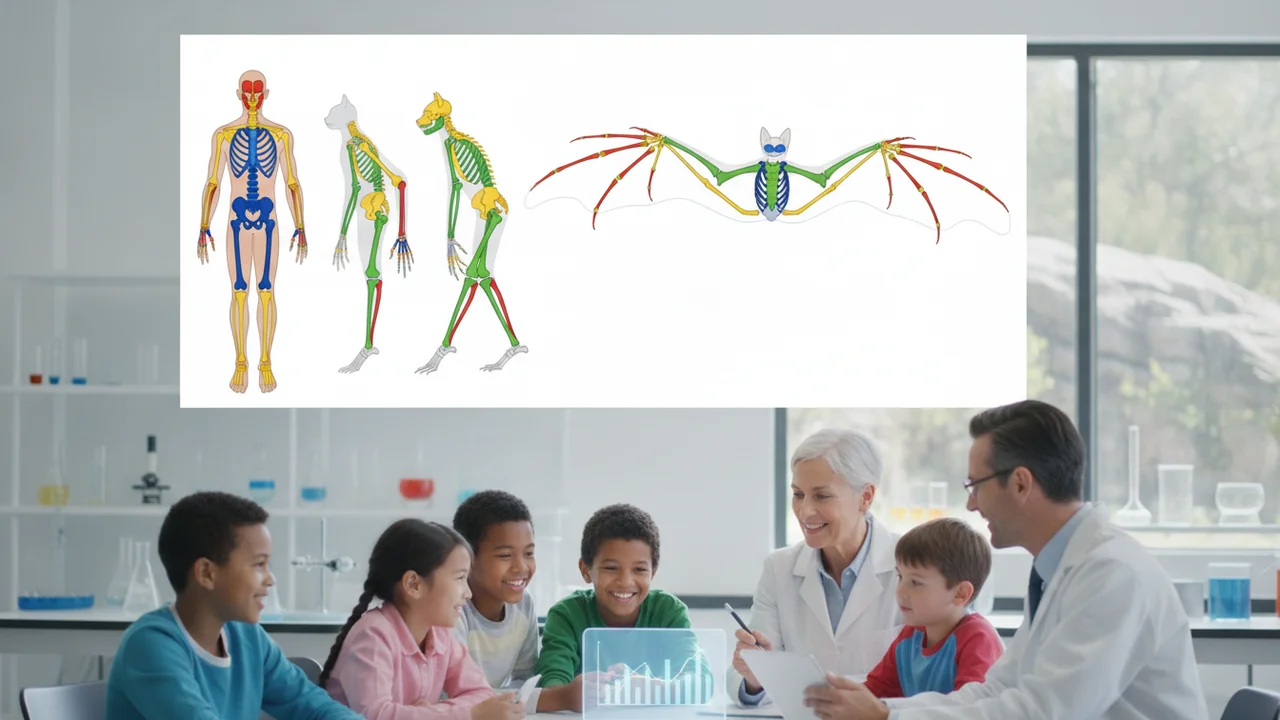
2. Anatomy. Homologous structures have the same underlying pattern because they were inherited from a common ancestor, even when they now do different jobs. A human arm, a cat’s foreleg, a whale’s flipper and a bat’s wing all have one upper bone (humerus), two lower bones (radius and ulna), wrist bones and finger bones. Vestigial structures, reduced remnants of structures that were functional in ancestors, tell the same story: living whales have small pelvic bones embedded in their bodies. By contrast, analogous structures, such as a bird’s wing and a butterfly’s wing, do similar jobs but are built differently; they show similar demands, not close ancestry.
3. Embryology. Early embryos of fish, chickens and humans all have a series of pharyngeal arches in the neck region. In fish these develop into gill structures; in humans they form parts of the jaw, ear and throat.
4. Molecules. All living things use DNA and nearly the same genetic code, which you used in Biology I. The more closely related two species are, the more similar their DNA. The National Human Genome Research Institute notes that human and chimpanzee DNA is about 98.8% identical. Because the code is redundant, different DNA sequences can code for the same amino acid (the mRNA codons GGU, GGC, GGA and GGG all code for glycine), so protein sequences change more slowly than DNA. Humans and other primates even share the same broken copy of a gene (GULO) that other mammals use to make vitamin C, which is why we need it in our diet. Shared mistakes are hard to explain except by shared ancestry.
5. Biogeography. The finches and mockingbirds of the Galápagos Islands, which Darwin studied, are found nowhere else, yet they most resemble species on the nearby South American mainland. Island species that most resemble the nearest mainland species are what common ancestry predicts.
Worked example 1: comparing sequences (illustrative). Compare a 20-base stretch of the same gene in four species with species A. B differs at 1 base (95% identical), C at 2 (90%), D at 5 (75%). The simplest tree groups A with B first, then C, then D: the fewer the differences, the more recent the shared ancestor. Real studies compare thousands of bases and get trees that match the fossil and anatomical evidence, which is exactly the point: independent lines agree.
Worked example 2: patterns at different scales. The whale fossils span about 10 million years of rock; a whale embryo develops hind-limb buds in weeks and then loses them; whale DNA groups whales closest to hippos among living mammals. Three scales of time and space, one consistent branching pattern. HS-LS4-1 asks you to communicate exactly this kind of agreement.
Gallery procedure. (This lab spans two 50-minute periods.) Rotate through five stations in 8 minutes each. At each, record the evidence, the method that produced it and what it predicts if common ancestry is true. Then complete the sequence table and draw a tree.
| Station | Evidence observed | Method (how it was gathered) | What common ancestry predicts | Does it match? |
|---|---|---|---|---|
| Fossils | ||||
| Anatomy | ||||
| Embryology | ||||
| Molecules | ||||
| Biogeography |
Reading: OpenStax Biology 2e, Chapter 18 (Evolution and the Origin of Species), Chapter 19 (The Evolution of Populations) and Sections 20.1–20.2 (Phylogenies); OpenStax Concepts of Biology, Chapters 11 and 12. CC BY 4.0.
Guided Exercises ~15 min
Use your gallery record.
Independent Practice ~10 min
Write the argument, in two formats.
Write your argument for common ancestry using at least three lines of evidence from the gallery. Explain why agreement among independent lines makes the conclusion stronger than any single line. Cite the source of each piece of evidence (station card, OpenStax section or NHGRI).
Show the same argument in a second format: a labeled tree with the sequence differences on its branches, or a one-minute spoken script for a museum guide.
Closure ~5 min
Five methods, one branching pattern. Next: we watch selection produce adaptation in a simulation and in bacteria.
Exit ticket: which line of evidence would be the most convincing on a museum panel, and why? Name its source.
How confident are you that you can explain and communicate how several independent lines of evidence support common ancestry?
Teacher notes
Timing: spans two 50-minute periods: day 1 is the gallery; day 2 is the sequence table, tree and written argument.
Materials: five station cards with images (whale fossil sequence, forelimb bones, embryo drawings, a short DNA alignment, an island map), colored pencils, printed sequence strips.
Fact check: the 98.8% figure is from NHGRI; whale dates are approximate and widely cited; GULO pseudogene evidence is standard in textbooks.
Listen for: “humans came from chimpanzees” (both share an ancestor); treating analogous structures as homologous; reading a tree as a ladder.
Support / stretch: pre-fill the method column. Stretch: build a tree from a real alignment in a free online tool and compare it with the fossil order.