3.06 Splitting, Spreading or Vanishing: A CER on Environmental Change, Then Ideate
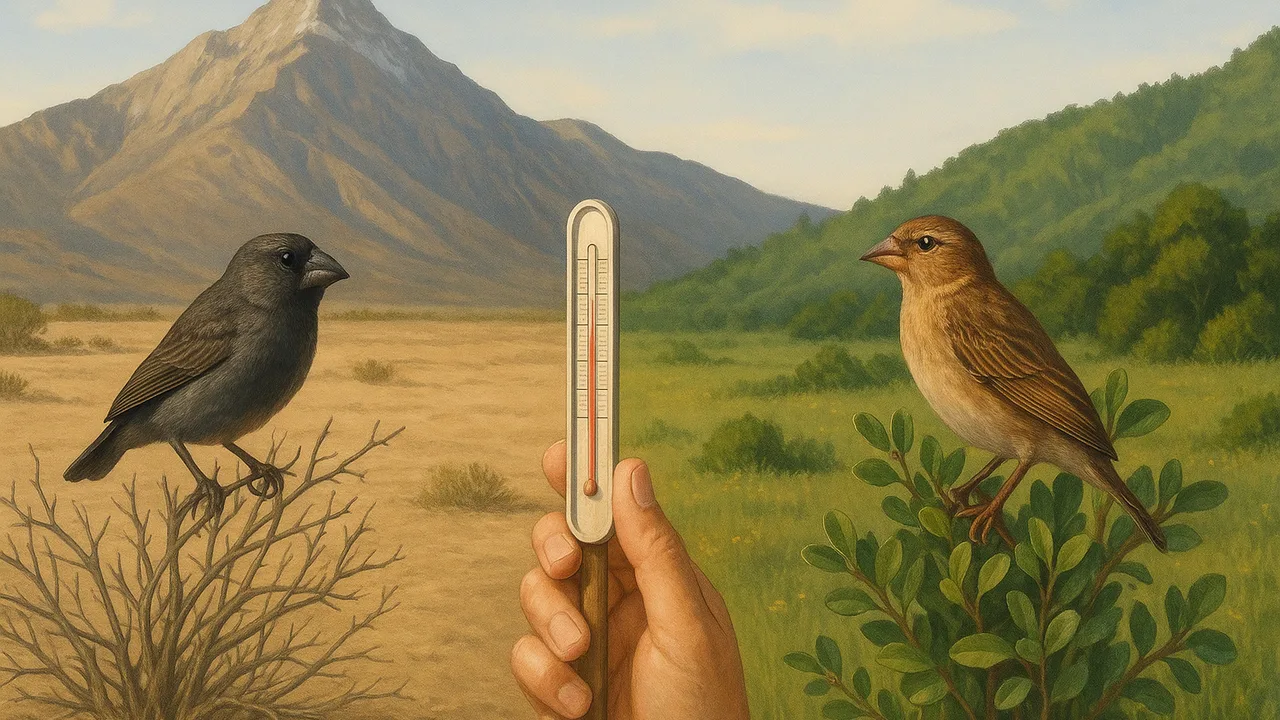
evaluate claims that environmental change causes species to increase, emerge or go extinct, judge whether the evidence shows cause or only correlation, revise our model of the salamander ring, and brainstorm exhibit ideas.
- I can use additional evidence to analyze how valid, reliable, and strong the given evidence is, and explain its strengths and weaknesses in supporting arguments about group outcomes.
- I can assess whether the given evidence can be used to show cause-and-effect or just correlation between environmental changes and changes in species numbers, diversity, or the appearance or extinction of species.
- I can evaluate how well the given evidence supports logical arguments that link environmental changes to changes in the number of individuals or species, based on factors that affect survival and reproduction.
Phase 3: Make Sense
Warm-Up ~5 min
Do Now. Ice cream sales and sunburns both rise in the same months. Does ice cream cause sunburn? Write one sentence naming the hidden factor.
Two variables rise together over ten years. What can you conclude from that alone?
Instruction ~10 min
Three claims to evaluate. HS-LS4-5 asks you to evaluate evidence for claims that environmental change leads to (1) more individuals of some species, (2) new species, or (3) extinction. Today you weigh three cases and judge each piece of evidence for validity (does it measure what the claim is about?), reliability (would it come out the same again?) and whether it shows cause or only correlation.
Case A: lizards after the hurricanes. In 2017, researchers had measured anole lizards on two small Caribbean islands just days before two major hurricanes struck. Returning after the storms, they found that the surviving lizards had, on average, larger toe pads and longer front legs than the population measured before. Strengths: the same populations were measured before and after, so the change is not just a difference between places; a lab test showed that lizards clinging to perches in strong wind hold on with their front legs. Weaknesses: only two islands; the study shows which lizards survived, and later generations would have to be measured to show whether the shift is inherited.
Case B: a salamander decline (sample data). A survey at the dry edge of the ring recorded salamanders per 100 cover boards and summer rainfall:
| Year | Summer rain (cm) | Salamanders per 100 boards |
|---|---|---|
| 1 | 14 | 22 |
| 3 | 12 | 19 |
| 5 | 9 | 15 |
| 7 | 8 | 11 |
| 9 | 6 | 8 |
The claim: drier summers are causing the population to decline toward local extinction. The two columns fall together: a correlation. A mechanism exists (moist skin, water loss), which strengthens the claim, but other changes over the same years (logging, a new predator, fewer survey visits) could also explain it. Stronger evidence would include counts at wetter sites over the same years (a comparison), lab data on water loss, and survival of marked individuals in dry and wet years.
Case C: the ring itself. The claim: isolation across the dry valley led to the emergence of new species. Evidence: neighbors interbreed; the ends rarely do; genetic studies show greater differences between populations farther apart around the ring. This is a pattern in space, not an experiment, so it supports the claim through consistency with what speciation predicts rather than proving it.
Worked example: revising the ring model. Our 3.01 model said “salamanders spread around the valley and changed.” Version 2 adds the mechanisms we now have evidence for: Because the valley floor is too dry, gene flow occurs only along each side. Because individuals vary in heritable pattern and predators find some patterns more easily (dot lab, sample data 0.50 → 0.89), local patterns are selected: blotches on dark leaf litter inland, a newt-like look on the coast. Because differences accumulate and add up over the length of the ring, the ends are reproductively isolated. And DNA comparisons, at the scale of molecules, show the ring populations share a common ancestor, matching the pattern seen at the scale of geography.
Ideate. Now turn the science into exhibit ideas. Rules: no idea is wrong in the first ten minutes; build on others’ ideas (“yes, and”); aim for at least eight. Each idea must teach one of: the four factors, isolation and speciation, or a line of evidence for common ancestry.
Guided Exercises ~15 min
Evaluate each case with your team, then answer.
Independent Practice ~10 min
Write the CER, then ideate.
Choose Case A or Case B. Write a CER evaluating the claim: state the claim, judge one strength and one weakness of the evidence for validity or reliability, decide whether it shows cause or correlation, and name the additional evidence that would settle it.
Write version 2 of your ring model using the frame “We used to think… The new evidence… Now we think…” Then list at least eight exhibit ideas and star your team's top three.
Closure ~5 min
We have a revised model and a pile of ideas. Next: we design competing exhibit stations and choose with a decision matrix.
Exit ticket: in one sentence each, give an example of correlation and an example of causation from this unit.
How confident are you that you can evaluate whether evidence shows that environmental change causes species to increase, emerge or go extinct?
Teacher notes
Materials: case cards A–C, the 3.01 ring model posters, sticky notes for ideation, timers.
Fact check: Case A follows Donihue and colleagues’ 2018 study of Anolis scriptus on two islands in the Turks and Caicos after Hurricanes Irma and Maria; it is described only at the level of its published summary. Case B is sample data.
Listen for: “proves” used for correlational data; “the lizards grew bigger toes to survive” (need-based language).
Support / stretch: give an evidence-evaluation organizer (valid? reliable? cause or correlation? missing?). Stretch: design the study that would turn Case B into a causal test, including a control.