3.09 Showcase: Explaining the Ring for the Museum
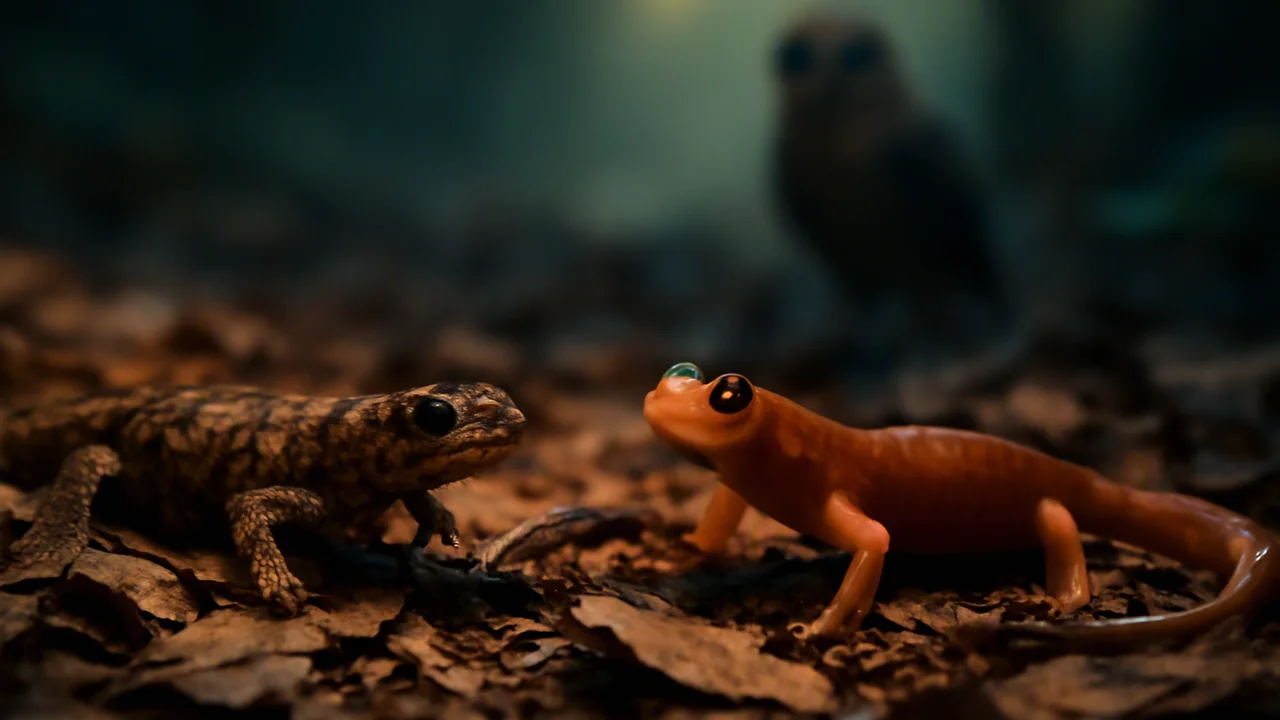
construct and defend an evidence-based explanation, with a labeled map or model, of how natural selection and isolation could have produced the salamander ring, and present our exhibit station to the museum team.
- I can explain how genetic variation leads to differences in traits among individuals in a population.
- I can reason that individuals with traits that give them a competitive advantage are more likely to survive and reproduce because of competition for limited resources.
- I can describe how individuals that survive and reproduce more often pass their genetic variations to more individuals in the next generation.
- I can use evidence to explain how biotic and abiotic factors in ecosystems can change gene frequencies in populations through natural selection.
- I can explain how an increase in the frequency of a gene leads to more individuals in a population showing a particular trait over generations.
- I can use reasoning and evidence to show how natural selection leads to populations becoming adapted to their environment through the spread of advantageous traits.
- I can evaluate how well the given evidence supports logical arguments that link environmental changes to changes in the number of individuals or species, based on factors that affect survival and reproduction.
Phase 5: Prove It
Warm-Up ~5 min
Do Now. The museum team has four minutes for your station. Write the one sentence you most want every visitor to remember.
Why does the dry valley floor act as a barrier for the salamanders?
Instruction ~10 min
The question. How could a population of salamanders spreading around a large, dry valley have come to vary so much that the two ends of the ring behave like separate species? You are writing for the museum’s exhibits team: people who know the animals well, but who need an explanation that visitors can follow.
What a strong explanation contains.
- The four factors (HS-LS4-2). Apply each factor to the salamanders: they produce more young than survive; individuals vary in color and pattern, partly heritably, through mutation and sexual reproduction; predators and limited damp habitat mean not all survive; and those whose coloring suits their local environment leave more offspring. Use your predation-lab data to show how an advantage changes a trait’s proportion.
- Adaptation to local environments (HS-LS4-4). Explain why a blotched pattern could be favored in the inland forests (camouflage on leaf litter) and why a newt-like appearance could be favored on the coast, where predators that have learned to avoid the toxic newt may also avoid salamanders that resemble it. Present these as hypotheses supported by evidence, and say what evidence would test them.
- Isolation and speciation (HS-LS4-5). Explain how the hot, dry valley, unsuitable for a lungless salamander, limits gene flow across it, and how differences accumulated around the ring until the ends were reproductively isolated.
- Evidence of common ancestry (HS-LS4-1). Explain what kind of evidence (for example, DNA comparisons among populations) would show that the ring populations share a common ancestor, and how it would be interpreted, in at least two formats.
- Honest uncertainty. Scientists agree that ring populations like these have diverged through evolution. They debate details: how many species to recognize, and whether all populations spread around the ring in a simple sequence. Say what is well supported and what is debated.
Worked example: one link. Claim: a blotched pattern increased in inland populations because it reduced predation. Evidence: in the predation lab, the color matching the background rose from a proportion of 0.50 to about 0.89 in four generations, while the control habitat showed no steady trend; in the finch case, a real selective event shifted a trait distribution within one generation. Reasoning: if predators hunting on inland leaf litter find blotched salamanders less often, blotched individuals survive and reproduce more, and because the pattern is heritable its proportion rises over generations. Note the limit: the lab is a model, so field data would be needed to confirm the mechanism.
Presentation. In four minutes, live or recorded, walk the museum team through your version 2 station and your map or model, and answer one question about your evidence.
Guided Exercises ~15 min
Rehearse and check your explanation with your team.
Independent Practice ~10 min
After the presentations, reflect.
What question did the museum team ask, and how well did your evidence answer it? What would you change in your explanation or station?
Name one idea from another team's station that you would borrow, and explain the evidence behind it.
Project task: Explaining the Ring
Write an evidence-based explanation of 900–1,300 words, with at least one labeled map or model, of how the salamanders around the valley came to vary around the ring and to behave like separate species where the ends meet. Use the four factors of natural selection, adaptation to local environments (including camouflage and resemblance to the toxic newt), and the role of geographic isolation. Use evidence from the predation lab, the lines-of-evidence argument, the Natural Selection simulation and the finch case, cite every source, and state honestly where scientists still debate the details. Include your version 2 exhibit station and its visitor-test result as an appendix. Then present in four minutes, live or recorded.
Submission workflow
- Stage 1: Plan. Your labeled map or model, a list of the evidence for each section with its source, and an outline linking each section to a standard.
- Stage 2: Peer-reviewed draft. A partner checks every claim for evidence and every number for a source or a “sample data” label, and marks any need-based language; submit their notes and your revision plan.
- Stage 3: Final explanation. 900–1,300 words with revised map or model, citations, the station appendix and a limitations paragraph.
- Stage 4: Presentation and defense. Four minutes, live or recorded, answering one question about your evidence.
How it is scored
| Criterion | What proficient looks like |
|---|---|
| Natural selection (HS-LS4-2) | Applies all four factors accurately to the salamanders, distinguishes selection (process) from evolution (result), and uses valid, reliable sources. |
| Adaptation (HS-LS4-4) | Explains how biotic and abiotic factors favored different patterns in different environments, presented as testable hypotheses with evidence. |
| Isolation and speciation (HS-LS4-5) | Explains how the barrier limits gene flow and how accumulated differences lead to reproductive isolation; evaluates the strength of the evidence. |
| Common ancestry (HS-LS4-1) | Explains which evidence would show shared ancestry and how to interpret it, communicated in at least two formats with sources. |
| Exhibit and revision | The station communicates the science accurately; changes from version 1 to version 2 are justified by visitor-test data. |
| Evidence and communication | Every number sourced or labeled sample data; uncertainty stated honestly; the presentation answers a question accurately. |
Closure ~5 min
You gave the museum an accurate, evidence-based station. Next: the unit checkpoint.
Exit ticket: which Wonder Board question can you now answer best? Write the question and your answer.
How confident are you that you can build and defend an explanation of adaptation and speciation using evidence?
Teacher notes
Timing: the task spans about three periods (planning, peer review, presentations); this lesson is the presentation day, with drafting done in class and at home.
Setup: invite staff, family or a museum or nature-center educator to role-play the exhibits team. Visitors can score the communication row.
Listen for: need-based language; “proves” for correlational evidence; mimicry stated as fact rather than a hypothesis.
Support / stretch: give a section-by-section outline with sentence frames. Stretch: research one other proposed ring species and compare its evidence with the salamanders’.