4.01 A Coastal Elephant Seal Colony: Crowds, Fights and a Comeback
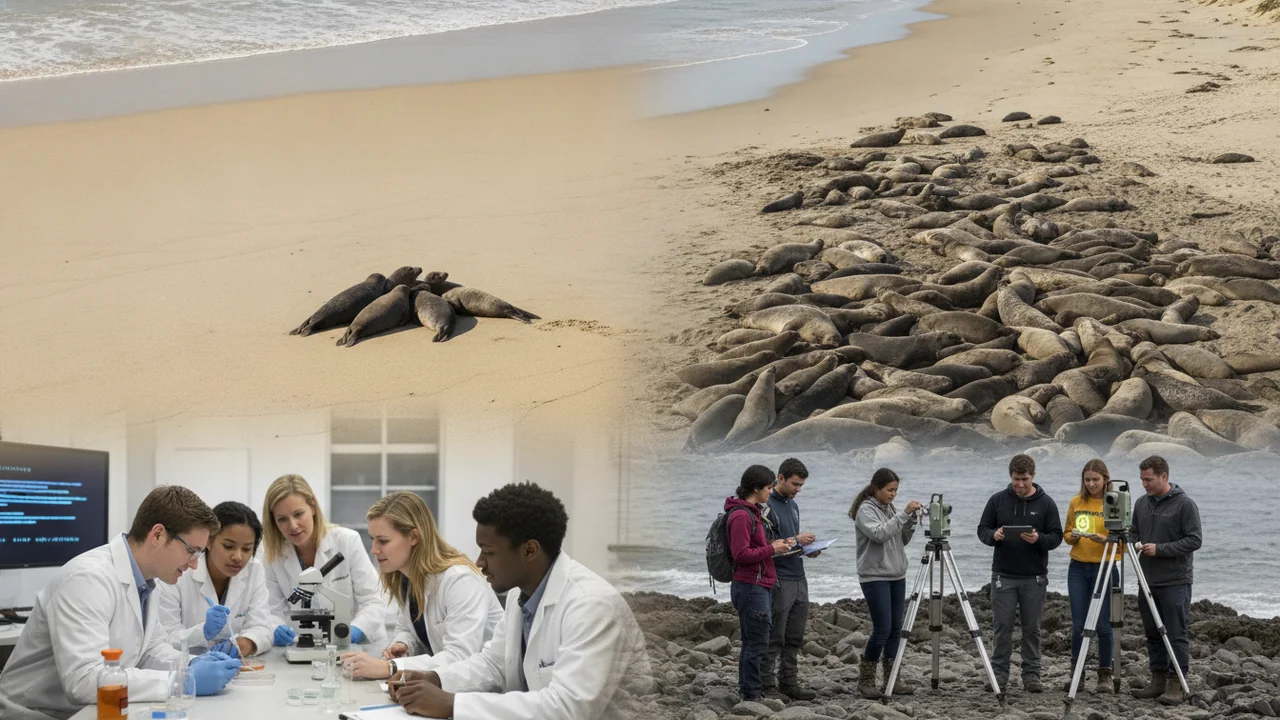
The Colony Comeback Plan
How do behavior and population size shape a species’ survival, and how should a sanctuary protect a colony that came back from near extinction?
The mystery: Northern elephant seals were hunted until only a small remnant survived; today a coastal elephant seal colony crowds its beach, where a few dominant males father most pups and the whole species carries little genetic variation.
describe the recovery and breeding behavior of northern elephant seals, explain how group behavior affects which individuals reproduce, and ask questions about the population’s growth and genetic variation.
- I can explain how group behavior can increase the chances for an individual and a species to survive and reproduce.
- I can identify the evidence that is being used to support the explanation about group behavior and survival.
Phase 1: Spark
Warm-Up ~5 min
Do Now. Study the colony table. Write what you notice about how fast the colony grew in each five-year period, and one thing you wonder about the seals’ behavior on a crowded beach.
| Season | Pups born at the colony (sample data) | Note |
|---|---|---|
| Year 0 | 10 | First pups born on the mainland beach |
| Year 5 | about 60 | Colony spreading along the beach |
| Year 10 | about 300 | Rapid growth |
| Year 15 | about 900 | Beach getting crowded |
| Year 20 | about 1,600 | Growth slowing |
| Year 25 | about 2,000 | Close to the highest count |
Most pups in a colony are fathered by a few dominant males. What do you predict about genetic variation in the next generation, compared with a population where many males father pups?
Instruction ~10 min
The phenomenon. Every winter, thousands of northern elephant seals haul out on beaches along the Pacific coast of North America. At a coastal elephant seal colony, males can weigh well over a tonne and roar through their trunk-like noses; females give birth and nurse pups for about four weeks. It is a spectacle of abundance, and it almost did not happen. In the 1800s elephant seals were killed in huge numbers for the oil in their blubber. By the 1890s they were thought to be extinct; a small group survived on a single island off Mexico’s Pacific coast. Estimates of how many survived vary, from a few dozen to about a hundred. Protected first by Mexico and later by the United States, they spread north again, recolonizing islands and then mainland beaches over the following decades. NOAA estimated the total population at more than 200,000 animals in 2010. Our question for the unit: how do behavior and population size shape a species’ survival, and what did the near-extinction leave behind in its genes?
Worked example 1: how fast is that recovery? Suppose (a rough assumption for this calculation) that about 100 seals survived in 1890 and there were about 200,000 in 2010. The per-capita growth rate would be r = ln(200,000/100) ÷ 120 = ln 2,000 ÷ 120 ≈ 0.063 per year, a doubling time of about ln 2 ÷ 0.063 ≈ 11 years. The number is only as good as the assumption, but it shows how steadily a protected population with abundant food can grow. If only 50 had survived, r = ln 4,000 ÷ 120 ≈ 0.069: the conclusion barely changes, which is reassuring.
Behavior on the breeding beach. Elephant seals breed in dense colonies. Males arrive first and fight, sometimes bloodily, to establish a dominance hierarchy. The highest-ranking males control access to groups of females, called harems. Long-term studies at breeding colonies found that a small number of dominant males father most of the pups each season, while many males never mate at all. Females gather in groups on the beach to give birth; crowding has costs, since pups can be separated from their mothers or crushed in fights, as well as benefits. HS-LS2-8 asks you to evaluate evidence about how group behavior affects individuals’ and species’ chances to survive and reproduce. The colony is one case; you will compare others.
Worked example 2: evidence for a behavior claim (sample data). Claim: rank in the hierarchy determines which males reproduce. Evidence: in one season at a sample colony, genetic paternity tests on 100 pups assigned 60 to the 5 highest-ranking males, 30 to 15 middle-ranking males, and 10 to the remaining 80 males. The top 5 males (5% of the 100 males) fathered 60% of the pups. Identify the evidence: paternity tests (who fathered pups) and observed rank (who won contests). The tests are strong evidence because they measure reproduction directly, rather than guessing from who was seen mating.
Behavior and genes. Two features of this story affect genetic variation. First, the population passed through a bottleneck: all of today’s seals descend from the few that survived, carrying only the alleles those few happened to have. Studies of northern elephant seals have found far less genetic variation than in their close relatives, the southern elephant seals, which were never reduced so severely. Second, when only a few males father most pups, fewer individuals pass on their genes each generation, which can make chance losses of alleles more likely.
Asking questions. Why do elephant seals fight? is a start. What fraction of the males on the beach fathered at least one pup this season? is testable with genetic paternity tests, and researchers have done it.
Reading: OpenStax Biology 2e, Sections 19.1–19.2 (Population Evidence of Evolution; Population Genetics) and Section 45.7 (Behavioral Biology); OpenStax Concepts of Biology, Chapter 11. CC BY 4.0.
Guided Exercises ~15 min
Work with a partner. Show the arithmetic for every calculation.
Independent Practice ~10 min
Start your Colony Notebook.
Make a timeline of the northern elephant seal from 1800 to today, marking hunting, the bottleneck, protection and recolonization. Then write two testable questions about their behavior or genetics.
Explain how the harem system can increase one male's chance to reproduce but lower another's, and identify the evidence that supports your explanation.
Closure ~5 min
We have a phenomenon and a question. Next lesson, we meet the client and form our project teams.
Exit ticket: in two sentences, explain how a group behavior on the breeding beach affects which seals reproduce, and name one cost of living in a dense colony.
How confident are you that you can describe how elephant seal breeding behavior affects which individuals reproduce, and how the population recovered?
Teacher notes
Materials: the colony table (projected), calculators with ln, photographs or a public webcam of an elephant seal beach (optional), chart paper for the Wonder Board.
Fact check: the hunting history, the bottleneck and the low genetic variation compared with southern elephant seals are widely documented; NOAA Fisheries publishes the stock assessment. The colony table and the paternity numbers are sample data.
Sensitivity: fights can be bloody; keep images to wide shots of the beach.
Listen for: “males fight for the good of the species”; “a big population means healthy genes”.
Support / stretch: give a timeline template. Stretch: plot ln (pups) against year for the colony table and decide where growth stops being exponential.