3.01 A Ring of Salamanders Around a Valley
One Population, Two Species?
How can one population become two species, and how can we show people the evidence that living things share common ancestors?
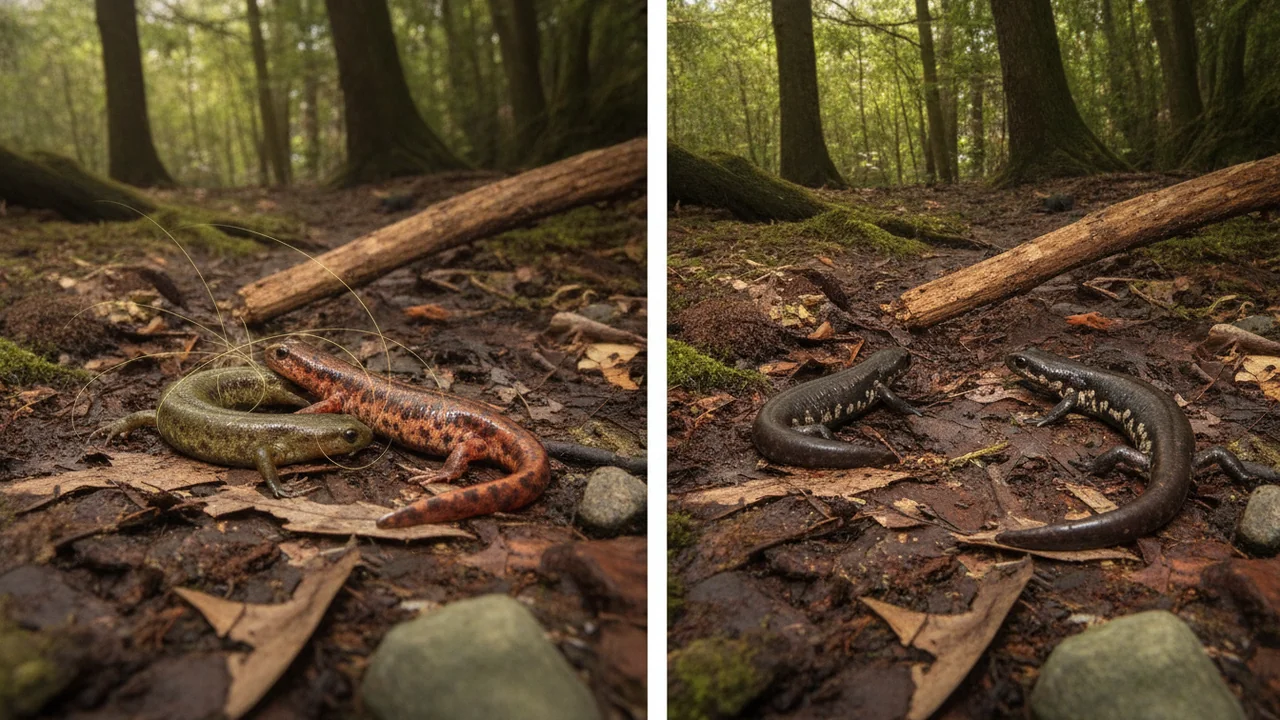
The mystery: In a ring species of salamanders around a large valley, populations change gradually in color and pattern around the ring, and where the two ends of the ring meet they live side by side but rarely interbreed.
describe the pattern of variation in a ring species of salamanders around a large valley, define species and speciation, and ask testable questions about how populations change and split over time.
- I can identify claims that changes in environmental conditions may cause some species to increase in number, lead to the emergence of new species over time, or result in the extinction of other species.
- I can identify the evidence provided that supports or challenges claims about how environmental changes affect species.
Phase 1: Spark
Warm-Up ~5 min
Do Now. Study the ring table. Salamanders live in a ring of cool, damp forests around a large, hot, dry valley. Write what you notice as you move around the ring, and one thing you wonder about the last row.
| Site around the ring | Body pattern (sample data) | Interbreeds with neighbors? |
|---|---|---|
| North (where the ring starts) | plain brown | yes |
| West coast forests | plain orange-brown; one form newt-like, with orange underparts | yes |
| East mountain forests | dark body with orange or yellow blotches | yes |
| South, where the two ends meet | plain coastal form and blotched inland form side by side | rarely; hybrids are uncommon |
Neighboring populations interbreed all the way around the ring, yet the two ends rarely do. What best explains this?
Instruction ~10 min
The phenomenon. On damp nights in the forested mountains around a large valley, you might find a small, lungless salamander under a log. It breathes through its moist skin, so it lives only where forests stay cool and damp. Those forests form a ring around the valley’s hot, dry floor: down the coast range on one side and down the inland mountains on the other. The salamanders are not the same all the way round. Along the coast they are mostly plain brown or orange; one coastal form has orange underparts and yellow in the eye, closely resembling a newt whose skin is toxic. In the inland mountains they are blotched with orange or yellow on a dark body, a pattern that blends into leaf litter. Neighboring populations interbreed where they meet. But in the mountains at the valley’s southern end, where the plain coastal form and a blotched inland form meet, they live side by side and rarely interbreed. Biologists call a pattern like this a ring species. Our question for the unit: how could one population change gradually around a ring until its two ends behave like different species?
What is a species? The most common definition, the biological species concept, says a species is a group of populations whose members can interbreed in nature and produce fertile offspring, and which cannot do so with other groups. Speciation is the process by which one species splits into two. It usually begins when populations are separated, by a mountain range, a valley or distance, so that they stop exchanging genes. Each population then changes in its own way through mutation, natural selection and chance, until the differences stop them interbreeding even if they meet again.
Worked example 1: reading the ring as a claim and its evidence. Claim: separation by an unsuitable valley can lead to the emergence of new species. Evidence in the table: neighbors interbreed (no barrier between them), but the two ends, which have been separated the longest by the valley, rarely do. What the evidence does not show: how long the separation took, or which differences cause the isolation. Separating a claim from its evidence, and naming what is missing, is the skill HS-LS4-5 asks for.
Why ring species matter. Speciation usually takes far longer than a human lifetime, so we rarely see it happen. A ring species lets us see the stages side by side in space: slight differences between neighbors, larger differences farther around, and reproductive isolation at the ends. It is also a good example of how science works. Genetic studies of the best-known ring of salamanders have shown that the history is more complicated than a simple ring, with some populations more separated than their appearance suggests, and biologists still debate whether it is best treated as one species or several. The debate is about how to draw the lines, not about whether the populations have evolved.
Worked example 2: from wondering to a testable question. Why are the salamanders different? is a start. Are blotched salamanders less likely than plain ones to be found by predators on mountain leaf litter? is testable: it names the variables (pattern, being found) and a setting. The next lab tests a model of it.
Evolution as a science. In this course you will study evolution as scientists do: through evidence, models and argument. Evolution is the unifying idea of biology, supported by many independent lines of evidence. Understanding the evidence does not require you to give up any belief, and you will never be asked to state your beliefs.
Reading: OpenStax Biology 2e, Chapter 18 (Evolution and the Origin of Species), Chapter 19 (The Evolution of Populations) and Sections 20.1–20.2 (Phylogenies); OpenStax Concepts of Biology, Chapters 11 and 12. CC BY 4.0.
Guided Exercises ~15 min
Work with a partner. Use the ring table and the mini-lecture.
Independent Practice ~10 min
Start your Evolution Notebook.
Sketch the ring around the valley. Label the plain coastal forms, the newt-like coastal form, the blotched inland forms and the zone of contact at the southern end. Then write two testable questions the map raises.
Identify one claim the ring supports about how environmental conditions can lead to new species, the evidence for it, and one piece of evidence you would still want.
Closure ~5 min
We have a phenomenon and a question. Next lesson, we meet the client and form our project teams.
Exit ticket: in two sentences, explain how a barrier such as the dry valley could help turn one population into two species. Use the words gene flow and reproductive isolation.
How confident are you that you can describe the salamander ring and explain how isolation can lead to new species?
Teacher notes
Materials: the ring table (projected), blank outline maps of a valley ringed by mountains, chart paper for the Wonder Board.
Background: the phenomenon is modeled on the textbook ring species Ensatina eschscholtzii; the course keeps the geography generic. The table is simplified sample data.
Sensitivity: state plainly that students learn the evidence and models of evolution and are never asked to state beliefs.
Listen for: “they look different, so they are different species”; “the salamanders changed so they could survive” (need-based language); treating scientific debate as doubt about evolution itself.
Support / stretch: give a labeled map template. Stretch: read about another proposed ring species (for example, the greenish warblers around the Tibetan Plateau) and compare.