3.05 Adaptation in Action: Modeling Selection and Resistance
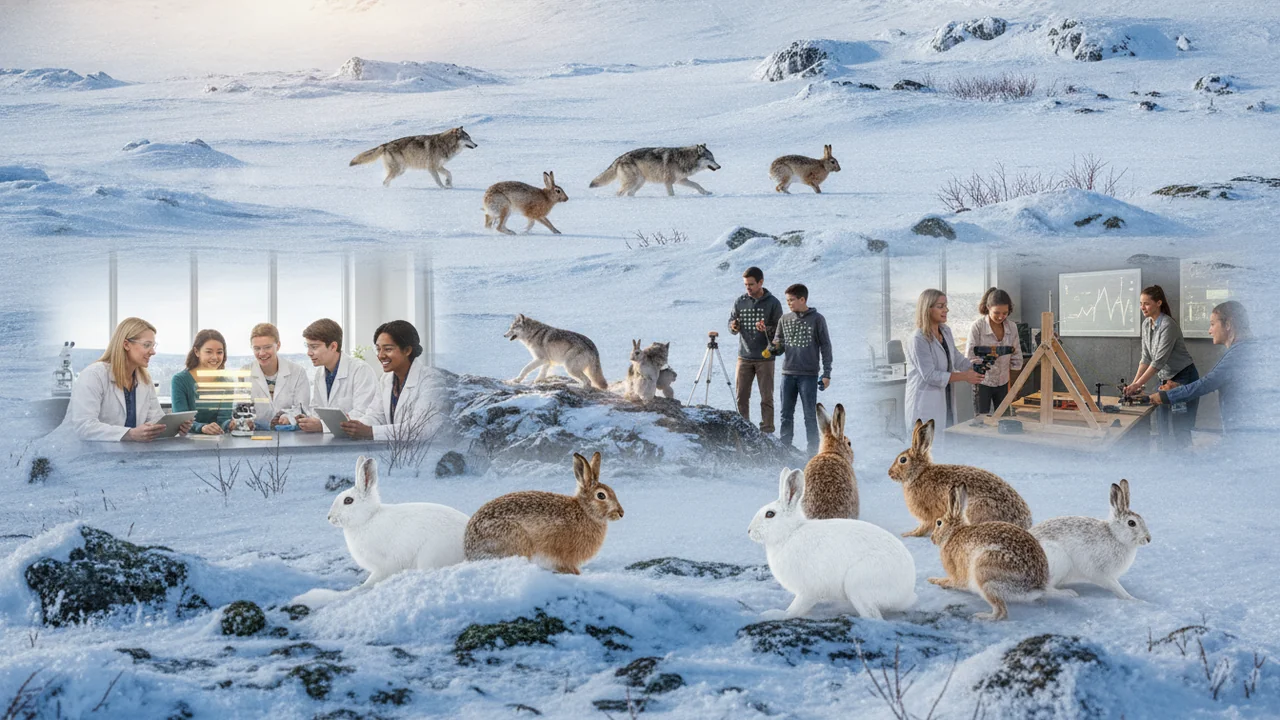
use a simulation and a calculation to explain how natural selection produces adaptation, including antibiotic resistance, and how environmental change can lead to the spread, emergence or extinction of species.
- I can describe how changes in the environment can lead to changes in a population.
- I can analyze data to compare the survival rates of organisms with different traits in a specific environment.
- I can explain how genetic variation in a species is passed to offspring and how certain traits can give individuals a competitive advantage.
- I can use evidence to explain how biotic and abiotic factors in ecosystems can change gene frequencies in populations through natural selection.
- I can explain how an increase in the frequency of a gene leads to more individuals in a population showing a particular trait over generations.
- I can use reasoning and evidence to show how natural selection leads to populations becoming adapted to their environment through the spread of advantageous traits.
- I can describe the difference between natural selection as a process and biological evolution as a result of that process.
- I can explain the cause and effect relationship between genetic variation, the selection of advantageous traits, and the evolution of populations that express those traits.
Phase 3: Make Sense
Warm-Up ~5 min
Do Now. A doctor says, “Finish the whole course of antibiotics, and never take them for a cold.” Using what you learned in the dot lab, write one sentence explaining why.
1% of the bacteria in an infection are resistant. One round of antibiotic kills 90% of the susceptible bacteria and none of the resistant ones. What fraction of the survivors is resistant?
Instruction ~10 min
Adaptation is a population-level result. An adaptation is a heritable trait that improves survival or reproduction in a particular environment. Adaptations are produced by natural selection over generations: variation arises by mutation and recombination, and the environment determines which variants leave more offspring. An adaptation is always relative to an environment. White fur helps a hare hide in snow and makes it conspicuous on brown ground. Natural selection is the process; evolution of the population, a change in the frequencies of traits and alleles, is the result.
Worked example 1: antibiotic resistance. According to the CDC’s 2019 report Antibiotic Resistance Threats in the United States, more than 2.8 million antibiotic-resistant infections occur in the United States each year, and more than 35,000 people die as a result. Here is why resistance evolves so fast. Suppose 1% of the bacteria in an infection carry a mutation that makes them resistant. A course of antibiotic kills 90% of the susceptible bacteria and none of the resistant ones. Out of every 1,000 bacteria, 10 resistant and 990 susceptible become 10 resistant and 99 susceptible. The resistant fraction is now 10 ÷ 109 ≈ 9.2%. If the survivors regrow and are treated again, the fraction rises to about 50%, and after a third round to about 91%. The antibiotic did not create the mutation; it selected the bacteria that already had it. This is why doctors ask patients not to take antibiotics for viral infections, where they do not help, and to follow the prescribed course.
Modeling with PhET. The Natural Selection simulation lets you run a bunny population across generations, add mutations (brown fur, long teeth, floppy ears) and add selection agents (wolves, limited food). Because you control each variable, you can test the four factors directly: turn the wolves off and fur color stops mattering, so the mutation neither spreads nor disappears because of color; change the environment from arctic to equator and brown fur turns from a liability into an advantage. Treat the sim as a model: it simplifies genetics and the environment, and part of your job is to say what it leaves out.
Worked example 2: comparing survival in one environment. In an arctic run with wolves (sample numbers), 40 white and 10 brown bunnies enter a season; 32 white and 4 brown survive. Survival: white 32/40 = 0.80, brown 4/10 = 0.40. White bunnies are twice as likely to survive, so their alleles are passed on more often and the fur-color allele frequency shifts toward white. Biotic factors (wolves) and abiotic factors (snow cover) together set the direction of change.
Environmental change and species (HS-LS4-5). When conditions change, three outcomes are possible. Some species increase: after the kelp forest collapse you studied in Unit 2, purple urchins multiplied. New species can emerge: the salamander populations separated by the dry valley have been diverging into forms that rarely interbreed. Some species go extinct: mammoths, giant ground sloths and saber-toothed cats disappeared from North America at the end of the last ice age, as climates changed and humans spread across the continent; scientists continue to debate the relative importance of these causes, because the evidence shows the two happened at about the same time (a correlation) and does not by itself show which was the cause. Which outcome occurs depends on how fast the environment changes, how much heritable variation a population has, and whether it can move to suitable habitat.
Why speed matters. Bacteria can have a new generation in under an hour, so selection changes them in days. Salamanders take years per generation, so the same process takes thousands of years. When human activity changes an environment faster than a slow-breeding species can adapt or move, extinction becomes more likely.
Valid and reliable sources. Your explanation should rest on sources you can name: your own lab data, a simulation (stating its simplifications), and published reports such as the CDC’s. A source is reliable if repeated measurements agree, and valid if it measures what you claim it measures.
Reading: OpenStax Biology 2e, Chapter 18 (Evolution and the Origin of Species), Chapter 19 (The Evolution of Populations) and Sections 20.1–20.2 (Phylogenies); OpenStax Concepts of Biology, Chapters 11 and 12. CC BY 4.0.
Guided Exercises ~15 min
Work through the simulation, then the calculations.
Independent Practice ~10 min
Explain adaptation with the four factors.
Using your simulation data (A, B or C), explain how a change in the environment (arctic to equator) changed which fur-color allele became more frequent. Name one biotic and one abiotic factor, apply all four factors, and state one thing the simulation leaves out.
Explain antibiotic resistance as a cause-and-effect chain from genetic variation to selection to an evolved population. Cite the CDC report for the scale of the problem and your calculation for the mechanism.
Closure ~5 min
Selection explains adaptation in bunnies, bacteria and salamanders. Next: we put the whole unit together and revise our model of the ring.
Exit ticket: why could the same mutation be harmful in one environment and helpful in another? Give an example from today.
How confident are you that you can explain how natural selection produces adaptation, using a simulation and a calculation?
Teacher notes
Timing: spans two 50-minute periods: day 1 is the simulation and the three runs; day 2 is the resistance calculation, the HS-LS4-5 discussion and the written explanation.
Materials: devices for the PhET sim (or printed Option B tables, or Option C coins and counters), calculators.
Fact check: the 2.8 million infections and 35,000 deaths are from the CDC’s 2019 report. The bunny numbers in worked example 2 are sample numbers.
Listen for: “the bacteria became immune” (individuals do not acquire resistance from exposure in this model); “the antibiotic caused the mutation”; treating a simultaneous change (climate and human arrival) as proof of a cause.
Support / stretch: give a three-column table for the resistance rounds. Stretch: model a resistant strain that pays a growth cost when no antibiotic is present, and predict what happens when treatment stops.