3.07 Design and Prototype: Competing Exhibit Stations and a Decision Matrix
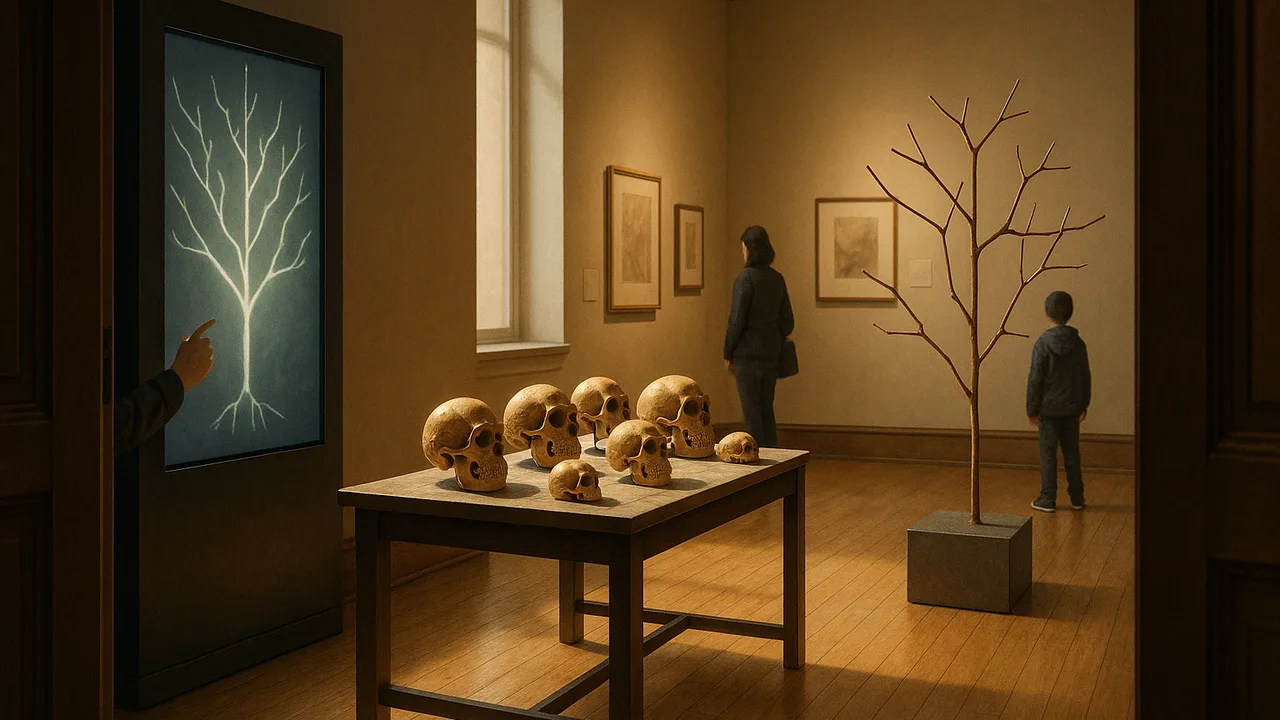
define criteria and constraints for the museum exhibit, prototype competing station designs that communicate evolution in more than one format, and choose among them with a weighted decision matrix.
- I can communicate scientific information about common ancestry and biological evolution using at least two different formats, such as oral, graphical, textual, or mathematical.
- I can cite the origin of scientific information I use to support my explanations about common ancestry and biological evolution.
- I can use valid and reliable sources, such as data from investigations, theories, simulations, or peer-reviewed studies, to support my explanation of evolution.
- I can use valid and reliable sources, such as scientific theories, simulations, peer-reviewed research, or my own investigations, to gather evidence for my explanation.
Phase 4: Build
Warm-Up ~5 min
Do Now. From the Ideate list, the class shortlisted three station designs: A a Predator Game table where visitors hunt colored prey on patterned boards; B Walk the Ring, a floor map with salamander models at each site and flip cards of DNA and fossil evidence; C an Evolution Kiosk, a touchscreen running a selection simulation. Which do you favor right now, and why?
Which is a CONSTRAINT rather than a criterion for the exhibit?
Instruction ~10 min
Designers, define success first. Class criteria (sample targets): (1) accuracy: the station uses all four factors of natural selection and at least three lines of evidence for common ancestry, each with a named source; (2) visitor learning: after a 3-minute visit, at least 60% of test visitors correctly explain why a trait became common, a rise of at least 25 percentage points from before; (3) accessibility: readable panels, reachable from a wheelchair, with a tactile or audio element. Constraints: a 3 m by 3 m floor space; a sample budget of $4,000; no live animals; durable enough for daily school groups.
Prototype = a working mock-up. For an exhibit, the prototype is a cardboard-and-paper version that real visitors can use: a game board, a floor map taped to the classroom floor, or a paper “screen” flipbook. It must carry the science in at least two formats (graphical, textual, oral or mathematical).
Worked example 1: is each panel valid and reliable? Team Priya’s draft panel says: “Antibiotic resistance kills thousands each year.” The Evidence Lead revises it to: “More than 35,000 people in the United States die each year from antibiotic-resistant infections (CDC, 2019).” A second panel uses the class dot-lab result, labeled “our class model, pooled from eight groups.” A third uses the PhET simulation, labeled “a simplified computer model.” Visitors can see where each idea comes from and how much to trust it.
Worked example 2: a weighted decision matrix. Score each option 1 to 5 on each criterion, multiply by the weight, and add. Weights (team choice): accuracy 0.35, visitor learning 0.30, accessibility 0.20, cost and space 0.15.
| Option | Accuracy (0.35) | Visitor learning (0.30) | Accessibility (0.20) | Cost and space (0.15) | Total |
|---|---|---|---|---|---|
| A Predator Game | 4 | 4 | 3 | 4 | 3.80 |
| B Walk the Ring | 5 | 3 | 4 | 3 | 3.90 |
| C Evolution Kiosk | 3 | 3 | 3 | 2 | 2.85 |
B leads narrowly; A scores best on learning because visitors do the selection. Close totals invite a hybrid: a ring floor map with a small predator game at the inland-forest stop. The team must explain its trade-offs, not hide behind a number.
Planning the visitor test. To measure learning, ask each test visitor the same question before and after: Why did blotched salamanders become common in the inland forests? Score each answer as correct (selection on heritable variation) or not. Report the proportion correct before and after, and the proportion using need-based language. Twenty visitors per prototype is a reasonable class sample.
Guided Exercises ~15 min
Build your matrix and test plan with your team.
Independent Practice ~10 min
Version 1 of the station.
Write your team's version 1 rationale: the option you chose, its matrix total, the trade-off the museum should know about, and how the station teaches each of the four factors.
Write the 60-word main panel for your station. It must use the words heritable variation and selection, cite at least one valid and reliable source, and avoid need-based language.
Closure ~5 min
Version 1 is ready for visitors. Next: a gallery critique, a visitor test and version 2.
Exit ticket: what misconception is your station most likely to fail to correct, and how will the visitor test reveal it?
Teacher notes
Materials: cardboard, paper, markers, tape for floor maps, colored paper dots and patterned fabric from 3.03, matrix templates.
Data note: the criteria targets, budget and matrix scores are sample numbers; teams may justify different ones.
Listen for: panels that say “adapted to survive” or “evolved because they needed to”; sources missing or vague; changing weights after scoring.
Support / stretch: give a panel-writing frame with a source line. Stretch: plan an audio version of the main panel for visitors with low vision.