1.02 Project Brief and Wonder Board: The Herd Health Plan
The Herd Health Plan
What sets the limit on a population, and how should a reserve plan for a herd whose limit can change?
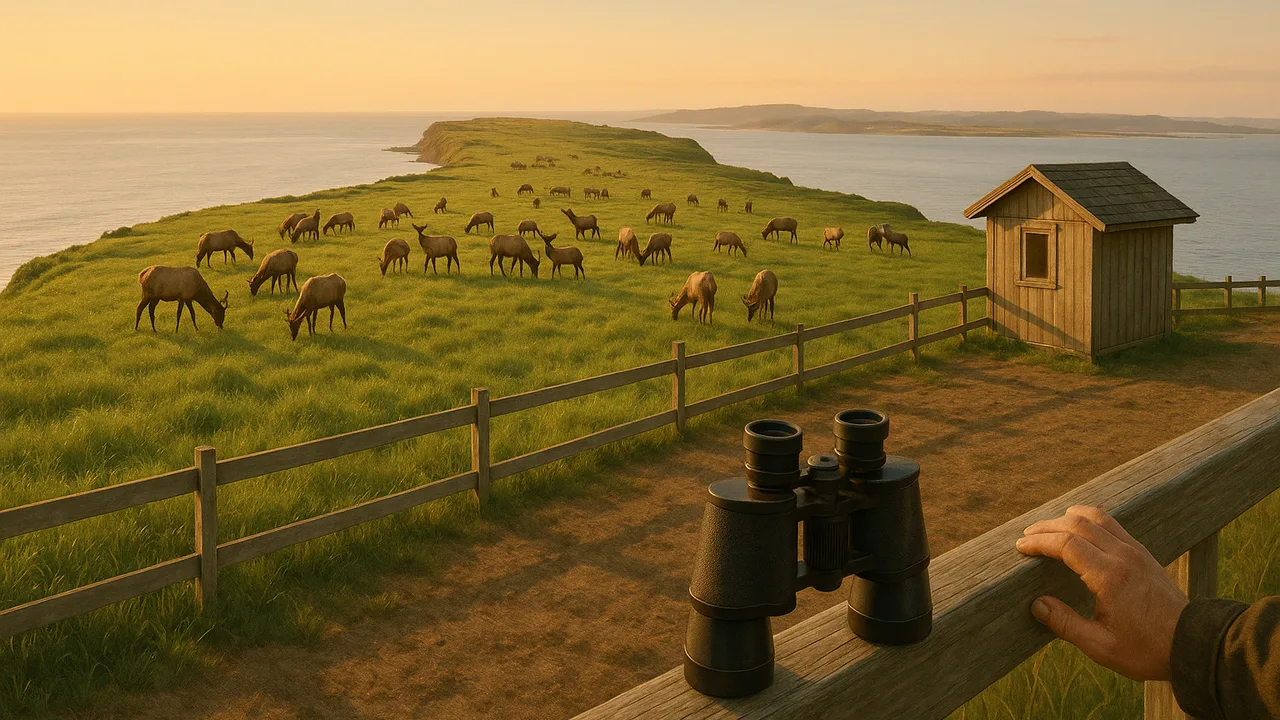
The mystery: Ten elk released onto a fenced coastal peninsula grew to several hundred over about three decades, then nearly half the herd died during a two-year drought.
Questions we will figure out together in this unit:
- Why did the herd keep growing for thirty years and then crash in just two?
- Does the herd’s size each year depend on the previous winter’s rain?
- How much grass does one elk need in a year?
- Are the elk changing which plants grow on the peninsula?
- How do scientists count animals they cannot all see at once?
- Would adding water troughs raise the carrying capacity?
- Why are there so few large predators in any ecosystem?
- Is it better to move some elk off the peninsula before a drought?
explain the reserve board’s problem, our driving question and the need-to-knows, and compare how the numbers and kinds of organisms change in ecosystems of different sizes.
- I can use graphs, charts, or other data representations to identify how the numbers and types of organisms in ecosystems of different sizes change over time.
- I can identify and describe the data in mathematical representations, such as trends, averages, and graphs, that show the numbers and types of organisms in a stable ecosystem.
- I can explain how mathematical representations show interactions between ecosystems at different scales.
Phase 1: Spark
Warm-Up ~5 min
Do Now. Read the letter below from the reserve’s advisory board. Underline what the board wants, and circle what it is worried about.
“Our elk herd grew for three decades, then lost nearly half its members in a drought. Some residents want more elk; others worry about the grassland. Before the next dry year we need a Herd Health Plan: an explanation of what limits the herd, a way to monitor it, and a comparison of management options backed by data.”
Which request is the board actually making?
Instruction ~10 min
Meet the client. The advisory board of a regional wildlife reserve manages the fenced peninsula where our herd lives. Board members include a reserve biologist, a neighboring rancher, a hiking-club volunteer and a teacher. They do not all agree, and they want the mathematics explained in plain words.
Driving question. What sets the limit on a population, and how should the reserve plan for a herd whose limit can change?
The product. Each team writes a Herd Health Plan: a report with a fitted growth model, an energy calculation, a plan for monitoring plant diversity, and a decision matrix comparing management options. You present it to the board in the Prove It phase.
Ecosystems at different scales. The board’s data come at three scales, and HS-LS2-1 and HS-LS2-2 ask you to compare them. Sample data:
| Scale | Population tracked | Start | Highest | Time to level off | Main limit (best guess) |
|---|---|---|---|---|---|
| Cup (250 mL) | duckweed fronds | 10 | about 200 | 3 weeks | |
| Fenced peninsula | elk | 10 | about 540 | about 30 years | |
| Whole region | number of plant species per 1 m² plot | — | 6–14 | steady over decades |
Worked example 1: same shape, different clock. Both the cup and the peninsula start at 10 and level off, so both follow logistic growth. Duckweed doubles in days; elk need about six years. The shape is the same, but the time scale differs by a factor of hundreds, because generation times differ.
Worked example 2: averages hide variation. A region’s plots average 10 plant species per square meter (sample data), but individual plots range from 6 to 14. An average is useful for comparing regions; the range tells you where to look for change. Always report both.
Need-to-knows and teams. We list what we must learn to answer the board, and we form teams of four with rotating roles: Data Lead (checks every number), Modeler (spreadsheets and graphs), Field Lead (materials and safety), and Communicator (writing and board contact). Roles rotate each phase.
Guided Exercises ~15 min
Use the three-scale table. Discuss with your team, then answer.
Independent Practice ~10 min
Team charter and Wonder Board.
Write your team charter: names and first roles, how you will make decisions, and what you will do if someone is absent.
Add three questions to the class Wonder Board: one about growth, one about energy, and one about how the board should decide.
Closure ~5 min
Our project is launched. Next: the investigation lab, where we grow our own population and watch it hit a limit.
Exit ticket: using the three-scale table, explain one way the duckweed cup and the elk peninsula are alike and one way they differ.
Teacher notes
Materials: the board letter (printed), team role cards, the Wonder Board from 1.01.
Setup: the client is fictional and generic; a staff member can read the letter aloud or record a short video as the board chair. Keep the Wonder Board posted all unit; 1.06 and 1.09 return to it.
Listen for: students who think a bigger herd is always better or always worse; push them toward “what does the evidence say about the limit?”
Support / stretch: give a need-to-know sorter (know / need to know / nice to know). Stretch: ask which board member would weigh which criterion most, and why.