4.04 Alarm Calls and Helpers: When Does Group Behavior Pay?
evaluate field evidence about alarm calls, cooperative breeding and schooling, and argue when group behavior increases the survival and reproduction of individuals and their relatives.
- I can use my additional evidence to analyze how valid and reliable the given evidence is, and discuss its strengths and weaknesses in supporting arguments about group behavior outcomes.
- I can evaluate how well the evidence supports a causal claim that group behavior gives a survival advantage, including whether it shows cause and effect or just correlation, and compare survival rates of individuals in groups versus alone.
Phase 2: Investigate
Warm-Up ~5 min
Do Now. A squirrel sees a coyote and gives a loud call. Other squirrels run; the caller is now the easiest one to spot. Why might a behavior like this survive natural selection? Write your best guess.
Which idea would natural selection NOT predict?
Instruction ~10 min
A puzzle for natural selection. Group behavior is everywhere: fish school, birds flock, bees share work, and some animals warn others of danger at a risk to themselves. If natural selection favors traits that help individuals survive and reproduce, why would an animal take a risk to help others? HS-LS2-8 asks you to evaluate the evidence. Three cases give different answers.
Case 1: Belding’s ground squirrels. These squirrels live in high mountain meadows of western North America. When a weasel or coyote approaches, some squirrels give a loud alarm call and others dash for burrows. In a classic field study published in 1977, Paul Sherman recorded who called. Callers were more likely than non-callers to be stalked or chased, so calling is risky. But calling was not random: females called more often than males, and females with close relatives living nearby called more than those without. Males usually leave their birth area, so they have few relatives nearby. This pattern supports kin selection: a behavior can spread if it helps relatives, who share many of the same alleles, survive and reproduce. A sister shares on average half of her alleles with her siblings by common descent, so saving several sisters can pass on more copies of an allele than the caller would lose by taking a risk.
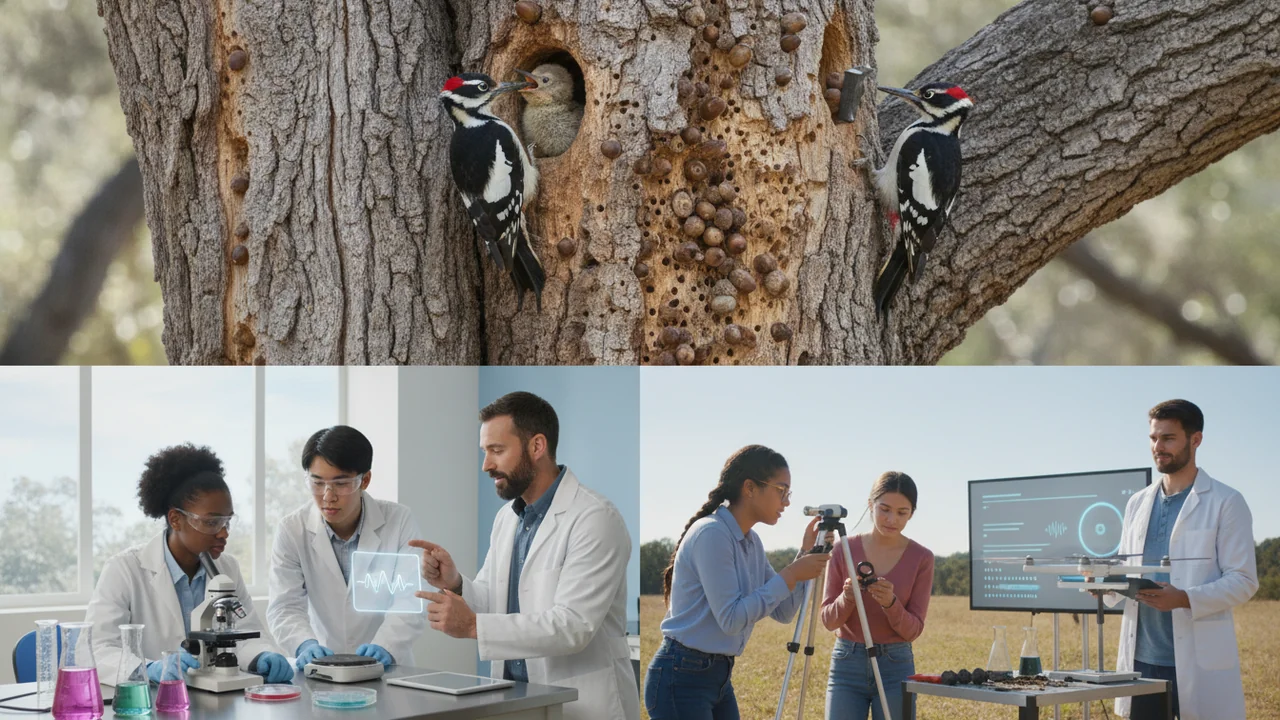
Case 2: acorn woodpeckers. In oak woodlands of western North America, studied for decades at field research reserves, acorn woodpeckers live in family groups that drill thousands of holes into a “granary” tree and store acorns for winter. Many groups include helpers, often grown offspring from earlier years, who feed chicks that are not their own instead of breeding themselves. Evidence suggests helpers gain in two ways: they help raise relatives, and they may later inherit a territory with a stocked granary. The granary itself is a shared resource that no single bird could build or defend alone.
Case 3: schooling fish. Anchovies and sardines off many coasts swim in schools of thousands. A school can reduce each fish’s risk: a predator can catch only one fish at a time from many (the dilution effect), and a mass of turning fish can confuse a predator. But schools also attract predators such as sea lions and seabirds, which can herd them. Whether schooling helps depends on the situation, a reminder that group behavior has costs as well as benefits.
Worked example 1: Hamilton’s rule. A helping behavior can spread if rB > C, where r is relatedness, B the benefit to the relative and C the cost to the helper. Illustrative example: an alarm call costs the caller a 5% extra risk of death (C = 0.05) and saves, on average, a 0.3 chance of death for three sisters (r = 0.5 each). Total rB = 3 × 0.5 × 0.3 = 0.45, much larger than 0.05, so the behavior is favored. For three unrelated neighbors, r is about 0 and the call would not be favored by this route.
Worked example 2: groups versus alone (sample data). In a tank trial, a predator fish made 20 attacks on lone prey fish and caught 12 (0.60 per attack); it made 20 attacks on a school of 30 and caught 4 (0.20 per attack). Per attack, a lone fish is certain to be the target, but a fish in a school of 30 has about a 1-in-30 chance. Evaluate the evidence: the comparison suggests a survival advantage for schooling. It is an experiment with a comparison, which supports cause, but it used one predator in one tank, so its reliability and its match to open water are limited. More replicates and field data would strengthen it.
Building your argument. Your claim should say when group behavior pays, using at least two cases. A strong rebuttal addresses a claim such as animals help others for the good of the species; the ground squirrel data show that who helps depends on relatedness, which that claim does not predict.
Reading: OpenStax Biology 2e, Sections 19.1–19.2 (Population Evidence of Evolution; Population Genetics) and Section 45.7 (Behavioral Biology); OpenStax Concepts of Biology, Chapter 11. CC BY 4.0.
Guided Exercises ~15 min
Fill in your evidence table for the three cases, then answer.
Independent Practice ~10 min
Write the argument.
Write your argument about when group behavior pays, using at least two of the three cases. Compare survival or reproduction of individuals in groups versus alone with at least one number, and include a rebuttal of the claim that animals help others for the good of the species.
Closure ~5 min
Group behavior pays when it helps the individual or its relatives. Next: how do we measure what happens to a population’s genes?
Exit ticket: explain, using rB > C, why a female ground squirrel with sisters nearby is more likely to call than a male that has left home.
How confident are you that you can evaluate evidence about how group behavior affects survival and reproduction of individuals and relatives?
Teacher notes
Timing: spans two 50-minute periods: day 1 is the three cases and the evidence table; day 2 is the model, Hamilton’s rule and the written argument.
Materials: case cards, evidence-table template, devices for NetLogo Web (or Option B printouts), calculators.
Fact check: Sherman’s alarm-call study appeared in Science in 1977. The acorn woodpecker findings summarize long-term studies in western oak woodlands. The tank-trial numbers and the Hamilton’s rule values are illustrative.
Listen for: “for the good of the species”; treating relatedness as friendship; ignoring costs of group living.
Support / stretch: give a CER-plus-rebuttal frame. Stretch: find the smallest benefit B to three cousins (r = 0.125) at which a call with C = 0.05 is favored.