4.08 Hand-Warmer Prototype: Test, Evaluate and Revise
build and test an iron-oxidation hand-warmer prototype, compare its data with an energy model and a commercial warmer, evaluate the accuracy and precision of my investigation, explain where energy appears to be lost, and revise the design and the plan.
- I can evaluate my investigation by analyzing the accuracy and precision of my data, identifying any limitations, and determining if my data provide the evidence I need.
- I can revise my investigation plan to improve the accuracy, precision, and usefulness of my data if needed.
- I can identify possible reasons why energy might appear to be lost from my closed system and suggest changes to my experiment to reduce these losses.
- I can identify and describe the limitations of a computational model based on the assumptions made in the algebraic descriptions of energy changes and flows.
Phase 4: Build
Warm-Up ~5 min
Do Now. A disposable warmer’s label lists iron powder, water, salt, activated carbon and vermiculite. Write a guess for the job of each ingredient. Which one is the fuel?
Why does a disposable hand warmer stay sealed in an airtight wrapper until you use it?
Instruction ~10 min
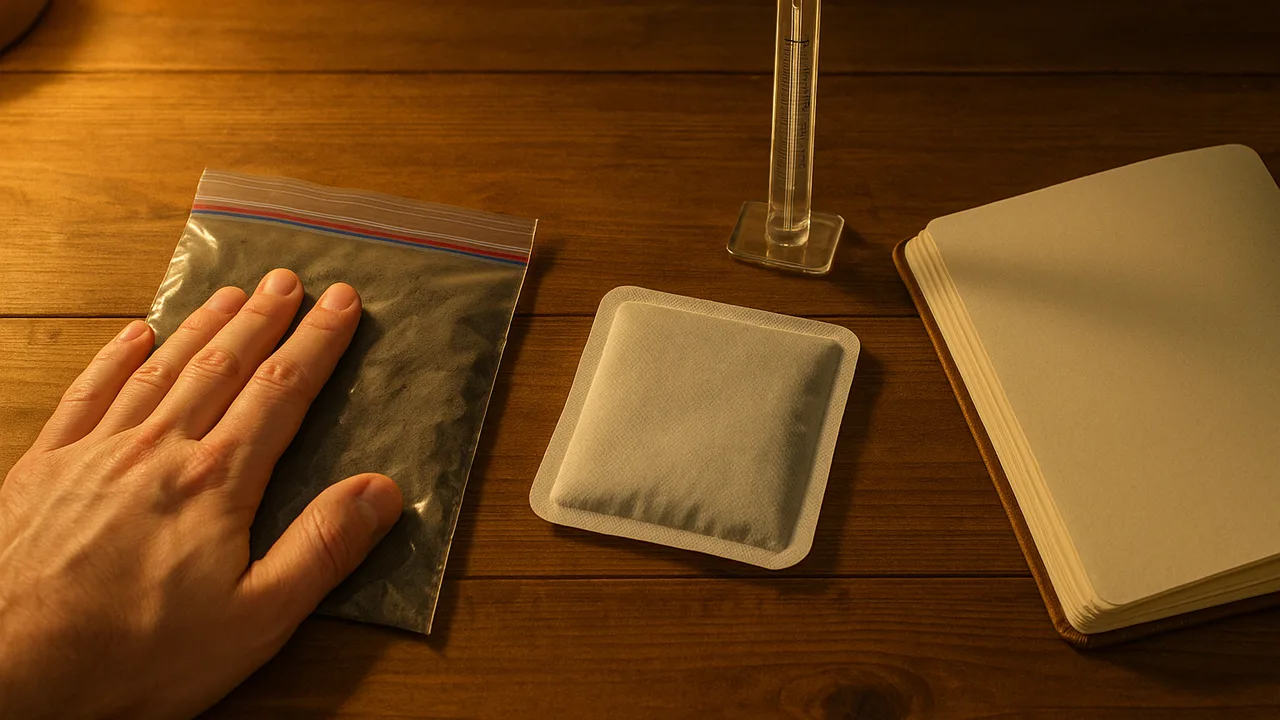
Today you build. Your team makes a hand-warmer prototype in a zip-top bag, measures its temperature for 20 minutes, and compares the result with a commercial disposable warmer tested beside it. Then you judge your own investigation the way a product lab would.
How the warmer works. Iron oxidizes: 4Fe + 3O2 → 2Fe2O3, ΔH = −1,648.4 kJ. On its own, a nail takes weeks to rust. The warmer speeds it up four ways: powdered iron has an enormous surface area; salt water carries ions that speed the electron transfer; activated carbon holds water and air against the iron and helps conduct; vermiculite (or sawdust) holds water and slows the spread of heat. The release is still slow enough to last hours.
Procedure. (1) In a quart zip-top bag, mix 10.0 g iron powder, 1.0 g table salt and, for version B, 2.0 g activated carbon. (2) Add 5.0 mL of water, press out most of the air, seal, and knead for 30 s. (3) Open a 1 cm gap for air, slide the thermometer probe into the middle of the mix and wrap the bag once in a paper towel. (4) Record the temperature every minute for 20 minutes. (5) Tape a second probe to a commercial warmer opened at the same moment. (6) Run version B three times across the class.
Worked example 1: accuracy and precision (sample data). Grace’s class ran three version B bags. Peaks: 47.2, 45.1 and 48.4 °C; mean 46.9 °C, spread 3.3 °C. The commercial warmer peaked at 52.0 °C. Precision is how close the trials are to each other (a 3.3 °C spread is fair); accuracy is how close the result is to a target or reference value. Version A, without carbon, peaked at only 34.5 °C: the carbon clearly matters. Grace also noticed the probe position changed readings by about 2 °C, a limitation of her plan.
Worked example 2: where did the energy go? Sami compared the data with a model. 10.0 g of iron could release 10.0 × 7.38 = 73.8 kJ. The bag’s heat capacity is small: 10.0 g iron (0.449) + 5.0 g water (4.18) + about 3 g of salt and carbon (about 0.8) ≈ 4.5 + 20.9 + 2.4 ≈ 28 J/°C. Warming it by 26 °C stores only about 730 J. Over 20 minutes most of the released energy flowed out to the air, the towel and the bench, and some went into evaporating water. Energy is not missing; it crossed the boundary. And only a small fraction of the iron reacted in 20 minutes, which is why warmers last for hours.
Revising. A good revision names the evidence that prompted it. Examples: “Probe position changed readings by 2 °C, so we fix the probe at the bag’s center with tape” (better precision). “The bag lost most of its energy through one thin layer, so we test a felt sleeve” (less apparent loss, longer warmth). “Our warmer peaked 5 °C below the commercial one, so we add vermiculite to hold water” (closer to the reference). The same thinking improves your 4.04 cup plan: a lid, faster pouring and a measured cup heat capacity.
Comparing with the reusable option. A sodium acetate warmer holds near 54 °C while crystals form, then cools; it can be reset by boiling but stores only about 0.27 kJ per gram. Iron stores far more per gram but cannot be reset. That trade-off is the heart of the hand-warmer recommendation.
Guided Exercises ~15 min
Answer during the 20-minute run; finish after clean-up.
Independent Practice ~10 min
Run version C (your revision) and complete the comparison.
Compare versions A, B and C on peak temperature, time above 40 °C and the highest surface temperature. Which criterion improved most, and what did you give up to get it?
🔎 Mini case study: Flameless ration heaters in the field ~8 min
For decades, soldiers and disaster crews eating packaged field meals have heated them with a flameless ration heater: a thin pad of powdered magnesium alloyed with a little iron, plus salt, in a plastic sleeve. Pour in a small amount of water, slide in the sealed meal, and within roughly 10 to 15 minutes the meal is hot. The iron and salt speed up magnesium’s reaction with water, the same reaction our model uses.
The heaters carry printed warnings. The reaction makes hydrogen gas, so they are not to be used in closed spaces such as vehicles or tents with the flaps down; the steam and the pad can burn skin; and the spent pad should cool before disposal. Because of the hydrogen, many carriers limit how the heaters can be shipped. Designers have to weigh a fast, high-energy reaction against a gas that needs ventilation.
Think about it: Which of our constraints does this case add or sharpen, and how should the relief nonprofit’s instructions handle hydrogen in a crowded shelter?
Closure ~5 min
Your prototype is tested, evaluated and revised. Next phase you write the design brief and defend it to the nonprofit.
Exit ticket: name one piece of evidence from today that changed your design or your plan, and state the change.
Teacher notes
Materials (per team): iron powder (fine, about 100 mesh) in a closed jar, table salt, activated carbon, vermiculite (optional), quart zip-top bags, a balance, a 10 mL graduated cylinder, two digital thermometer probes, paper towels, tape, felt or fleece scraps for revisions, one commercial disposable warmer per class, gloves and goggles.
Timing: setup 10 minutes, 20-minute run (answer the cards during it), evaluation 10 minutes, version C next session. Sample peaks here are invented; your class’s values will differ with iron mesh and water amount.
Listen for: “precise means accurate”; “the energy disappeared”; revisions with no evidence behind them.
Support / stretch: give a precision/accuracy target diagram. Stretch: estimate the fraction of iron that reacted in 20 minutes if the bag lost an average of 3 W to the air (3 J/s × 1,200 s ≈ 3.6 kJ, about 5% of 73.8 kJ).