2.02 Project Brief and Wonder Board: The County’s De-icer Choice
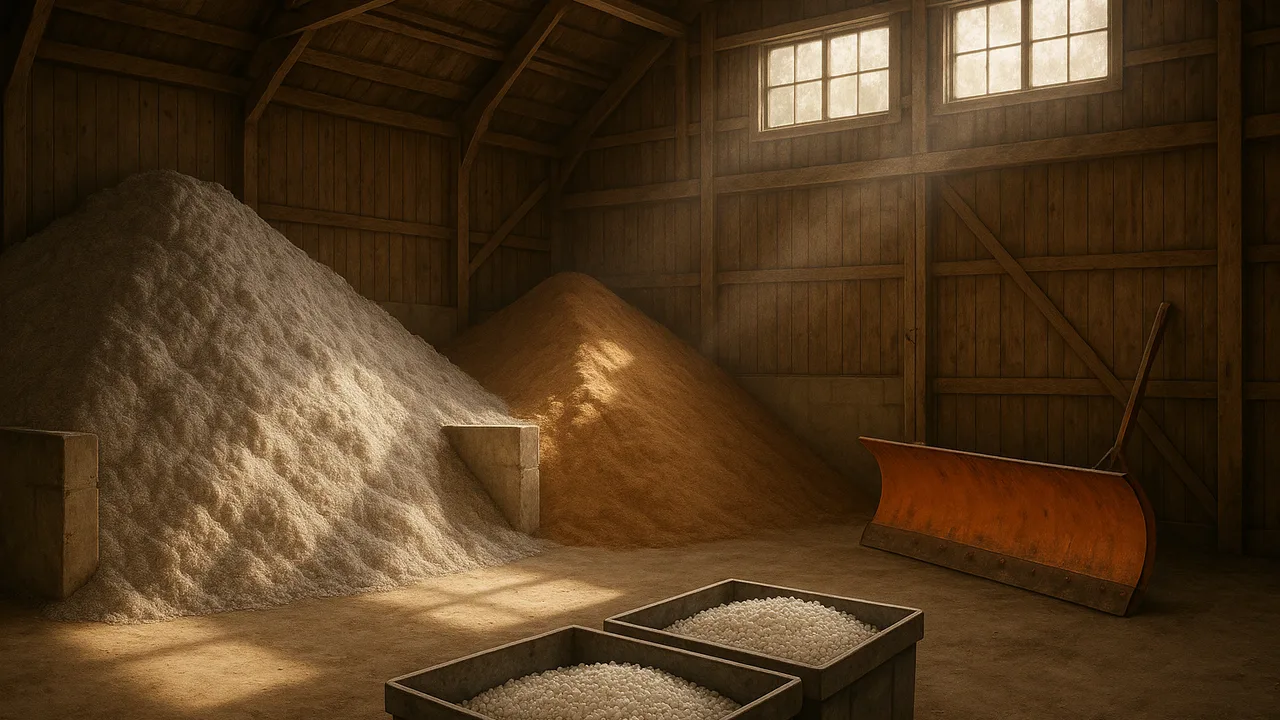
Salt, Sand or Beet Brine? A De-icer Materials Brief for a County Road Department
Why do some substances melt ice down to much colder temperatures than others, how does water itself break up roads and rock as it freezes and thaws, and which winter treatment should a county road department choose?
The mystery: After a winter of freezing nights and thawing afternoons, a county road is pitted with potholes, its shoulders are crusted white with dried salt, and chips of rock have piled up at the foot of the roadside cut. The same water that trucks spread salt to melt is breaking the pavement apart.
Questions we will figure out together in this unit:
- Why does salt melt ice but sand does not?
- Why did the calcium chloride get warm?
- Is there a temperature below which salt stops working?
- Why does ice float when most solids sink in their own liquid?
- How much does freezing water widen a crack?
- Does salty water damage concrete faster than fresh water?
- Why add sugary beet juice to salt brine?
- Where does the salt go after the snow melts?
explain the road department’s request and constraints, observe how five winter treatments act on ice, and turn our questions into need-to-knows for the project.
- I can describe the intended function of a chosen designed material.
- I can plan an investigation that uses bulk properties such as melting point, boiling point, volatility, and surface tension to gather evidence about the strength of electrical forces between particles.
- I can describe the data I will collect and explain how it can be used to infer the strength of electrical forces between particles.
- I can describe how the properties of water are connected to their effects on Earth materials and surface processes.
Phase 1: Spark
Warm-Up ~5 min
Do Now. List every way you have seen people deal with an icy sidewalk, driveway or road. For each, write whether it removes the ice or only makes it less slippery.
Equal spoonfuls of rock salt, sugar and sand are placed on three identical ice cubes in a room-temperature tray. After ten minutes, which cube will have the deepest pit melted into it?
Instruction ~10 min
Meet the client. The road department of a snowy, hilly county has written to our class. Its crews treat about 600 lane-miles of road each winter. The county has always spread rock salt, but its budget committee, a neighborhood group living by a trout stream, and its own bridge engineers are asking whether something else would work better. Before next season, the department must choose among five treatments: rock salt (sodium chloride), calcium chloride pellets, magnesium chloride brine, a sugar-beet brine blend (salt brine mixed with a sugary beet-processing liquid), and sand. Its two requests:
- A materials brief explaining why each option melts ice, or does not, and down to roughly what temperature, from the science of bonding, dissolving and the forces between particles.
- A freeze–thaw report explaining how water itself damages pavement and roadside rock as it freezes and thaws, based on an investigation the class designs, and whether salty water makes the damage worse.
Driving question. Why do some substances melt ice down to much colder temperatures than others, how does water itself break up roads and rock, and which winter treatment should the county choose?
Function: what each material is meant to do. Engineers start by naming a material’s intended function. The four chemical de-icers are meant to dissolve into the film of water on ice and stop it refreezing, so ice melts and cannot bond to the pavement. Sand is not meant to melt anything; its function is traction, giving tires something to grip. The beet liquid is added to salt brine so the brine sticks to the road instead of running off. Asking “what is its function?” first keeps us from judging sand as a failed de-icer.
Worked example 1: reading the demo. In the teacher demo, Lucia recorded the pit depths after ten minutes: calcium chloride deepest, rock salt close behind, sugar a shallow pit, sand none. A thermometer tucked against the calcium chloride cube read several degrees warmer than the one by the salt cube. She wrote, “Calcium chloride did something extra: it gave off heat. Salt and calcium chloride are both ionic, so maybe the ions matter.” That is a need-to-know, and it already points to a measurement (temperature change).
Worked example 2: from wonder to need-to-know. “Why do roads get potholes?” becomes “How much does water expand when it freezes, and how does that change a crack over many cycles?” “Which salt is best?” becomes “How far does each dissolved de-icer lower the freezing point of water, per gram?” The new versions say what to measure.
Criteria and constraints (HS-ETS1-1). The department’s letter lists criteria: works on the coldest typical nights; melts quickly; does not scatter off the road; costs within budget; limits corrosion of vehicles, guard rails and bridge steel; limits chloride running off into the trout stream; does not speed up pavement damage. No option wins on every criterion, which is why the brief must rank them.
Team roles. Teams of four rotate weekly: Lead Chemist, Data Analyst, Lab Manager and Communicator, as in Unit 1.
Guided Exercises ~15 min
Use the client letter and your demo observations.
Independent Practice ~10 min
Start your Materials Notebook and the team charter.
In 3–4 sentences, restate the department's two requests, name the intended function of all five treatments, and list three criteria in the order you think matters most.
Add two questions to the Wonder Board: one about how de-icers melt ice, one about how water damages pavement or rock.
Closure ~5 min
We know the client, the five options and our teams. Next phase, we test the de-icers in the lab.
Exit ticket: use the demo to explain why the county cannot judge sand and salt by the same single test.
Teacher notes
Materials: the client letter (generic, on county letterhead you design), four identical ice cubes on a tray, one teaspoon each of rock salt, calcium chloride pellets, granulated sugar and sand, a toothpick to probe pit depth, two small thermometers; role cards; chart paper for the Wonder Board.
Setup: run the demo at the start so pits form during the lecture. Keep the Wonder Board posted all unit; 2.06 and 2.08 return to it. The county is fictional; the 600 lane-miles is illustrative.
Listen for: “salt heats the ice” (it does not; calcium chloride does release heat, salt does not); “sand failed.”
Support / stretch: sentence frame for need-to-knows (“We need to know ___ so that we can ___”). Stretch: rank the department’s criteria and defend the top one to a partner who ranked differently.