2.03 Lab: Five De-icers in Water: Solubility, Conductivity and Heat
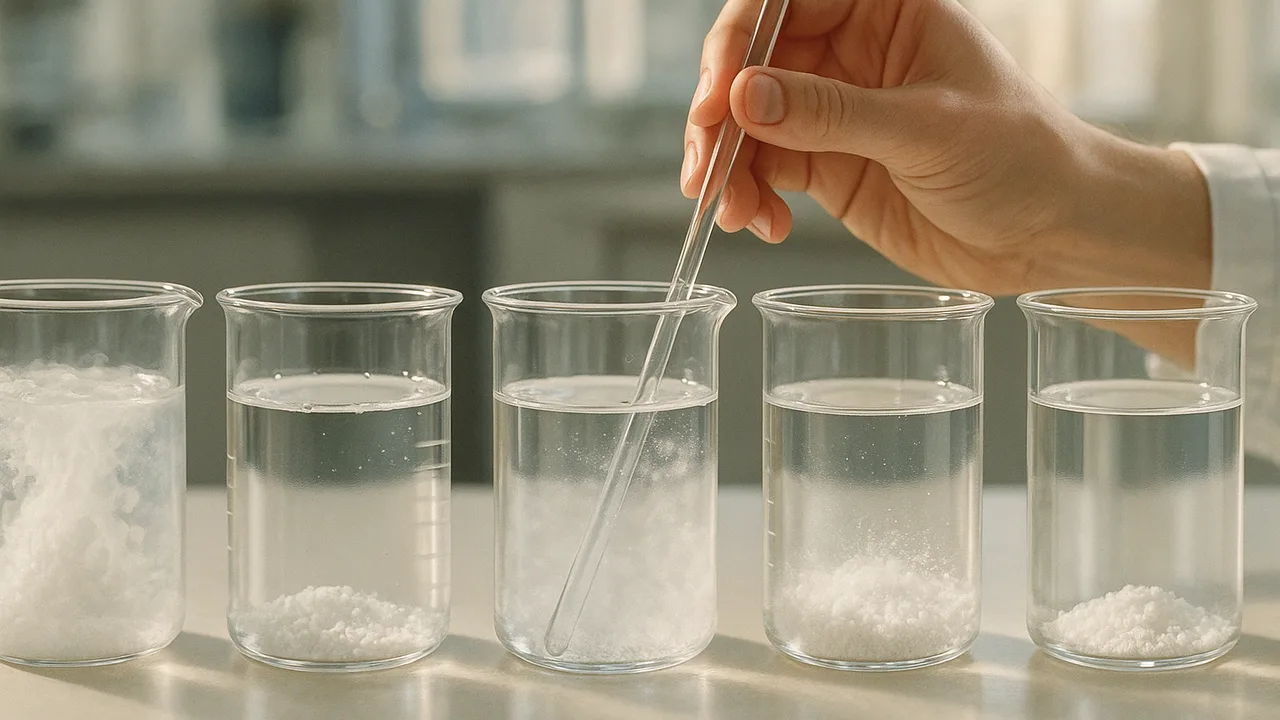
test the five winter treatments for solubility, conductivity in solution and temperature change on dissolving, and use the results to infer what particles each releases into water and how strongly they attract water.
- I can justify my choice of substances to compare and describe their composition at the atomic and molecular scale.
- I can describe how I will collect data, including the number of trials, the experimental setup, and the equipment I will use.
- I can collect and record both quantitative and qualitative data about the bulk properties of substances.
- I can plan an investigation that uses bulk properties such as melting point, boiling point, volatility, and surface tension to gather evidence about the strength of electrical forces between particles.
- I can describe the data I will collect and explain how it can be used to infer the strength of electrical forces between particles.
Phase 2: Investigate
Warm-Up ~5 min
Do Now. Rock salt, calcium chloride pellets, magnesium chloride flakes, a beet-sugar blend and sand sit in five labeled dishes. Write one prediction for each: will it dissolve, and will its solution conduct electricity?
1.0 g of rock salt and 1.0 g of calcium chloride are each dissolved in 100 mL of water. Which solution contains more dissolved ions?
Instruction ~10 min
The investigation question. What does each winter treatment release into water, and how strongly do those particles attract water? Every de-icer works only after it dissolves into the thin film of liquid on ice, so the first evidence we need is how each behaves in water. You will measure three bulk properties: solubility, conductivity of the solution, and the temperature change as it dissolves. This lab runs one long period.
How an ionic solid dissolves. Water molecules are polar: oxygen is δ−, the hydrogens δ+. At the surface of a salt crystal, the oxygen ends of water molecules turn toward Na+ ions and the hydrogen ends toward Cl− ions. These ion–dipole attractions pull ions out of the lattice, and each ion leaves wrapped in a shell of water molecules (it is hydrated). Sugar dissolves differently: whole sucrose molecules leave the crystal, held to water by hydrogen bonds through their O–H groups, but they do not split into ions. Quartz sand does not dissolve at all: water cannot break its network of covalent bonds.
Conductivity is the ion test. A current in a solution is ions moving. Dissolved chlorides conduct; dissolved sugar does not, even though it dissolves completely. A conductivity pen reads in microsiemens per centimeter (µS/cm). Distilled water reads close to zero; tap water reads a few hundred because it already carries some ions, so we use distilled water and test it alone first as the control.
Energy when dissolving. Pulling ions out of a lattice costs energy; wrapping them in water releases energy. The balance is the enthalpy of solution, ΔHsoln. For NaCl it is about +3.9 kJ/mol (a little more energy is taken in than given out, so the water cools slightly). For anhydrous CaCl2 it is about −81 kJ/mol: the small, doubly charged Ca2+ ion attracts water so strongly that much more energy is released than the lattice costs, and the water warms. That released heat is one reason calcium chloride starts melting ice fast on very cold days.
Worked example 1: predicting the temperature change. Darius dissolved 5.0 g of CaCl2 in 50.0 g of water. Moles: 5.0 g ÷ 110.98 g/mol = 0.0451 mol. Heat released: 0.0451 mol × 81.3 kJ/mol = 3.66 kJ = 3,660 J. Treating the 55.0 g of solution like water (c = 4.184 J/g·°C): ΔT = 3,660 J ÷ (55.0 g × 4.184 J/g·°C) = 15.9 °C. His cup rose from 21.0 to 34.5 °C (sample data), 13.5 °C. The measured rise is smaller because heat escaped to the cup and air, and store-bought pellets are not perfectly anhydrous. The same 5.0 g of NaCl (0.0856 mol × 3.88 kJ/mol = 332 J taken in) predicts a drop of only about 1.4 °C.
Worked example 2: reading the conductivity table. Hana’s team dissolved 0.10 g of each solid in 100 mL of distilled water (sample data): water alone 4 µS/cm; NaCl 2,010; CaCl2 1,830; MgCl2 flakes 1,040; sugar 6; sand 5; beet blend 1,520. Sugar and sand read like the control: no ions. The magnesium chloride flakes read lowest of the chlorides because the flakes are a hydrate, MgCl2·6H2O (203.30 g/mol): more than half of each gram is water locked in the crystal, not salt. The beet blend conducts because it is mostly salt brine; its sugar adds no ions.
Fair testing. Same mass (on a 0.01 g balance), same volume of distilled water, same stirring time, same starting temperature. Rinse the pen with distilled water and blot it between samples; a trace of brine on the probe inflates the next reading. Record solubility as all / part / none after 2 minutes of stirring, conductivity after the reading settles, and temperature before and after dissolving 5.0 g in 50.0 g of water in an insulated cup.
| Sample | Dissolves? (all / part / none) | Conductivity (µS/cm) | T start / T end (°C) | Particles released into water |
|---|---|---|---|---|
| Distilled water (control) | n/a | n/a | n/a | |
| Rock salt | ||||
| Calcium chloride | ||||
| Magnesium chloride flakes | ||||
| Beet blend | ||||
| Sand |
Reading. OpenStax Chemistry 2e, sections 11.1 (the dissolution process) and 11.2 (electrolytes), CC BY 4.0. Enthalpies of solution and molar masses from NIST.
Guided Exercises ~15 min
Answer while your samples stir.
Independent Practice ~10 min
Lab analysis.
Justify the choice of substances: explain, for each of the five, what it is made of at the atomic or molecular scale and what its result added to the comparison.
Calculate the predicted temperature change for your calcium chloride cup, compare it with your measured change, and give two reasons they differ.
Closure ~5 min
We know which treatments put ions into water. Next class: how far each one lowers the freezing point.
Exit ticket: sand neither dissolved nor conducted. Use bonding to explain why, and say what that means for its job on the road.
Teacher notes
Materials (per team): about 15 g each of rock salt, calcium chloride pellets (household ice-melt or lab grade, anhydrous), magnesium chloride flakes (hexahydrate), a beet-blend model (teacher-mixed: 4 parts saturated salt brine to 1 part sugar syrup or molasses, as a stand-in for commercial beet blends) and washed play sand; distilled water; 0.01 g balance; conductivity pen (or the LED battery tester from Physical Science, scoring 0–2); two nested foam cups and a thermometer; 100 mL graduated cylinder; stirring rods; goggles and gloves.
Timing: solubility and conductivity 25 minutes, temperature change 15, analysis 15. No-lab alternative: use the sample data in the worked examples.
Listen for: “sugar conducts because it dissolved”; “calcium chloride melts ice because it is hot” (the heat helps start melting; freezing-point lowering does most of the work).
Support / stretch: give a decision tree (dissolves? conducts? warms or cools?). Stretch: explain why the dihydrate CaCl2·2H2O releases less heat per gram than anhydrous CaCl2.