3.01 One Cake Rises, One Sinks: Evidence of Chemical Reactions
The Leavening Brief: Scaling a Quick Bread for a Community Bakery Co-op
How can chemists use balanced equations and the mole to tell a bakery exactly how much baking soda and acid a 200-loaf batch needs, so the loaves rise with the right amount of carbon dioxide and no soapy leftover soda?
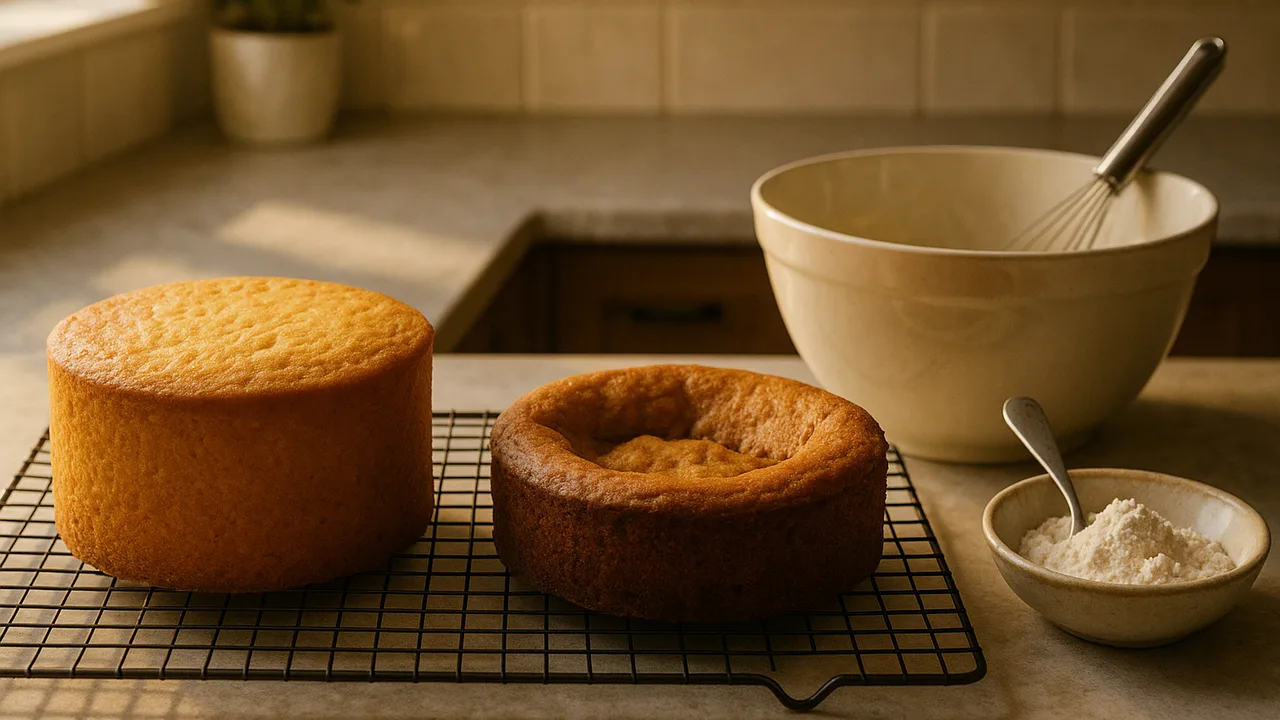
The mystery: Two cakes come out of the same oven: one has risen tall and springy, the other has sunk in the middle. At a pancake breakfast, one stack tastes fine and the next tastes bitter and soapy. The flour, eggs and oven were the same each time; only the leavening was different.
identify evidence of chemical reactions in baking, classify reactions as synthesis, decomposition, single replacement, double replacement or combustion, and write and balance equations by counting atoms.
- I can explain how the total number of atoms of each element stays the same before and after a chemical reaction.
- I can describe the types of bonds (ionic or covalent) formed in a reaction, using information about valence electrons and electronegativity.
- I can use the periodic table to predict the outermost electron states of atoms and discuss how these patterns help determine the type of reaction that occurs.
- I can identify the reactants and products in a chemical reaction, including their chemical formulas and the arrangement of their valence electrons.
- I can show that the number and types of atoms are the same before and after a reaction, and describe the types of bonds present in both reactants and products.
- I can use the periodic table to recognize patterns of reactivity and explain how valence electron configuration and electronegativity relate to the atoms involved in the reaction.
Phase 1: Spark
Warm-Up ~5 min
Do Now. Look at the two photos: a cake that rose tall and springy, and one from the same oven that sank in the middle. Write two differences you notice and one question about what happened inside the batter.
A recipe calls for baking soda and buttermilk. When the two are stirred together, the batter starts to bubble. The bubbles are mostly…
Instruction ~10 min
The phenomenon. Bakers have a saying: baking is chemistry you can eat. Quick breads, pancakes, muffins and many cakes rise without yeast. They rise because a chemical reaction in the batter makes carbon dioxide gas, which forms bubbles that the oven’s heat expands and then sets in place. Too little gas and the loaf is dense and flat. Too much, or gas made too early, and the bubbles grow, merge and escape, and the cake collapses. And when the baking soda has nothing left to react with, the leftover tastes bitter and soapy. This unit asks how to get the amounts exactly right.
Evidence of a chemical reaction. In a chemical reaction, atoms rearrange into new substances with new properties. Evidence includes a gas made where none was before (the fizz in batter), a solid forming from two clear solutions (a precipitate), a color change (a browning crust), a temperature change, and new properties such as a new taste or smell. Melting butter and dissolving sugar are physical changes: the substances stay the same.
Five common types of reaction. Chemists sort reactions by pattern. Synthesis: two or more substances combine into one, 2Na + Cl2 → 2NaCl. Decomposition: one substance breaks into two or more, 2H2O2 → 2H2O + O2. Single replacement: an element takes the place of another in a compound, Zn + 2HCl → ZnCl2 + H2. Double replacement: two compounds swap partners, CaCl2 + Na2CO3 → CaCO3 + 2NaCl. Combustion: a fuel reacts with oxygen, usually making carbon dioxide and water, as in the gas flame of a bakery oven. The baking-soda reaction is an acid–carbonate reaction: a double replacement whose product, carbonic acid, falls apart into water and carbon dioxide.
Writing equations. Baking soda is sodium hydrogen carbonate, NaHCO3. With the acetic acid in vinegar: NaHCO3 + CH3COOH → NaCH3COO + H2O + CO2. Count the atoms. Left: 1 Na, 5 H, 3 C, 5 O. Right: 1 Na, 3 + 2 = 5 H, 2 + 1 = 3 C, 2 + 1 + 2 = 5 O. Every atom on the left appears on the right, so the equation is balanced as written. The bonds changed; the atoms did not.
Balancing by counting atoms. Change only coefficients, never subscripts, because a new subscript is a new substance. Worked example 1: baking soda in a hot oven. When baking soda is heated with no acid left to react, it decomposes: NaHCO3 → Na2CO3 + H2O + CO2. Sodium: 1 left, 2 right, so write 2NaHCO3. Now check: Na 2 = 2; H 2 = 2; C 2 = 1 + 1; O 6 = 3 + 1 + 2. Balanced: 2NaHCO3 → Na2CO3 + H2O + CO2. The sodium carbonate it leaves behind (washing soda) is a stronger base than baking soda, and it is the source of the soapy taste.
Worked example 2: the oven’s gas flame. Propane burns: C3H8 + O2 → CO2 + H2O. Carbon first: 3 on the left, so 3CO2. Hydrogen: 8 on the left, so 4H2O. Oxygen last: the right now has 3(2) + 4(1) = 10 O, so 5O2. Result: C3H8 + 5O2 → 3CO2 + 4H2O. Check: C 3 = 3; H 8 = 8; O 10 = 10. Leave the element that appears in a free form (like O2) for last.
What a balanced equation promises. Read the coefficients as a recipe in particles: 2 formula units of baking soda make 1 of sodium carbonate, 1 water molecule and 1 carbon dioxide molecule. Because the same atoms are on both sides, the total mass of the products must equal the total mass of the reactants. That is a strong claim for a reaction that sends gas into the air, and you will test it in the lab in 3.03.
Reading. OpenStax Chemistry 2e, chapter 4, sections 4.1 (writing and balancing chemical equations) and 4.2 (classifying chemical reactions), CC BY 4.0.
Guided Exercises ~15 min
Work with a partner. Write the atom count for every element on both sides of every equation you balance.
Independent Practice ~10 min
Balance and classify five equations in your Leavening Notebook. Show the atom count for each.
| Equation (unbalanced) | Balanced | Type | Atoms left = right? |
|---|---|---|---|
| H2 + O2 → H2O | |||
| KClO3 → KCl + O2 | |||
| Fe + CuSO4 → FeSO4 + Cu | |||
| AgNO3 + NaCl → AgCl + NaNO3 | |||
| C2H6 + O2 → CO2 + H2O |
Pick the ethane combustion. Explain the order in which you balanced the elements and why, and show that your final equation has the same number of each kind of atom on both sides.
Write three questions about the risen and sunken cakes for the question board: one we could answer with a lab, one with a calculation, and one that needs a model of what happens to atoms first.
Closure ~5 min
We have a phenomenon and a way to write reactions. Next class you meet the client whose loaves are coming out flat and soapy, and we build the Wonder Board.
Exit ticket: use the balanced equation 2NaHCO3 → Na2CO3 + H2O + CO2 to explain where a soapy taste could come from when a muffin has more baking soda than acid.
Teacher notes
Materials: generic photos of a risen and a sunken cake and of batter bubbling, chart paper for the question board, periodic tables, devices for the PhET sim or paper equation sheets. Optional 1-minute demo: a spoon of baking soda into a clear cup of vinegar, and a spoon of sugar into water, side by side.
Answers: 2H2 + O2 → 2H2O (synthesis); 2KClO3 → 2KCl + 3O2 (decomposition); Fe + CuSO4 → FeSO4 + Cu, already balanced (single replacement); AgNO3 + NaCl → AgCl + NaNO3, already balanced (double replacement); 2C2H6 + 7O2 → 4CO2 + 6H2O (combustion).
Listen for: “the bubbles are air”; balancing by changing subscripts; “the gas has no mass, so the cake gets lighter because matter is lost.”
Support / stretch: give an atom-count table template with one row per element. Stretch: balance the cream of tartar reaction NaHCO3 + KHC4H4O6 → KNaC4H4O6 + H2O + CO2 (already balanced: 1 Na, 1 K, 6 H, 5 C, 9 O on each side).