3.03 Open Flask, Capped Bottle, Balloon: Does the Gas Have Mass?
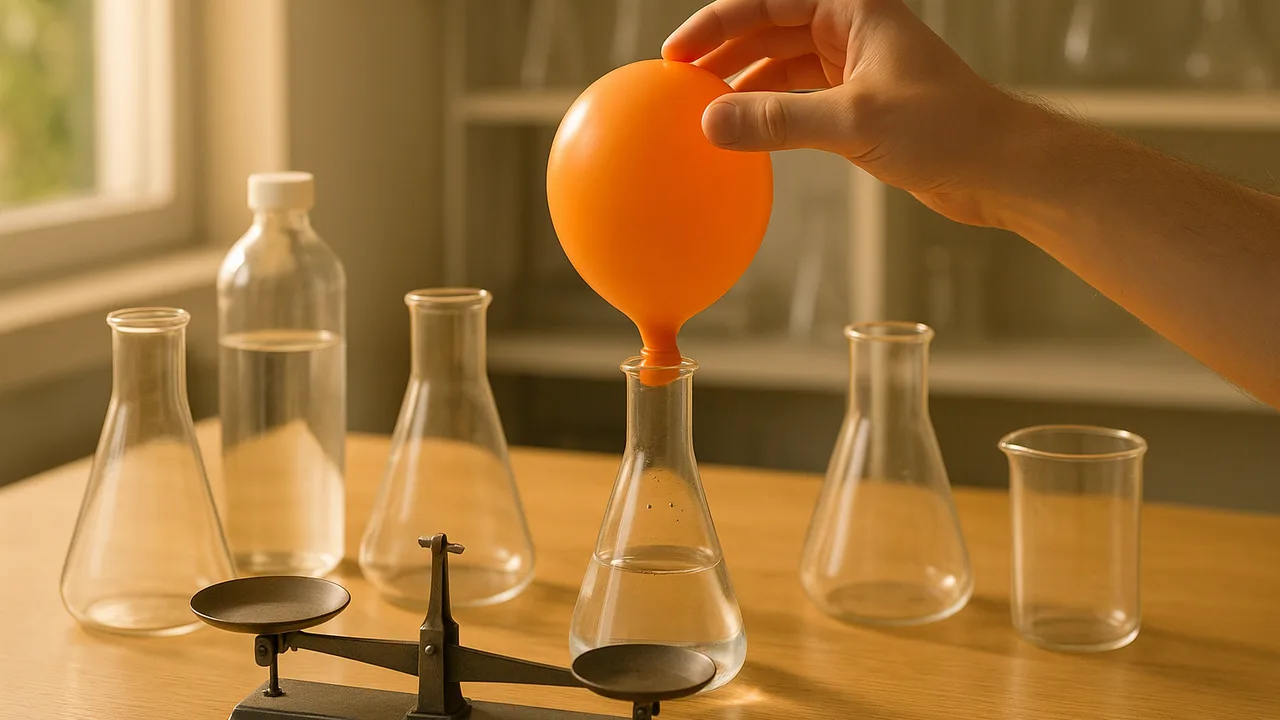
measure the mass of a baking-soda reaction in an open flask, a capped bottle and a balloon-topped flask, measure the carbon dioxide made by mass loss, and use the results to support the claim that atoms, and therefore mass, are conserved.
- I can clearly state that atoms, and therefore mass, are conserved during a chemical reaction.
- I can use calculations, graphs, or diagrams to show quantitative information about chemical reactions.
Phase 2: Investigate
Warm-Up ~5 min
Do Now. A loaf of quick bread weighs less after baking than the batter did. Write two places the “missing” mass might have gone, and how you could catch it to weigh it.
Baking soda and vinegar react inside a capped plastic bottle on a balance. The reading will…
Instruction ~10 min
The investigation question. If atoms are conserved, mass should be conserved, even when a reaction makes a gas. Today you test that claim with three setups: an open system, where matter can leave; a rigid closed system, where it cannot; and a flexible closed system, a balloon over a flask. The open setup also gives the co-op its first real number: the mass of carbon dioxide one gram of baking soda can make. This lab runs two 50-minute periods.
The reaction. NaHCO3 + CH3COOH → NaCH3COO + H2O + CO2. You balanced it by counting atoms in 3.01. Each setup uses 1.00 g of baking soda and 20 mL of vinegar, which is more acid than the soda needs, so all the soda reacts.
Worked example 1: the equation predicts no change in mass. Using molar masses from the periodic table (NaHCO3 84.006, CH3COOH 60.052, NaCH3COO 82.034, H2O 18.015, CO2 44.009 g/mol), the reactants total 84.006 + 60.052 = 144.058 g per mole of reaction, and the products total 82.034 + 18.015 + 44.009 = 144.058 g. A mole is a fixed, very large count of particles; you will learn to use it in 3.05. For now, notice that the equation itself says mass in equals mass out.
What to expect. In 3.05 you will calculate that 1.00 g of baking soda can make at most 0.524 g of CO2. In the open flask, the gas bubbles into the room, so the reading should drop by a little less than that (some CO2 stays dissolved in the liquid). In the capped bottle, the gas is trapped, so the reading should not change.
The balloon puzzle. A balloon over the flask also traps the gas, but it swells. At room temperature 0.524 g of CO2 takes up about 0.29 L. The swollen balloon pushes aside about 0.29 L of air, and air (about 1.2 g/L) pushes back up on it with a force equal to the weight of 0.35 g. So the balloon setup should read about a third of a gram light even though no atoms left. That is buoyancy, the same push that lifts a helium balloon; it is a measurement effect, not lost matter. The rigid bottle avoids it because its volume does not change.
Reading a balance well. Use a balance that reads to 0.01 g (uncertainty about ±0.01 g). Weigh the whole system, cup of vinegar and weighing paper included, before mixing, and never tare with the system on the pan, because you need the total.
Procedure. Open flask: (1) Put 20 mL of vinegar in a 250 mL flask. Place it and the paper holding 1.00 g of baking soda on the balance together; record the total. (2) Tip the soda in, leave the paper on the pan, swirl gently, and record the mass when fizzing stops (about 3 minutes). Capped bottle: (3) Put 20 mL of vinegar in a clean 500 mL carbonated-drink bottle. Fold the baking soda into a small twist of tissue, hold it above the vinegar, and screw the cap on with the twist trapped under it; or drop it in and cap immediately. Record the mass. (4) Shake the twist down, swirl, and record the mass when fizzing stops. Open the cap slowly over the sink. Balloon: (5) Put the baking soda in a balloon, stretch the balloon over a 250 mL flask holding 20 mL of vinegar without tipping it in, and weigh. (6) Lift the balloon so the soda falls in, wait for fizzing to stop, and weigh again. (7) Add your changes to the class table.
| Setup | Initial mass (g) | Final mass (g) | Change (g) | Observations |
|---|---|---|---|---|
| Open flask | ||||
| Capped bottle | ||||
| Balloon flask | ||||
| Class averages (n = ___) |
Worked example 2: reading class data (sample data). Eight groups ran all three setups. Open flask changes: −0.46, −0.49, −0.44, −0.48, −0.47, −0.45, −0.50, −0.47 g; average −0.47 g, which is 90% of the 0.524 g maximum. Capped bottle: −0.01, 0.00, −0.01, −0.02, 0.00, −0.01, 0.00, −0.01 g; average −0.01 g, within the uncertainty of zero. Balloon: −0.31, −0.34, −0.29, −0.33, −0.36, −0.30, −0.32, −0.31 g; average −0.32 g, close to the 0.35 g buoyancy estimate. Marisol’s group wrote: “Only the open flask lost real matter, and we can say what it was: about 0.47 g of CO2.” That is a mathematical representation of conservation, the kind HS-PS1-7 asks for.
Guided Exercises ~15 min
Answer as you collect data; return to the cards after clean-up.
Independent Practice ~10 min
Lab analysis, in your Leavening Notebook.
The co-op's bread loses mass in the oven. Using today's data, list every substance that could leave a baking loaf (think about the products of the reaction and the water in batter), and explain why this does not break the law of conservation of mass.
Design a fourth setup that would measure the CO2 made by buttermilk and baking soda. Say whether it is open or closed, what you would weigh, and one error you would need to control.
Closure ~5 min
Gas has mass, and mass is conserved when every atom is counted. Next class: what happens when one ingredient runs out before the other?
Exit ticket: a student says the capped bottle “didn't react” because its mass didn't change. What evidence from the bottle shows a reaction happened, and why did the mass stay the same?
Teacher notes
Materials (per group): baking soda (three 1.00 g portions on weighing paper), white vinegar (5%, 60 mL), two 250 mL Erlenmeyer flasks, one clean 500 mL carbonated-drink bottle with cap, tissue squares, a 9- or 12-inch balloon, a balance reading to 0.01 g, a 25 mL graduated cylinder, goggles, paper towels.
Two periods: day 1 all three setups and the class table; day 2 analysis and the CER. No-lab alternative: a recorded demonstration with on-screen balance readings and the sample class data above. If only 0.1 g balances are available, double the soda to 2.00 g and the vinegar to 40 mL in the open and balloon setups, and keep the bottle at 1.00 g.
Listen for: “gas has no mass”; “the balloon lost mass so conservation failed”; taring with the flask on the pan.
Support / stretch: give a CER frame with the evidence column pre-labeled. Stretch: estimate how much CO2 stayed dissolved in the open flask (0.524 − 0.47 ≈ 0.05 g) and propose a way to drive it out (gentle warming or longer swirling).