4.07 A Spreadsheet Energy Model of the Meal Pouch
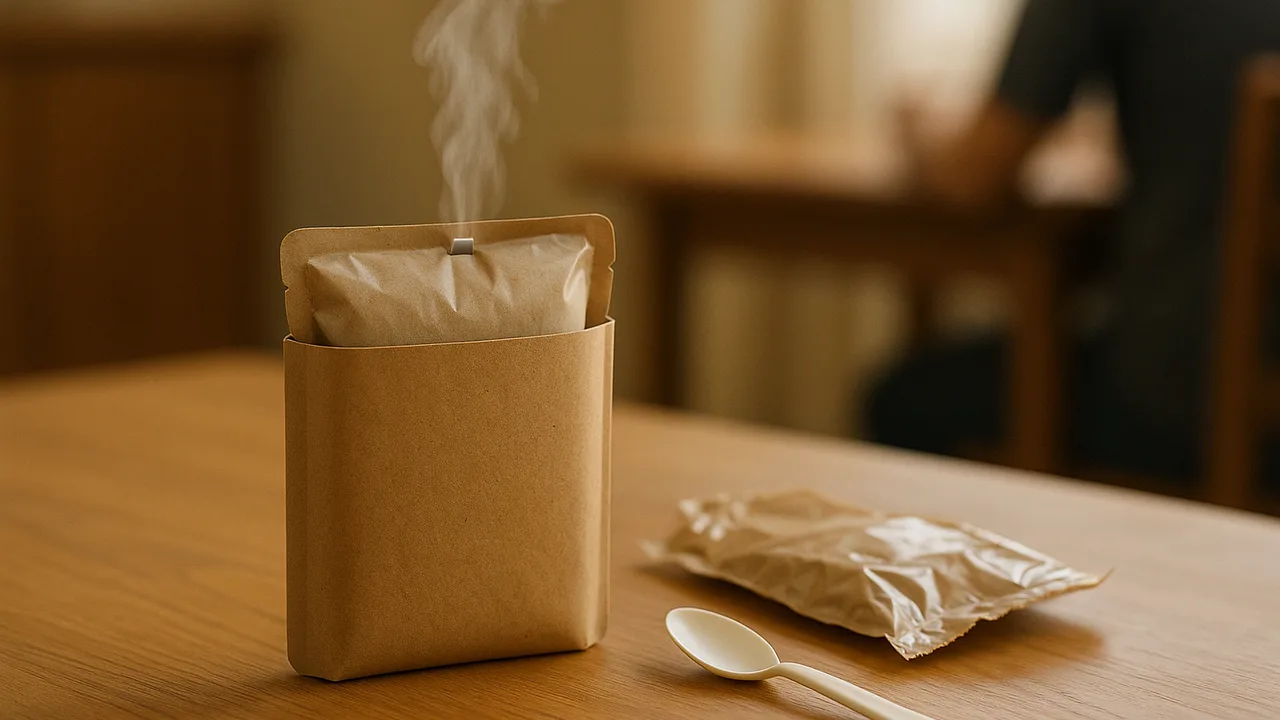
build a spreadsheet model, based on conservation of energy, that tracks the energy of each component of a self-heating meal pouch minute by minute, use it to predict the meal’s temperature and the largest possible temperature change, and state the model’s assumptions.
- I can identify and describe the boundaries of a system and explain how the reference level for potential energy is set to zero.
- I can quantify and express the initial energies of each component in a system using algebraic descriptions, including thermal, kinetic, and potential energies.
- I can describe and quantify energy flows into or out of a system using algebraic expressions, and I can calculate the total final energy of the system’s components.
- I can use algebraic descriptions of initial and final energy states, along with energy flows, to create a computational model based on the principle of conservation of energy.
- I can use a computational model to calculate the change in energy of one component in a system when I know the changes in energy of other components and the energy flows.
- I can use a computational model to predict the maximum possible change in the energy of one component in a system for a given set of energy flows.
Phase 4: Build
Warm-Up ~5 min
Do Now. A bank account starts at $50. Each week you deposit $20 and spend $15. Write the balance after three weeks, then write the rule you used as one line of algebra.
A heater releases 4,000 J into a meal in one minute while the meal loses 1,500 J to the air. How much does the meal's thermal energy change that minute?
Instruction ~10 min
Why a model. The nonprofit cannot test every heater recipe in every shelter. A computational model lets us try recipes on a screen first. Ours is a spreadsheet that applies one rule, conservation of energy, over and over, one minute per row.
Step 1: components, boundary and zero. The system is the whole pouch inside its sleeve. Components: the heater chemicals (3.00 g of magnesium in the sample design), 30 g of salt water that starts the reaction, and a 250 g meal. We pick two zero references. Chemical potential energy is zero for the products, Mg(OH)2 + H2, so the starting heater holds 3.00 g × 14.5 kJ/g = 43.5 kJ. Thermal energy is zero at the starting temperature, 20.0 °C. Any zero works as long as we use it consistently; only changes matter.
Step 2: algebra for each component and each flow. Heat capacity of meal plus heater water: C = (250 + 30) g × 4.18 J/(g·°C) = 1,170 J/°C, assuming the meal behaves like water. Flow inside the boundary: the heater releases R = 4,355 J each minute for 10 minutes. Flow out across the boundary: loss to the air L = k(T − Tair), with k = 120 J per °C per minute for a thin sleeve (a sample value the class fits to test data). The rules for each new row: Echem(new) = Echem − R; Ethermal(new) = Ethermal + R − L; T = 20.0 + Ethermal ÷ C. Total energy check: Echem + Ethermal + (all energy lost so far) = 43.5 kJ in every row.
Worked example 1: the largest possible change. Before any rows, Hana asked the best case: all 43,550 J into the meal and water with no loss at all. ΔTmax = 43,550 J ÷ 1,170 J/°C = 37.2 °C, so the meal could reach at most 57.2 °C. That is already below the client’s 60 °C, before a single joule leaks out. The model has told us the 3.00 g recipe cannot work, without building it.
Worked example 2: the first rows. Darius built the sheet. Columns: minute, energy released, energy lost, meal temperature. Row 1: loss = 120 × (20.0 − 20.0) = 0, so T = 20.0 + 4,355 ÷ 1,170 = 23.7 °C. Row 2: loss = 120 × 3.72 = 447 J, net 3,908 J, T = 27.1 °C. Row 3: loss = 848 J, T = 30.1 °C. In a spreadsheet the meal-temperature cell reads =D2+($R$1-$K$1*(D2-$A$1))/$C$1, filled down. By minute 10 the sample model peaks at 44.0 °C, after losing about 15.5 kJ to the air.
Solving for one component. The model also works backward. If the heater released its full 43.5 kJ and a heat-flux sensor showed 15.5 kJ left through the sleeve, the meal and water must have gained 43.5 − 15.5 = 28.0 kJ, a rise of 28,000 ÷ 1,170 = 23.9 °C. Knowing all but one energy change lets you calculate the last one.
Using the model to design. Change one input cell and the whole sheet updates. In the sample model, 5.0 g of magnesium in the thin sleeve just reaches 60.0 °C; 4.5 g in an insulated sleeve that halves k reaches about 65 °C. Every result depends on assumptions: the meal heats evenly, c stays constant, the heater releases energy at a steady rate, all the magnesium reacts, the hydrogen gas carries away no energy, and no water boils off. Real pouches break several of these; a model is only as good as its assumptions.
Reading. OpenStax Chemistry 2e, chapter 5.1 and 5.2 (energy, heat capacity and q = mcΔT), CC BY 4.0. The k value and the release rate are sample values chosen for this model.
Guided Exercises ~15 min
Build the sheet with your team. Use C = 1,170 J/°C, R = 4,355 J/min for 10 minutes, k = 120 J/(°C·min) and Tair = 20.0 °C unless a question changes one.
Independent Practice ~10 min
Model write-up, in your Energy Notebook.
Write the algebra for every component and every flow in your model, and state your two zero references and why the choice of zero does not change your predictions.
List at least four assumptions in the model. For each, say whether breaking it would make the real meal hotter or cooler than predicted, and how you could test it.
Closure ~5 min
We have a model that says what the meal pouch can and cannot do. Next class we test a real heater prototype against a model.
Exit ticket: the model says 3.00 g of magnesium can never reach 60 °C, even with perfect insulation. Explain how the model knows this in two sentences.
Teacher notes
Materials: a shared spreadsheet template (columns for minute, released, lost, Echem, Ethermal, T and a running total), devices, or paper tables and calculators for 10 rows.
Key values (sample model): 3.00 g Mg peaks at 44.0 °C at minute 10 with k = 120; 4.0 g gives 52.0 °C; 5.0 g gives 60.0 °C. With k = 60: 3.00 g gives 49.7, 4.0 g 59.6 and 4.5 g 64.6 °C. Total lost by minute 10 with the 3.00 g recipe is about 15.5 kJ.
Listen for: losses added instead of subtracted; temperature added as if it were energy; “the model is wrong because the real pouch is different” (it is a model; name the assumption).
Support / stretch: pre-fill the first three rows. Stretch: add a column that turns off the release after the magnesium runs out and model a heater whose release rate falls each minute.