1.08 Peer Critique and Version 2 of the Color Brief
give and use evidence-based critique, check every number and explanation in my team’s color brief against the criteria, and justify the changes in version 2 with energy levels and periodic trends.
- I can predict the number and types of bonds an element can form, and the kinds of bonds formed between elements.
- I can predict the number and charges of stable ions that form from atoms in a group of the periodic table.
- I can analyze and compare trends in reactivity, electronegativity, and atomic size across rows and down groups in the periodic table, based on the attraction of valence electrons to the nucleus.
- I can use the periodic table to predict how elements behave based on the attraction and repulsion between charged particles and the patterns of outermost electrons that affect an atom’s reactivity.
Phase 4: Build
Warm-Up ~5 min
Do Now. Swap drafts with another team. Without reading their explanations, check three numbers: one wavelength-to-frequency conversion, one photon energy and one electron configuration. Mark each correct or not.
A draft says, “Copper's blue at 450 nm has photon energy 4.41 × 10⁻¹⁷ J.” What is wrong?
Instruction ~10 min
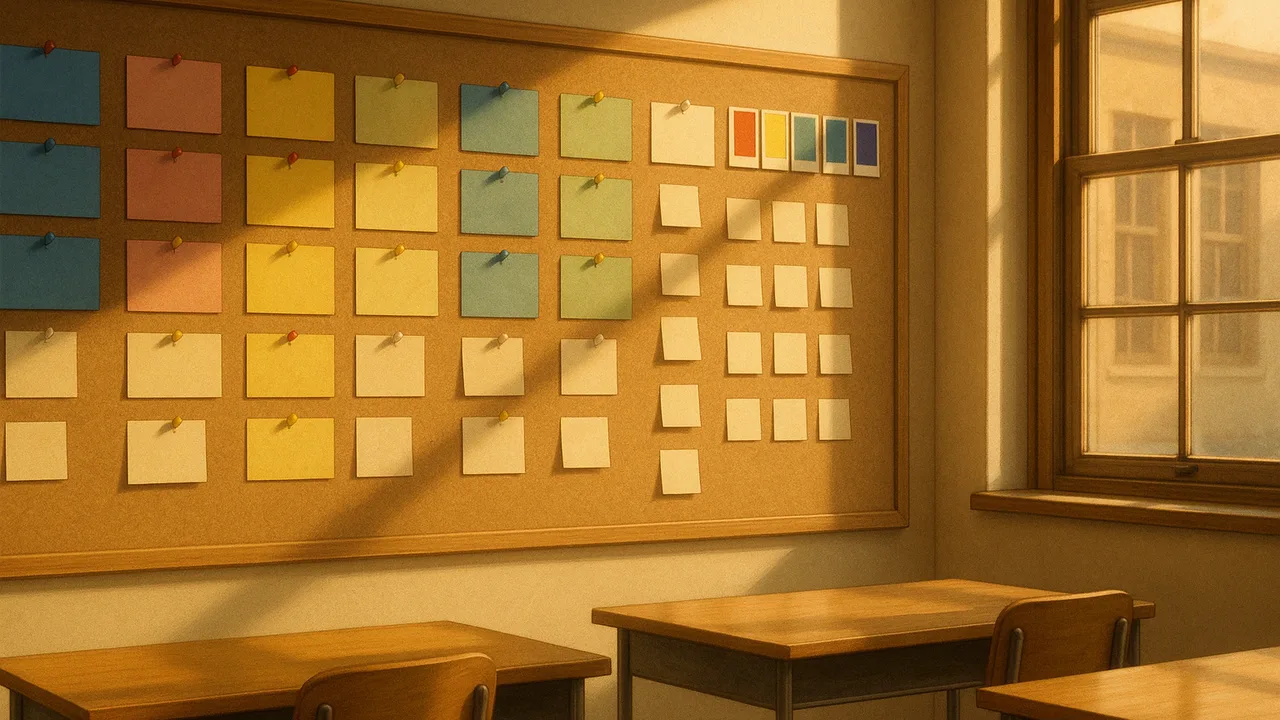
Gallery critique protocol. Each team posts its draft brief, decision matrices and trends table. Visitors leave three sticky notes: I like… (a strength tied to a criterion), I wonder… (a question about evidence or the science), and What if… (one specific change). Notes must cite a number, a configuration or a reason from the energy-level model; “looks good” does not count.
Class criteria for the color brief (set by the class with the committee’s letter). The brief must (1) give, for every color, the metal ion, a representative wavelength, its frequency and photon energy with units and correct significant figures; (2) explain every color with energy levels (excited electron, drop, photon); (3) give each chosen metal’s configuration and usual ion, and explain its ionization energy, radius and reactivity compared with at least one neighbor using Coulomb attraction and shielding; (4) include safety and environmental notes for every salt; and (5) fit on two pages that a committee member with no chemistry background can follow.
Worked example 1: a color explanation corrected. Hannah’s team wrote, “Strontium is red because of its 460.7 nm line.” A visitor noted, “I wonder: 460.7 nm is blue, not red. Check your wavelength.” The team checked: NIST does list a strong strontium-atom line at 460.7 nm, but in a flame most strontium is in SrCl and SrOH molecules, whose electrons drop across smaller gaps and give red light from about 600 to 690 nm. Version 2 uses 650 nm as the representative red (3.06 × 10⁻¹⁹ J) and adds one sentence explaining that the flame’s emitters are small molecules, with the same energy-level reasoning.
Worked example 2: a trend explanation strengthened. Omar’s team wrote, “Barium reacts more than strontium because barium has more protons.” A visitor asked, “What if more protons should hold electrons tighter?” More protons alone would predict the opposite. Revised: “Both have an effective nuclear charge of about +2 on their valence electrons, but barium’s 6s electrons are one level farther out and behind more core electrons, so by Coulomb’s law they are held more weakly (IE 502.9 against 549.5 kJ/mol). Barium loses them more easily, so it is more reactive.” The evidence did not change; the reasoning did.
| Criterion | Version 1 | Critique received | Change made | Met? |
|---|---|---|---|---|
| Color table numbers | ||||
| Energy-level explanations | ||||
| Configurations, ions and trends | ||||
| Safety and environment | ||||
| Readable in two pages |
Writing for the client. The committee are not chemists. Each explanation needs one plain sentence first (“Heat lifts an electron; when it falls back, it gives off one exact color”) and the numbers second. A small energy-ladder drawing does more than a paragraph.
What our evidence cannot show. Our flame tests used dilute salt solutions in a burner, not firework stars, which burn hotter and contain oxidizers, fuels and binders. Our brief explains why colors happen; it does not design fireworks. The brief must say so, and must say that all compositions are the licensed display company’s responsibility.
Guided Exercises ~15 min
Use your version 1 draft and the sticky notes you received. Useful values: c = 2.998 × 10⁸ m/s; h = 6.626 × 10⁻³⁴ J·s; 1 nm = 10−9 m.
Independent Practice ~10 min
Finish version 2 and the revision table.
Compare version 1 and version 2 on every criterion. Which explanation improved most, and what evidence or reasoning made the difference?
🔎 Mini case study: Why blue is the hardest firework color ~8 min
Fireworks makers have long called a deep, pure blue the hardest color to make. The best blue comes from copper(I) chloride, CuCl, formed in the flame when a copper compound burns with a source of chlorine. Its electrons drop across gaps that give blue light in the range of about 420 to 460 nm.
The trouble is temperature. A hotter flame makes a brighter star, but if the flame is too hot the CuCl molecules break apart and the blue fades toward white or green. Designers therefore balance brightness against color purity, choosing fuels and oxidizers that burn hot enough to glow but cool enough to keep the emitter intact. Chlorine-containing ingredients also raise environmental questions about what the smoke leaves behind, so the search for brighter, cleaner blues continues.
Think about it: Which of our class criteria does this trade-off touch, and what should the committee ask the display company about its blue?
Closure ~5 min
Version 2 is checked and justified. Next phase, you present the color brief to the committee.
Exit ticket: name one piece of critique that changed your explanation, and state your old and new explanation.
Teacher notes
Materials: posted drafts, sticky notes in three colors, the criteria poster, calculators, NIST line reference cards.
Timing: number check 5 minutes, critique 15 minutes, revision 25 minutes, comparison write-up 5 minutes.
Answers: 460.7 nm: 1.986 × 10⁻²⁵ / 4.607 × 10−7 = 4.31 × 10⁻¹⁹ J. Strontium’s atomic line at 460.7 nm is real (NIST), which is why the molecular-emitter point matters.
Listen for: critiques of formatting only; “more protons always means tighter hold”; safety notes with no reason.
Support / stretch: provide critique sentence starters and a number-check checklist. Stretch: explain why fireworks makers add a chlorine source to strontium and barium stars too (the chlorides SrCl and BaCl are strong emitters).