2.01 Potholes and Salt Crust: The Forces That Hold Matter Together
Salt, Sand or Beet Brine? A De-icer Materials Brief for a County Road Department
Why do some substances melt ice down to much colder temperatures than others, how does water itself break up roads and rock as it freezes and thaws, and which winter treatment should a county road department choose?
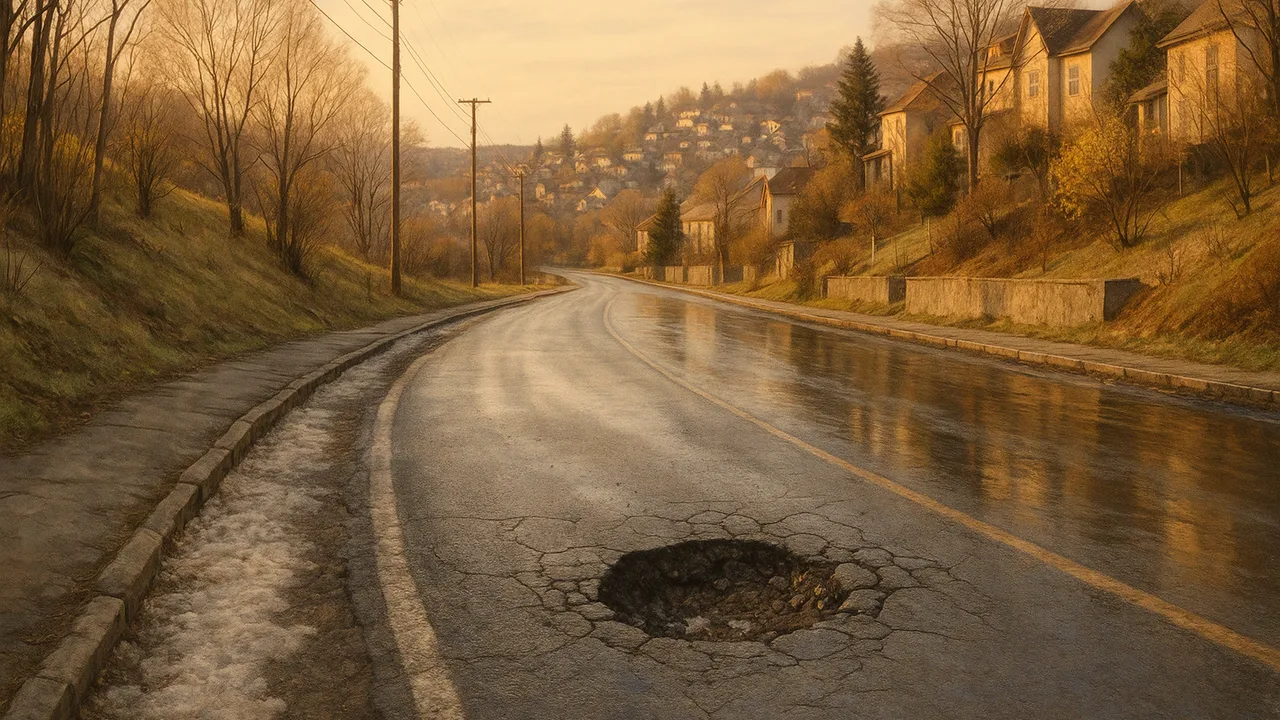
The mystery: After a winter of freezing nights and thawing afternoons, a county road is pitted with potholes, its shoulders are crusted white with dried salt, and chips of rock have piled up at the foot of the roadside cut. The same water that trucks spread salt to melt is breaking the pavement apart.
describe ionic, covalent and metallic bonding as electrical attractions, use electronegativity difference to predict a bond type, and ask testable questions about potholes and salt-crusted roads.
- I can explain how measurable properties like melting point, boiling point, vapor pressure, and surface tension relate to the strength of electrical forces between particles in a substance.
- I can describe how attractive and repulsive electrical forces between molecules affect the arrangement and structure of a designed material, such as whether it forms a solid, liquid, gas, network solid, or polymer.
- I can describe how the properties of water are connected to their effects on Earth materials and surface processes.
Phase 1: Spark
Warm-Up ~5 min
Do Now. Look at two photos from the same county road in March: a pothole full of meltwater, and a road shoulder crusted white where brine has dried. Write what you think made the hole, what the white crust is made of, and one question the pair raises for you.
A sealed glass jar filled to the brim with water is left outside on a night at −10 °C. What is most likely in the morning?
Instruction ~10 min
The phenomenon. Every spring, road crews in snowy counties face the same scene. Water seeps into small cracks in the asphalt and freezes at night. Ice takes up more room than the water it came from, so it pries the crack wider; the next afternoon it melts, water runs deeper, and the cycle repeats. Traffic breaks the weakened pavement into a pothole. Meanwhile the salt spread to melt the ice dries into white crusts along the shoulders. To explain both, we need a model of what holds particles together: chemical bonds inside substances and intermolecular forces between molecules. All of them are electrical attractions between positive and negative charges.
Ionic bonding. When a metal atom such as sodium meets a nonmetal such as chlorine, the nonmetal pulls an electron away completely. The result is a positive ion (Na+) and a negative ion (Cl−) that attract each other in every direction. Billions of them stack into a repeating three-dimensional crystal lattice; there are no separate “NaCl molecules.” Because each ion is held by many neighbors, ionic solids are hard, brittle and high-melting: sodium chloride melts at 801 °C. The white crust on the road shoulder is that lattice rebuilt as the water evaporated.
Covalent bonding. Two nonmetal atoms share a pair of electrons between them; both nuclei attract the shared pair, and that attraction is the bond. Covalent bonds join atoms into separate molecules such as water (H2O) and sucrose (C12H22O11, the sugar in beet juice). Sometimes covalent bonds run through a whole solid with no separate molecules: quartz (SiO2), the main mineral in sandstone and road sand, is such a covalent network, melting near 1,700 °C.
Metallic bonding. In a metal, each atom releases its outer electrons into a shared “sea” that moves through a lattice of positive ions. The mobile electrons hold the lattice together and carry electric current, which is why the steel of a plow blade conducts and can be bent without shattering.
Predicting the bond type. Electronegativity measures how strongly an atom attracts shared electrons (Pauling scale). As a guideline used in OpenStax Chemistry 2e: a difference below about 0.4 gives a nonpolar covalent bond; from 0.4 to about 1.8, a polar covalent bond; above about 1.8, ionic bonding. Metal-to-metal is metallic. The cut-offs are a guide, not a law: bonding is a continuum.
Worked example 1: the three chloride de-icers. Ana looked up Na 0.93, Ca 1.00, Mg 1.31 and Cl 3.16. Na–Cl: 3.16 − 0.93 = 2.23. Ca–Cl: 3.16 − 1.00 = 2.16. Mg–Cl: 3.16 − 1.31 = 1.85. All three are above about 1.8, so all three are classed as ionic, though magnesium chloride sits close to the line. The lab test that settles it is whether the dissolved compound conducts, which you will run in 2.03.
Worked example 2: inside water and sugar. Kwame compared O 3.44, H 2.20 and C 2.55. O–H: 3.44 − 2.20 = 1.24, polar covalent: the shared electrons sit closer to oxygen, leaving oxygen slightly negative (δ−) and hydrogen slightly positive (δ+). C–H: 2.55 − 2.20 = 0.35, nonpolar covalent. Water and sugar both have many O–H bonds, which is a clue to why sugar dissolves so well in water.
Bonds versus forces between molecules. When ice melts at 0 °C, no O–H bonds break; the molecules only loosen their hold on each other. When salt dissolves, the ionic lattice comes apart into separate ions. Keeping these two levels straight, attractions within a particle and attractions between particles, is the key to the whole unit.
Reading. OpenStax Chemistry 2e, chapter 7 (ionic and covalent bonding, electronegativity), CC BY 4.0. Melting points from NIST.
Guided Exercises ~15 min
Use the electronegativity values: Na 0.93, Mg 1.31, Ca 1.00, Si 1.90, C 2.55, H 2.20, O 3.44, Cl 3.16. Show every subtraction.
Independent Practice ~10 min
Complete the bond table in your notebook. Use the values above.
| Pair | Where it appears this unit | ΔEN | Bond type |
|---|---|---|---|
| Na–Cl | rock salt | ||
| Mg–Cl | magnesium chloride brine | ||
| O–H | water, sugar | ||
| C–H | sugar, asphalt | ||
| C–O | sugar | ||
| Si–O | sand, sandstone, concrete |
Pick the pair closest to a cut-off line. Explain why the electronegativity guideline alone cannot settle its bond type, and name a lab test that could.
Closure ~5 min
We have a phenomenon and three kinds of bonding. Next class you meet the road department that needs this science.
Exit ticket: the white crust on the road shoulder and the ice in the pothole are both solids. Name the particles in each and the kind of attraction that holds each solid together.
Teacher notes
Materials: generic photos of a pothole, a salt-crusted road shoulder and a roadside rock cut with fallen chips; electronegativity table; a periodic table per student; chart paper for the question board.
Optional demo: fill a small plastic bottle to the brim, cap it and freeze it overnight in the science freezer; show the bulged bottle next class. Do not use glass.
Listen for: “melting breaks the bonds”; “salt is made of NaCl molecules”; treating the 1.8 cut-off as an exact law.
Support / stretch: give a bond-type decision card (two metals → metallic; ΔEN > 1.8 → ionic; else covalent, polar or nonpolar). Stretch: explain why magnesium chloride (ΔEN 1.85) behaves more covalently than sodium chloride, using the small size and 2+ charge of Mg2+.