2.10 Unit 2 Checkpoint: Bonding, Intermolecular Forces and Water
show what I learned about bonding, intermolecular forces, bulk properties, designed materials and water’s effects on Earth materials by answering data questions, a scenario set and short constructed responses.
- I can explain how measurable properties like melting point, boiling point, vapor pressure, and surface tension relate to the strength of electrical forces between particles in a substance.
- I can identify and explain how the molecular-level structure and atomic interactions of a designed material determine its function.
- I can communicate how the properties of a material make it suitable for its intended use.
- I can describe how the properties of water are connected to their effects on Earth materials and surface processes.
Phase 5: Prove It
Warm-Up ~5 min
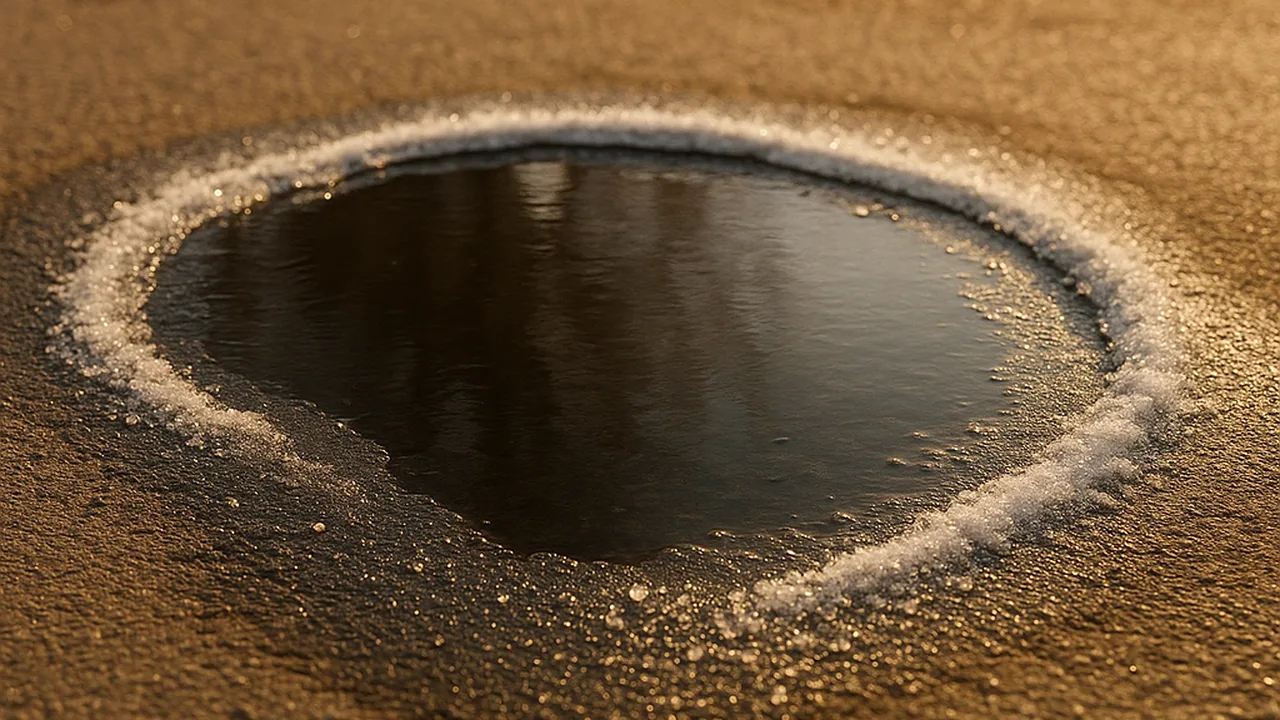
Do Now. Back to the potholes and the salt crust: in three sentences, explain why the pavement broke, why the salt melted the ice, and why the salt was left behind as a white crust.
Dissolving salt in water breaks the covalent bonds inside the water molecules.
Instruction ~10 min
Chemists, this is the unit checkpoint. Part A is multiple choice with data. Part B is a scenario set built on one table. Part C is short constructed responses, each scored 0–3.
How a 0–3 answer is scored. 3: correct claim, accurate evidence and reasoning that names the particles and the force. 2: correct claim and evidence, incomplete reasoning. 1: correct claim with little support, or partly correct. 0: incorrect or blank.
Worked example: from 1 point to 3. “Why does a puddle stay icy after the dry pavement around it has warmed?” “Water is cold” earns 1. “Water’s specific heat is 4.18 J/g·°C, about five times that of concrete, and melting ice takes 334 J/g” earns 2. Adding “because energy goes into breaking the hydrogen bonds between water molecules rather than speeding them up” earns 3.
Scenario data (sample class data). A team dissolved 10.0 g of each of four unlabeled winter treatments in 100 g of distilled water (or tried to), then measured conductivity and freezing point, three trials each. The thermometer read 0.0 °C in distilled water. Use for Part B.
| Sample | Dissolves? | Conductivity | Freezing point, trials (°C) |
|---|---|---|---|
| W | all | high | −6.0, −6.2, −5.9 |
| X | all | high | −4.7, −4.8, −4.6 |
| Y | all | same as water | −0.5, −0.6, −0.5 |
| Z | none | same as water | 0.0, 0.0, 0.1 |
Guided Exercises ~15 min
Parts A and B: answer on your own.
Independent Practice ~10 min
Part C: constructed responses, each scored 0–3.
13. Plan an investigation to compare the strength of attractions between particles in water, rubbing alcohol (isopropanol) and vegetable oil using one bulk property (evaporation, surface tension or drops on a coin). Describe each substance's particles, justify the choice, and name the data, number of trials and equipment. (0–3)
14. Sample data: mass lost after six cycles by wet brick in salt water, 0.9%, 1.2%, 0.8%, and by a fourth sample, 2.6%. Evaluate the precision, say whether the fourth value should be kept, and describe one revision to the method that would improve accuracy. (0–3)
15. Plan an investigation of how ONE property of water (heat capacity, density of ice, or polarity as a solvent) affects a rock or soil sample. Name what you will measure, how it indicates the effect, whether you will work alone or in a group, and how the data will show the effect on the material. (0–3)
16. In two formats (a labeled particle diagram AND three sentences), explain how the beet-sugar additive helps salt brine do its job. Name the structure, the force and the function. (0–3)
17. Rock salt gives more dissolved ions per gram than calcium chloride, yet the county uses calcium chloride on its coldest nights. Explain why, using particle-level reasoning and at least one published value. (0–3)
Closure ~5 min
Finished, chemists. Next unit: what happens when particles do not just attract but rearrange, in chemical reactions you can count with the mole.
Exit ticket: which item was hardest, and which idea do you want to practice before Unit 3?
How confident are you that you can I can explain de-icers, designed materials and freeze-thaw damage from the forces between particles.
Teacher notes
Materials: printed checkpoint with the scenario table, scoring guide for items 13–17.
Setup: about 45 minutes, then review. Item tags: 1, 4 and 17 → HS-PS1-3:1a; 13 → HS-PS1-3:2a, 3a, 3b; 4 → 2b; 5–7 → 4a; 14 → HS-PS1-3:5a, 5b and HS-ESS2-5:5a, 5c; 2 and 9 → HS-PS2-6:2a, 2d; 16 → HS-PS2-6:1a, 2b, 2c; 8 → 2c; 3 and 11 → 2e; 10 → 2f; 3 → HS-ESS2-5:1a; 15 → HS-ESS2-5:2a, 2b, 3a, 3b; 12 → 4a, 5b.
Answer notes: item 14: the three values are precise (range 0.4); 2.6% is an outlier to keep but flag unless a handling error is documented. Item 17: CaCl2‘s much higher solubility gives a eutectic near −50 °C against −21 °C for NaCl, and its exothermic dissolving (about −81 kJ/mol) starts melting fast.
Listen for: “dissolving breaks the water”; precision treated as accuracy; sand judged as a de-icer.
Support / stretch: read items aloud on request. Stretch: predict which freezes first outdoors, a puddle of fresh water or one of 3% salt water, and estimate the difference with the freezing-point equation.