3.06 Limiting Reactants and Percent Yield: Why the Big Batch Failed
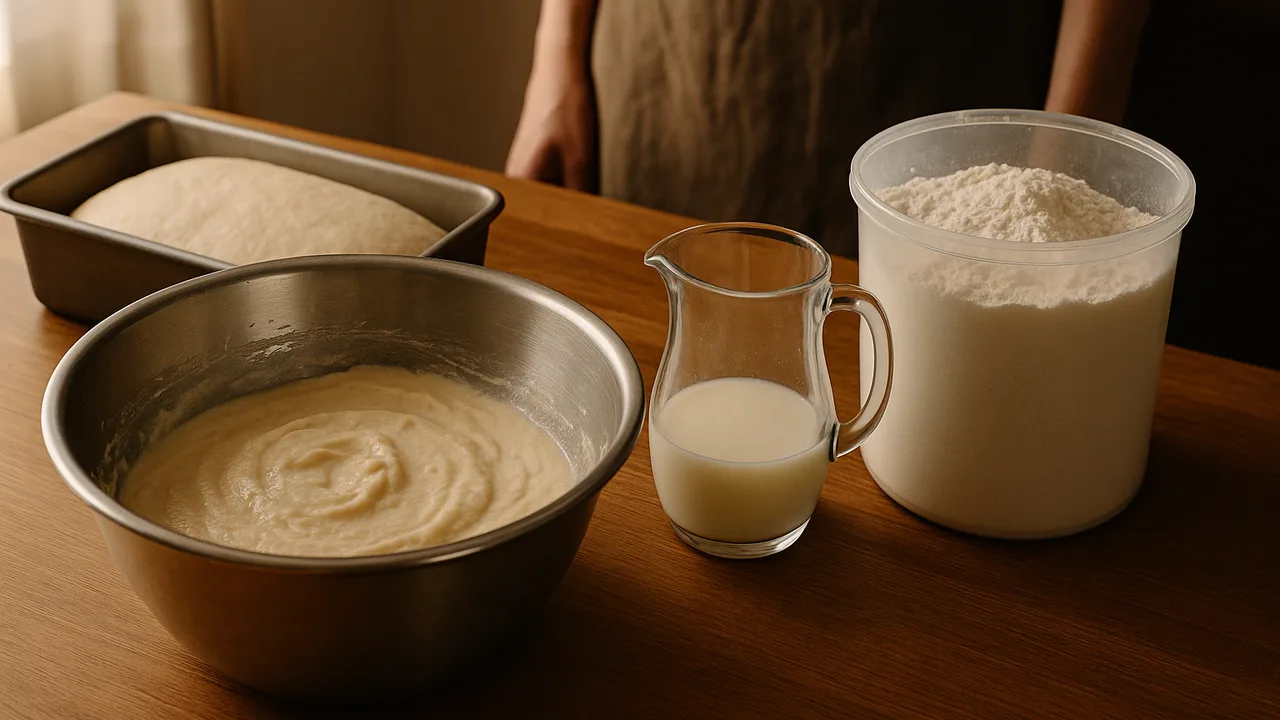
identify the limiting and excess reactants by calculation, find theoretical and percent yield for a precipitation I predict and carry out, and revise our explanation of the co-op’s flat, soapy loaves using new evidence.
- I can revise or expand my explanation about the outcome of a chemical reaction when given new evidence or context, and justify my changes.
- I can predict the relative number of atoms in the reactants and products of a chemical reaction using mathematical representations.
- I can calculate the mass of any substance in a chemical reaction if I know the mass of another substance involved.
- I can explain how my mathematical work (like stoichiometric calculations) supports the idea that atoms and mass are conserved in a chemical reaction.
Phase 3: Make Sense
Warm-Up ~5 min
Do Now. Look back at your Wonder Board explanation for the co-op’s flat, soapy loaves. Write one part you are sure of and one part you now doubt, after the limiting-reactant series.
New evidence (sample data): 2.00 g of baking soda heated alone in a 200 °C oven for 20 minutes leaves 1.26 g of a white solid that turns red cabbage indicator yellow-green. How should our model of leftover soda change?
Instruction ~10 min
Finding the limiting reactant by calculation. Convert every reactant to moles, then divide each by its coefficient in the balanced equation. The smallest result is the limiting reactant. Use the limiting reactant, never the excess one, to calculate the product.
Worked example 1: the co-op’s half-buttermilk batch. For 200 loaves the co-op used 400 g of baking soda, but only 24.0 kg of buttermilk (topped up with plain milk, which has almost no acid). Soda: 400 ÷ 84.006 = 4.762 mol. Lactic acid: 24,000 g × 0.0090 = 216 g ÷ 90.078 = 2.398 mol. The ratio is 1 : 1, so lactic acid is limiting. CO2 from the acid reaction: 2.398 mol, about half the 4.762 mol a full batch should make. Soda left over: 4.762 − 2.398 = 2.364 mol, or 2.364 × 84.006 = 199 g, nearly half the soda.
Revising the explanation with new evidence. Our first model said the leftover soda “just sits in the bread and tastes soapy.” The oven test in the warm-up shows more: in a hot oven, leftover soda decomposes, 2NaHCO3 → Na2CO3 + H2O + CO2. That releases some extra gas (only one CO2 for every two soda units, half as much as with acid) and leaves sodium carbonate, a stronger base than baking soda, which causes the soapy, bitter taste and a yellowish crumb. For the batch: 2.364 mol soda → 1.182 mol Na2CO3 × 105.988 = 125 g of sodium carbonate spread through 200 loaves. Total CO2: 2.398 + 1.182 = 3.580 mol, only 75% of the 4.762 mol intended. Add the half hour the batter waited for the oven, while the acid reaction’s gas bubbled away, and the loaves came out flat. Theo’s revised claim cited all three pieces of evidence: the limiting acid, the oven residue and the waiting time.
Predicting a double replacement. For the yield lab, mix solutions of calcium chloride and sodium carbonate. Use charges from outer electrons: calcium (group 2) forms Ca2+, sodium (group 1) Na+; chloride is Cl− and carbonate is CO32−. Swapping partners gives CaCO3 (2+ with 2−, one each) and NaCl (one each). Solubility rules say sodium salts dissolve but calcium carbonate does not, so CaCO3 falls out as a white precipitate: CaCl2 + Na2CO3 → CaCO3(s) + 2NaCl(aq). It is the same compound as chalk and eggshell.
Theoretical and percent yield. The theoretical yield is the mass of product the limiting reactant could make. The actual yield is what you recover. Percent yield = actual ÷ theoretical × 100%. Real yields fall short (solid left on glassware, particles through the filter); a yield above 100% usually means the product is still wet.
Worked example 2: the yield lab (sample data). Hana’s group dissolved 1.11 g of CaCl2 (110.98 g/mol) and 1.50 g of Na2CO3 (105.988 g/mol) in separate 25 mL portions of distilled water, then mixed them. Moles: CaCl2 1.11 ÷ 110.98 = 0.0100 mol; Na2CO3 1.50 ÷ 105.988 = 0.0142 mol. The ratio is 1 : 1, so CaCl2 is limiting and 0.0042 mol (0.44 g) of sodium carbonate is left over in solution. Theoretical CaCO3: 0.0100 mol × 100.086 = 1.00 g. They filtered, rinsed, dried overnight and recovered 0.91 g: percent yield 0.91 ÷ 1.00 × 100% = 91%.
Procedure (two periods). Day 1: weigh and dissolve the two solids, mix and observe, weigh a dry filter paper, filter the precipitate, rinse it twice with 10 mL of distilled water, and leave paper and solid to dry. Day 2: weigh the dry paper plus solid, subtract the paper, and calculate your percent yield. If your stockroom has calcium chloride dihydrate (CaCl2·2H2O, 147.01 g/mol), use 1.47 g for the same 0.0100 mol.
Reading. OpenStax Chemistry 2e, chapter 4, sections 4.2 (precipitation reactions and solubility) and 4.4 (reaction yields), CC BY 4.0.
Guided Exercises ~15 min
Work with your lab partner. Every answer needs units.
Independent Practice ~10 min
Yield lab write-up, after day 2.
Report your masses, the limiting reactant, the theoretical yield, your actual yield and your percent yield. Name two specific reasons your yield was not 100% and the direction each one pushes the result.
Use your lab to explain to the co-op why a recipe can never be judged by the mass of ingredients alone. Use the words moles, limiting and excess.
Closure ~5 min
Our model of the failed batch now includes the limiting acid, the oven decomposition and the waiting time. Next phase, we design a recipe that fixes all three.
Exit ticket: how much more buttermilk (0.90% lactic acid) would the co-op have needed to use up the 199 g of leftover soda? Show the path.
Teacher notes
Materials (per group): anhydrous calcium chloride (1.11 g) or the dihydrate (1.47 g), anhydrous sodium carbonate (1.50 g), distilled water, two 100 mL beakers, a stirring rod, funnel and filter paper, a wash bottle, a balance reading to 0.01 g, a labeled drying tray, goggles.
Timing: day 1 calculations and the precipitation (filter in the last 15 minutes); day 2 weighing, the CER and the write-up. Dry papers overnight on a tray, or for 30 minutes in a drying oven at about 100 °C if you have one.
Answers: guided item 2: 3.00 g soda = 0.0357 mol; 0.0357 − 0.0200 = 0.0157 mol left. Exit ticket: 2.364 mol lactic acid × 90.078 = 213 g ÷ 0.0090 = 2.37 × 10⁴ g, about 23.7 kg more buttermilk (so 47.7 kg in all).
Listen for: choosing the limiting reactant by smaller mass; calculating the product from the excess reactant; “the yield was low because atoms were lost.”
Support / stretch: a limiting-reactant table (mass, molar mass, moles, ÷ coefficient). Stretch: the filtrate still contains 0.0042 mol of sodium carbonate; predict what you would see if you added a few drops of calcium chloride solution to it, and why.