3.07 Buttermilk, Cream of Tartar or Baking Powder? Designing the Leavening Plan
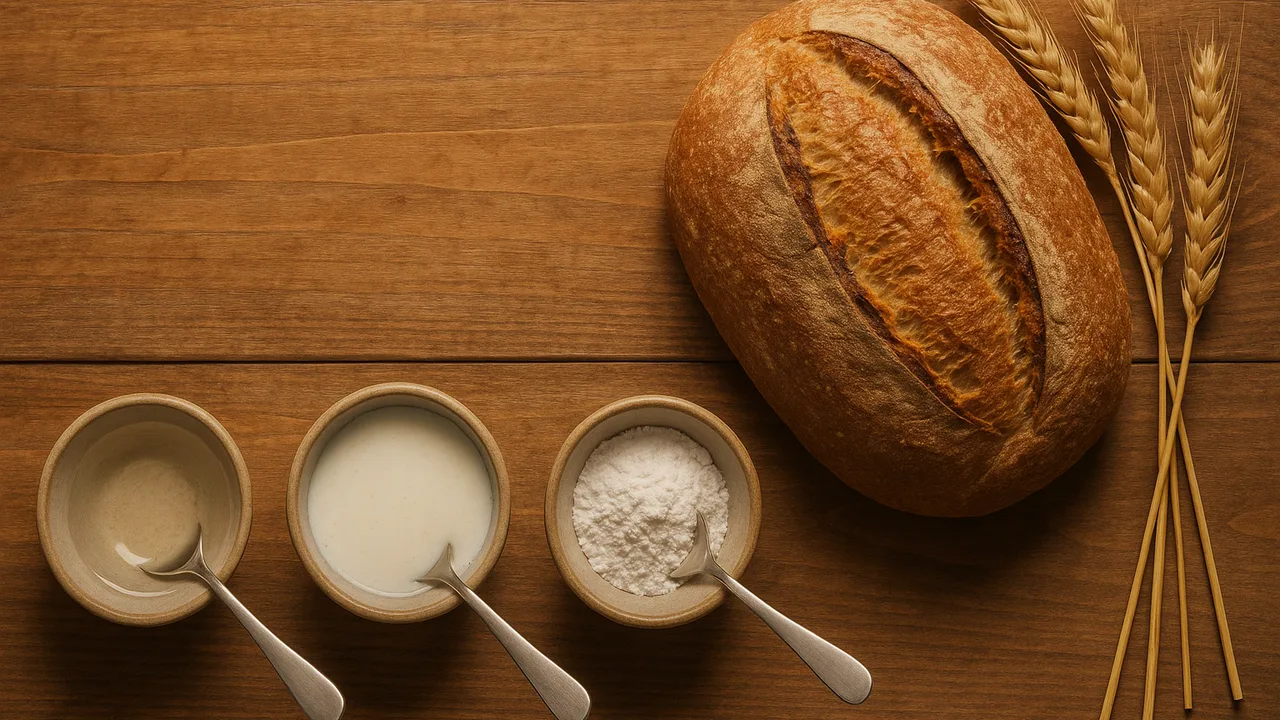
compare leavening systems with balanced equations, stoichiometry and a weighted decision matrix, calculate the acid and the carbon dioxide volume for a 200-loaf batch, and build and start testing version 1 of my team’s plan at bench scale.
- I can predict the relative number of atoms in the reactants and products of a chemical reaction using mathematical representations.
- I can calculate the mass of any substance in a chemical reaction if I know the mass of another substance involved.
- I can identify the reactants and products in a chemical reaction, including their chemical formulas and the arrangement of their valence electrons.
- I can show that the number and types of atoms are the same before and after a reaction, and describe the types of bonds present in both reactants and products.
- I can use the periodic table to recognize patterns of reactivity and explain how valence electron configuration and electronegativity relate to the atoms involved in the reaction.
Phase 4: Build
Warm-Up ~5 min
Do Now. The co-op’s batter waits up to 30 minutes for oven space. Write one way to make sure the loaves still rise after the wait: change an ingredient, change the order of steps, or something else.
Baking soda with cream of tartar, and a store-bought “double-acting” baking powder, are each stirred into cool milk and left for 30 minutes. Which still has more gas to give when it goes into the oven?
Instruction ~10 min
The design brief. The co-op needs a leavening plan for 200 loaves: which acid, how much of it, how much gas, and a process that survives the wait for oven space. The model from 3.06 tells us where it went wrong: limiting acid, leftover soda decomposing to sodium carbonate in the oven, and gas lost while the batter waited.
Four leavening reactions. All four are acid–carbonate reactions with a 1 : 1 ratio, because each acid hands one H+ to one hydrogen carbonate ion. Vinegar: NaHCO3 + CH3COOH → NaCH3COO + H2O + CO2. Buttermilk: NaHCO3 + HC3H5O3 → NaC3H5O3 + H2O + CO2. Cream of tartar: NaHCO3 + KHC4H4O6 → KNaC4H4O6 + H2O + CO2. Baking powder is baking soda premixed with one or more dry acids and a little starch to keep it dry; nothing happens until water dissolves the acid and soda so their ions can meet. The potassium in cream of tartar, like the sodium in soda, stays an ion throughout.
Four competing concepts.
- A. All buttermilk. Match buttermilk to soda exactly. Familiar flavor, but the co-op must buy about 48 kg of buttermilk per batch, and buttermilk’s acidity varies from carton to carton.
- B. Soda + cream of tartar with plain milk. Exact and cheap, but a fast acid: most gas is made at mixing.
- C. Double-acting baking powder with plain milk. Built-in timing, but the label does not say how much gas it makes, so the team must measure it (sample: 0.13 g of CO2 per gram of powder when heated in water).
- D. Hybrid. Use the buttermilk the co-op can get, match soda to it, and add baking powder for the rest of the gas.
Class criteria and constraints (sample values set by the class). A leavening plan for the 200-loaf batch must (1) leave no leftover soda: after the bench test, the liquid stays purple or pink with red cabbage indicator, never blue-green; (2) supply acid within 0–5% above the stoichiometric amount, so the loaf is not sour; (3) make at least 85% of the theoretical CO2 in the bench test (0.22 g of the 0.262 g a quarter-loaf mix can make); (4) still have at least half its gas to give after a 30-minute wait, by ingredient choice or by process, because big batches wait for oven space; (5) cost no more than 4 sample budget points per loaf; and (6) use ingredients the co-op can buy at a grocery store.
Worked example 1: concept B for 200 loaves. Priya’s team kept the 400 g of soda: 4.762 mol. Cream of tartar, 1 : 1: 4.762 × 188.176 = 896 g. CO2: 4.762 mol × 44.009 = 209.6 g. Volume: at 25 °C and normal pressure one mole of any gas fills about 24.5 L, so 4.762 × 24.5 = 117 L per batch, or 0.583 L per loaf. (At 0 °C the molar volume is 22.4 L, so the same gas would fill 107 L; in the hot oven it fills even more, which is what sets the loaf’s rise.) With the class’s 5% acid margin: 896 × 1.05 = 941 g.
Worked example 2: concept D, the hybrid. Omar’s team starts from the 24.0 kg of buttermilk the co-op can reliably buy. Lactic acid: 216 g = 2.398 mol, so soda to match it is 2.398 × 84.006 = 201 g. The batch still needs 4.762 − 2.398 = 2.364 mol of CO2, or 104.0 g. At 0.13 g of CO2 per gram of powder, that is 104.0 ÷ 0.13 = 800 g of double-acting baking powder. Total gas is the same 117 L, but part of it now waits for the oven.
Worked example 3: a weighted decision matrix (sample scores, 1–3). Weights: no leftover soda ×3, survives the wait ×3, gas yield ×2, cost ×1, flavor the co-op wants ×1.
| Criterion (weight) | A Buttermilk | B Cream of tartar | C Powder | D Hybrid |
|---|---|---|---|---|
| No leftover soda (×3) | 1 → 3 | 3 → 9 | 3 → 9 | 2 → 6 |
| Survives the wait (×3) | 1 → 3 | 1 → 3 | 3 → 9 | 2 → 6 |
| Gas yield (×2) | 3 → 6 | 3 → 6 | 2 → 4 | 3 → 6 |
| Cost (×1) | 1 → 1 | 3 → 3 | 2 → 2 | 2 → 2 |
| Flavor (×1) | 3 → 3 | 1 → 1 | 1 → 1 | 3 → 3 |
| Total | 16 | 22 | 25 | 23 |
Powder wins on paper, but loses the buttermilk flavor the co-op’s customers expect, and its gas yield is only a sample estimate. The matrix shows the trade-off instead of hiding it.
Build version 1 (second half of the period). Each team scales its plan to a quarter loaf (0.50 g of baking soda, or the equivalent powder, in 60 mL of liquid), mixes it in an open flask on the balance, and records the mass at 2, 10 and 30 minutes. Then the flask goes into a hot-water bath (about 50–60 °C, from the tap) for 10 minutes to stand in for the oven, and is weighed again. Finish with the indicator check.
| Measure | Target | Version 1 | Meets criterion? |
|---|---|---|---|
| CO2 lost by 30 min (g) | ≤ half of total | ||
| Total CO2 after hot bath (g) | ≥ 0.22 | ||
| Indicator color | purple or pink | ||
| Budget points per loaf | ≤ 4 |
Guided Exercises ~15 min
Answer before you choose your concept.
Independent Practice ~10 min
Fill your own decision matrix and record version 1.
Score all four concepts with your team's weights. Write a claim about which to build, citing two rows of the matrix and one calculation.
Record your version 1 bench-test data in the table. Predict whether your plan will pass the indicator check and the wait test, with a reason from the chemistry.
Closure ~5 min
Version 1 is built and measured. Next class: gallery critique and version 2.
Exit ticket: the hybrid plan uses 201 g of soda with 24.0 kg of buttermilk. Show that this amount of soda exactly uses up the buttermilk's lactic acid.
Teacher notes
Materials (per team): baking soda, cream of tartar, a generic double-acting baking powder, cultured buttermilk and milk (lab use only, kept cold), 250 mL flasks, a balance reading to 0.01 g, a basin of hot tap water, a thermometer, red cabbage indicator, 50 mL graduated cylinder, goggles.
Setup: sample budget points per loaf: concept A 4, B 2, C 3, D 3. Quarter-loaf amounts: A 0.50 g soda + 60 g buttermilk (0.90% lactic acid); B 0.50 g soda + 1.12 g cream of tartar in 60 mL milk; C 2.0 g baking powder in 60 mL milk; D 0.25 g soda + 30 g buttermilk + 1.0 g powder + 30 mL milk. Measure the powder’s own CO2 yield in the first minutes of class if time allows (2.00 g powder in 60 mL hot water, mass loss) so concept C teams use a class value instead of the sample.
Listen for: scaling acid by grams instead of moles; “more powder is always safer”; treating 24.5 L/mol as true at every temperature.
Support / stretch: a scaling sheet with one row per ingredient (one loaf, quarter loaf, 200 loaves). Stretch: use the oven temperature (about 180 °C = 453 K) and V ∝ T to estimate how much larger the gas volume is in the oven than at 25 °C (453 ÷ 298 ≈ 1.5 times).