1.05 From Bohr to Energy Levels: Why Each Element Has Its Own Colors
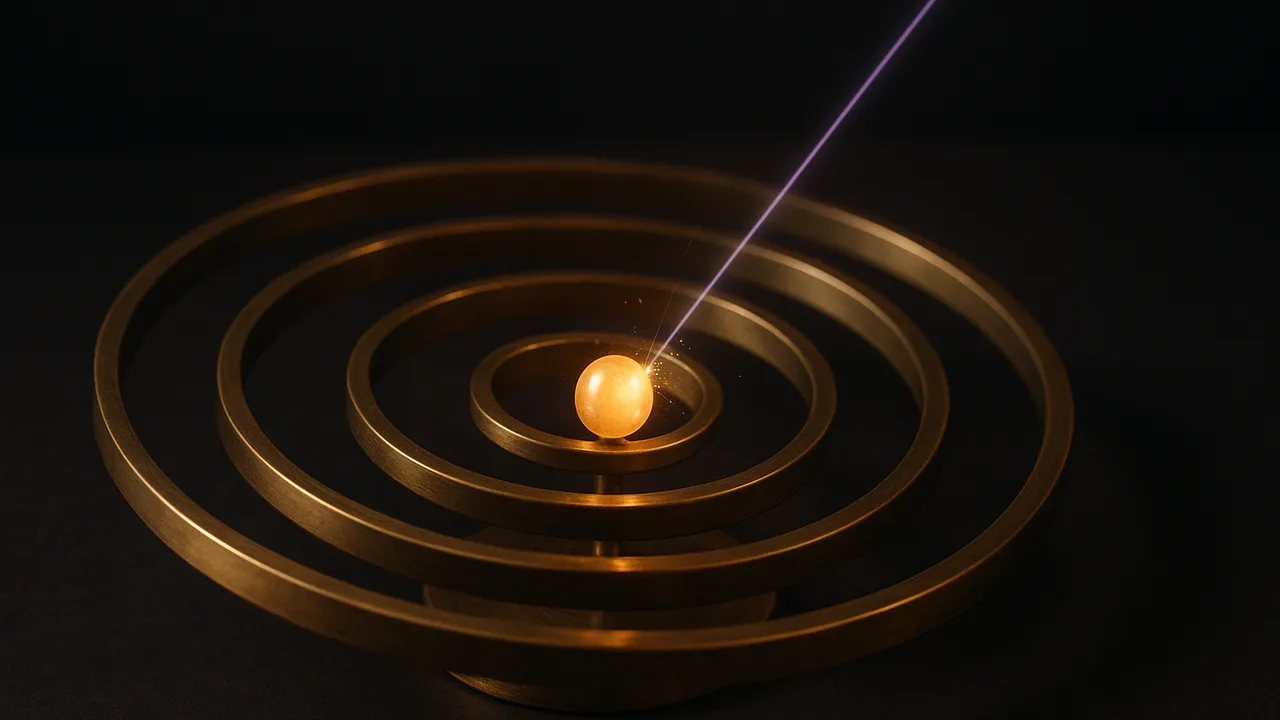
use the Bohr model and quantized energy levels to calculate the wavelengths of hydrogen’s lines, explain emission and absorption spectra, and revise our model of why a heated metal gives off its own colors.
- I can identify and describe how elements are arranged in the periodic table.
- I can explain that atoms have a positively charged nucleus made of protons and neutrons, surrounded by negatively charged electrons.
- I can describe how the number of protons and the arrangement of electrons, especially the outermost electrons, are important for understanding elements.
- I can use the periodic table to predict how elements behave based on the attraction and repulsion between charged particles and the patterns of outermost electrons that affect an atom’s reactivity.
Phase 3: Make Sense
Warm-Up ~5 min
Do Now. Look back at your hydrogen spectrum from 1.03. Write one sentence about what must be true inside a hydrogen atom if it can only give off four visible colors.
Hydrogen's lines are always at 656.3, 486.1, 434.0 and 410.2 nm. What does that tell us about the photons a hydrogen atom gives off?
Instruction ~10 min
A puzzle from 1.03. If an electron could orbit the nucleus at any distance with any energy, a glowing gas would give off every color, like a light bulb. Instead, hydrogen gives off only a few sharp lines. In 1913, Niels Bohr proposed a model that explains them: the electron in a hydrogen atom can have only certain energies, called energy levels, numbered n = 1, 2, 3 and so on. Energy that comes only in particular amounts is called quantized.
The energy ladder. Bohr’s model gives the energy of each level: En = −2.179 × 10⁻¹⁸ J / n2. The values are negative because a bound electron has less energy than a free one; it would take energy to pull it away. Level 1 (the ground state) is lowest, −2.179 × 10⁻¹⁸ J. Level 2 is −5.448 × 10⁻¹⁹ J, level 3 is −2.421 × 10⁻¹⁹ J and level 4 is −1.362 × 10⁻¹⁹ J. The rungs crowd together as n grows. The lowest level is the one closest to the nucleus, where the attraction between the positive nucleus and the negative electron is strongest.
Emission. Heat or an electric discharge can lift an electron to a higher level, an excited state. It soon drops back down, and the energy it loses leaves as one photon whose energy equals the gap: Ephoton = Eupper − Elower. Only certain gaps exist, so only certain wavelengths appear. All of hydrogen’s visible lines come from drops that end on level 2.
Worked example 1: hydrogen’s red line. Rosa calculated the drop from n = 3 to n = 2. Gap: (−2.421 × 10⁻¹⁹) − (−5.448 × 10⁻¹⁹) = 3.027 × 10⁻¹⁹ J. Wavelength: λ = hc / E = (6.626 × 10⁻³⁴)(2.998 × 10⁸) / (3.027 × 10⁻¹⁹) = 6.56 × 10⁻⁷ m = 656 nm. That is the red line she saw in the lab, and NIST lists 656.3 nm. A model built from energy levels predicts a measured color.
Worked example 2: the cyan line and the ionization link. Dev tried n = 4 to n = 2: (−1.362 × 10⁻¹⁹) − (−5.448 × 10⁻¹⁹) = 4.086 × 10⁻¹⁹ J, so λ = 486 nm, the cyan line (NIST 486.1 nm). Then he asked how much energy removes the electron completely from level 1: 2.179 × 10⁻¹⁸ J per atom × 6.022 × 10²³ atoms/mol = 1.312 × 10⁶ J/mol = 1312 kJ/mol, exactly hydrogen’s first ionization energy in the 1.04 table. The same ladder explains both the colors and the trend data.
Absorption. The ladder works in reverse. An electron in a lower level can absorb a photon only if the photon’s energy exactly matches a gap, and then it jumps up. That is why a cool gas removes exactly the wavelengths it would emit, leaving the dark lines in sunlight.
Beyond Bohr. Bohr’s circular orbits work only for one-electron atoms. The modern quantum model keeps quantized energy levels but replaces orbits with orbitals, regions where an electron is likely to be found, grouped into sublevels (s, p, d, f) within each level. In a many-electron atom, the outer electrons are the ones a flame excites. Sodium’s yellow 589 nm light comes from its single outer electron dropping from a 3p orbital to the 3s orbital. In real fireworks, much of the light comes from small molecules formed in the flame, such as SrCl and SrOH for red and CuCl for blue, but the rule is the same: electrons drop between fixed levels and the gap sets the color.
Revising our model. Our 1.01 model said “the color comes from the metal’s electrons.” The revised model says how: each element has its own set of energy levels, set by its nuclear charge and its electrons, so each element has its own gaps and its own colors. Reading. OpenStax Chemistry 2e, sections 6.2–6.3 (the Bohr model and the quantum model), CC BY 4.0.
Guided Exercises ~15 min
Use the energy ladder: En = −2.179 × 10⁻¹⁸ J / n2. Useful values: c = 2.998 × 10⁸ m/s; h = 6.626 × 10⁻³⁴ J·s; 1 nm = 10−9 m.
Independent Practice ~10 min
Model revision, in your Color Notebook.
Calculate the wavelength of the n = 4 to n = 3 drop in hydrogen. Is it visible? Explain why our spectroscopes would not show it.
Rewrite the class model of flame colors as a labeled diagram of a metal atom in a flame: energy in from the flame, electron up, electron down, photon out. Explain in two sentences why strontium and sodium cannot give the same color.
Closure ~5 min
Color is an energy gap. Next class, we learn how electrons fill the levels in bigger atoms, and the shape of the periodic table falls out.
Exit ticket: return to the Wonder Board question “Why does a metal need to be heated before it glows?” Answer it with the words energy level and photon.
Teacher notes
Materials: a large energy-ladder poster drawn to scale (1 cm = 10−19 J works), calculators, the students’ 1.03 spectra, a step stool or bookshelf as a physical analogy for levels.
Answers: E5 = −8.716 × 10⁻²⁰ J. Independent practice: 4-to-3 gap 1.059 × 10⁻¹⁹ J, λ ≈ 1,876 nm (infrared; NIST 1,875.1 nm), invisible and beyond the paper scale. 2-to-1: λ ≈ 121.6 nm.
Listen for: “electrons orbit like planets” (Bohr’s orbits are a historical step, not the modern picture); “higher level means closer to the nucleus.”
Support / stretch: give a gap-calculation frame (upper − lower, then λ = hc / E). Stretch: the Bohr formula can be written 1/λ = R(1/nlow2 − 1/nhigh2) with R = 1.097 × 10⁷ m−1; show it gives 656 nm for 3 to 2.