3.05 Counting Particles by Weighing: The Mole and Mass-Mass Stoichiometry
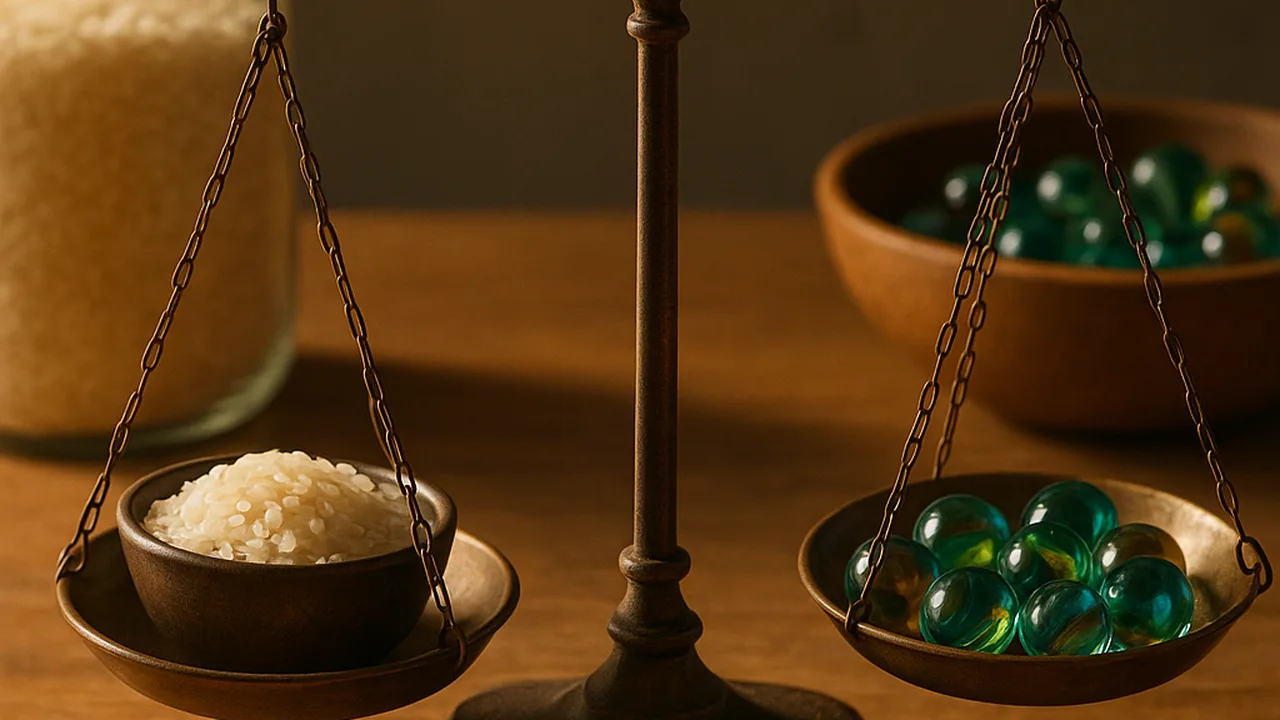
use Avogadro’s number, molar masses and the mole ratios in a balanced equation to convert between mass, moles and particles, predict the mass of carbon dioxide and of acid for a given mass of baking soda, and show that the calculation conserves mass.
- I can use the mole to convert between the number of particles and the mass of substances in a chemical reaction.
- I can predict the relative number of atoms in the reactants and products of a chemical reaction using mathematical representations.
- I can calculate the mass of any substance in a chemical reaction if I know the mass of another substance involved.
- I can describe how to use the mass of a substance to find the number of atoms, molecules, or ions by using moles and Avogadro’s number.
Phase 3: Make Sense
Warm-Up ~5 min
Do Now. A bakery buys sesame seeds by the kilogram, not by the seed. If 100 seeds have a mass of 0.36 g, about how many seeds are in a 1.0 kg bag? Write the calculation, then say how a chemist could use the same trick to count molecules.
One carbon dioxide molecule has a mass of about 7.3 × 10⁻²³ g. Why do chemists count molecules in moles instead of one by one?
Instruction ~10 min
The counting problem. A balanced equation counts particles: one baking-soda unit makes one CO2 molecule. A bakery measures grams. The mole is the bridge between the two.
The mole and Avogadro’s number. One mole is 6.022 × 10²³ particles (Avogadro’s number; the exact defined value is 6.02214076 × 10²³ per mole). The number is chosen so that one mole of atoms of an element has a mass in grams equal to its atomic mass: one mole of carbon atoms is 12.011 g, one mole of sodium atoms 22.990 g.
Molar mass of a compound. Add the atomic masses of every atom in the formula (H 1.008, C 12.011, O 15.999, Na 22.990, K 39.098). Baking soda, NaHCO3: 22.990 + 1.008 + 12.011 + 3(15.999) = 84.006 g/mol. Carbon dioxide: 12.011 + 2(15.999) = 44.009 g/mol. Acetic acid, CH3COOH (C2H4O2): 60.052 g/mol. Lactic acid, HC3H5O3: 3(12.011) + 6(1.008) + 3(15.999) = 90.078 g/mol. Cream of tartar, KHC4H4O6: 188.176 g/mol.
The conversions. grams ÷ molar mass = moles; moles × 6.022 × 1023 = particles. Going back, multiply by molar mass or divide by Avogadro’s number. A 4.20 g spoonful of baking soda is 4.20 ÷ 84.006 = 0.0500 mol, or 0.0500 × 6.022 × 1023 = 3.01 × 10²² formula units.
The three-step path. Every mass-to-mass prediction follows one route: grams of A → moles of A → moles of B (mole ratio from the balanced equation) → grams of B. The mole ratio is where the chemistry lives; the other two steps are unit conversions.
Worked example 1: the series plateau and crossing point. In 3.04 each flask had 2.00 g of soda. Moles: 2.00 ÷ 84.006 = 0.02381 mol. The ratio CO2 : NaHCO3 is 1 : 1, so 0.02381 mol CO2 × 44.009 g/mol = 1.05 g. The measured plateau (0.95 g) is 91% of this; the rest stayed dissolved. Acid needed: 1 : 1 again, 0.02381 mol × 60.052 = 1.430 g of acetic acid. The vinegar label (5% acidity) gives about 0.050 g of acetic acid per mL, so 1.430 ÷ 0.050 = 28.6 mL. The class graph crossed at about 29 mL. The calculation predicted the experiment.
Worked example 2: buttermilk, with a mass check. The co-op’s one-loaf recipe uses 2.00 g of baking soda. Lactic acid reacts 1 : 1: HC3H5O3 + NaHCO3 → NaC3H5O3 + H2O + CO2. Lactic acid needed: 0.02381 mol × 90.078 = 2.145 g. The co-op’s buttermilk tests at 0.90% lactic acid by mass (a class titration value; cultured buttermilk varies), so 2.145 ÷ 0.0090 = 238 g of buttermilk, almost exactly the 240 g the recipe calls for. That is why one loaf works. Mass check: reactants 2.00 + 2.145 = 4.145 g. Products: sodium lactate 0.02381 × 112.060 = 2.668 g; water 0.02381 × 18.015 = 0.429 g; CO2 1.048 g; total 4.145 g. Same atoms, same mass. Lucia added: “And 0.02381 mol of CO2 is 1.43 × 10²² molecules in one loaf.”
Significant figures. Report an answer to the fewest significant figures in the measured data. 2.00 g has three, so the CO2 is 1.05 g, not 1.0478 g. Keep extra digits in the middle of a calculation and round once at the end.
Reading. OpenStax Chemistry 2e, chapter 3, section 3.1 (formula mass and the mole concept), and chapter 4, section 4.3 (reaction stoichiometry), CC BY 4.0. Atomic masses: NIST and IUPAC standard values.
Guided Exercises ~15 min
Show every step with units. The path matters more than the answer.
Independent Practice ~10 min
Complete the mole map for three amounts of baking soda. Show every step with units.
| Baking soda | mol NaHCO3 | Formula units | g CO2 | g acetic acid needed | g lactic acid needed |
|---|---|---|---|---|---|
| 1.00 g (half a loaf) | |||||
| 4.20 g (a spoonful) | |||||
| 400 g (200 loaves) |
For the 400 g row, add up the mass of soda and acetic acid, then the masses of sodium acetate (82.034 g/mol), water and CO2 formed. Write a paragraph explaining how your numbers show that atoms, and therefore mass, are conserved.
Closure ~5 min
We can now predict CO2 and acid from a mass of soda. Next class: what happens when the amounts are wrong, and how much product a real reaction actually gives.
Exit ticket: how many grams of CO2 can 6.30 g of baking soda make? Show the three steps.
Teacher notes
Materials: periodic tables with atomic masses, calculators, a bag of dried beans or washers and a balance for a counting-by-weighing demo.
Answers: 1.00 g → 0.01190 mol, 7.17 × 10²¹ formula units, 0.524 g CO2, 0.715 g acetic acid, 1.07 g lactic acid. 4.20 g → 0.0500 mol, 3.01 × 10²², 2.20 g, 3.00 g, 4.50 g. 400 g → 4.762 mol, 2.87 × 1024, 209.6 g, 285.9 g, 428.9 g. Mass check (400 g row): 400 + 285.9 = 685.9 g; sodium acetate 390.6 g + water 85.8 g + CO2 209.6 g = 686.0 g (rounding). Exit ticket: 6.30 g → 0.07500 mol → 3.30 g CO2. Warm-up: about 2.8 × 10⁵ seeds.
Listen for: using the mole ratio as a mass ratio; multiplying by molar mass when they should divide; dropping units; reporting eight digits.
Support / stretch: a three-box mole map with unit labels on each arrow. Stretch: excess soda left in a loaf decomposes in the oven, 2NaHCO3 → Na2CO3 + H2O + CO2. What mass of sodium carbonate (105.988 g/mol) comes from 2.00 g of leftover soda? (0.02381 mol → 0.01190 mol → 1.26 g.)